






















MARKET PERSPECTIVE
By J Mulraj
Apr 6- 12 2026
But it is pulled down by an abysmally slow judiciary
Recently there have been several scientific achievements announced by India that deserve a loud applause.
One was the launch of the indigenously developed nuclear-powered ballistic missile submarine (SSBN), the INS Arihant. India is one of 6 countries that can make nuclear powered subs; the mission to indigenously develop the capability was launched by Indira Gandhi, after the US President Nixon sent its fleet, including submarines, to threaten India during the Bangladesh war. With this, India has the nuclear triad, the ability to counter a nuclear attack via land, air or sea.
Another was that, on April 6th, India’s Prototype Fast Breeder Reactor (PFBR) at Kalpakkam, Tamil Nadu, achieved criticality. With this, it achieved the second of three stages of Homi Bhabha’s plan for India to attain self sufficiency in power generation.
India has about 1% of the world’s uranium, but has 25% of the world’s thorium reserves. In the third stage of the plan, now made possible by the Kalpakkam PFBR achieving criticality, India will use its thorium to generate electricity and to produce uranium 233. India will become energy independent and not be vulnerable to events like the closure of the Strait of Hormuz.
India’s poor infrastructure resulted in high logistics costs, pushing up its manufacturing costs. Logistics costs used to be 12-13% of GDP, and now brought down to 8% due to better and faster connectivity and removal of irksome delays, and corruption, caused by stoppage of trucks to check for payment of an interstate tax called octroi. Turnaround time at ports has improved significantly.
Indian startups like Bangalore based Digintara has been selected by the World Economic Forum (WEF) for inclusion in its 2025 Technology Partners list.
Digintara is a space surveillance and intelligence company. There are several other Indian startups in the list, including GalaxEye Space Solutions, incubated in IIT Madras, which is developing the world’s first multi sensor, all satellite imaging constellation system; Agnikul, providing affordable space launch services; Cynlr, building robots with intuitive vision, and others.
These, and many other, achievements serve to pull up India’s economy and prestige.
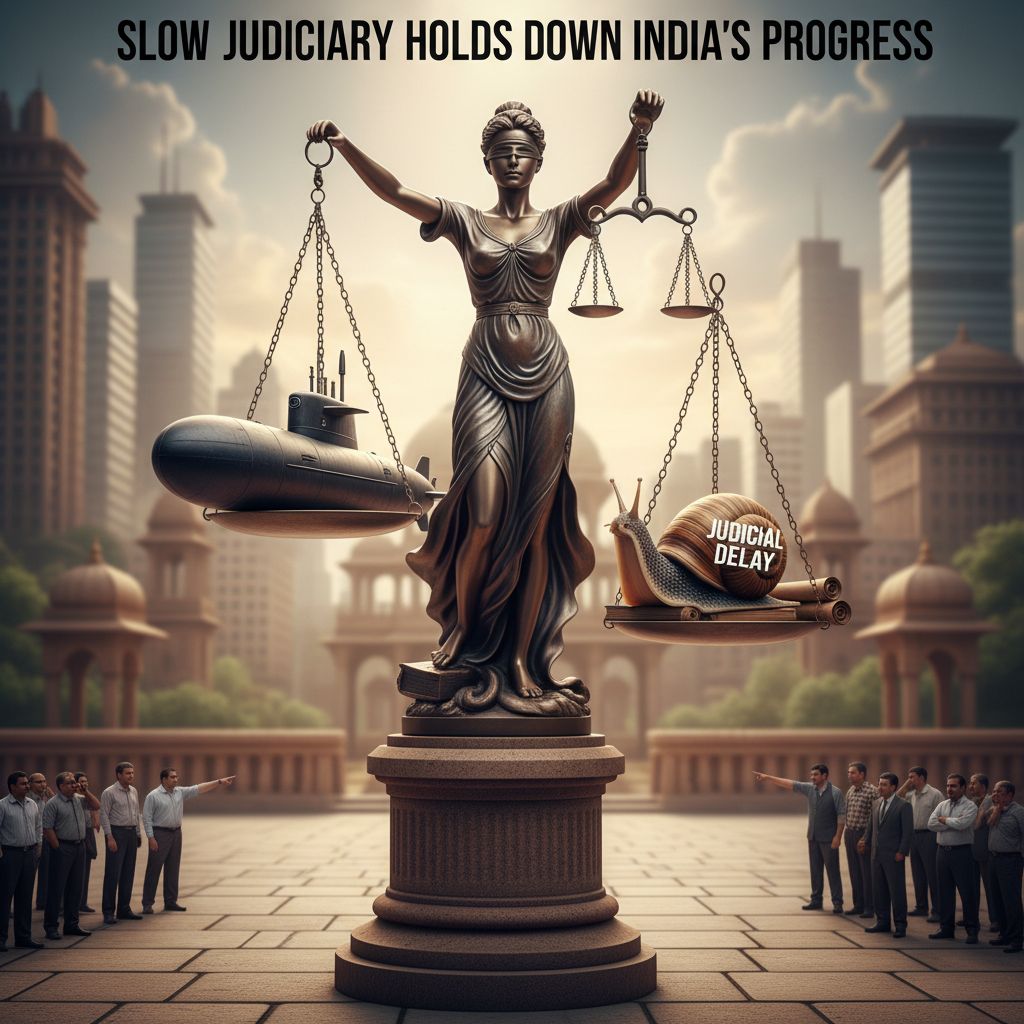
Sadly, India has two millstones dragging the country down. They are persistent and cancerous corruption and a lamentably slow judiciary which, by inexorably delaying justice, denies it. As per Wikipedia, there are a total of 55.8 million pending cases, a majority of them, 49 million, in District Courts.
As per the Rule of Law Index India ranks 114/143 countries in civil cases and 89/143 in criminal justice. That is certainly not an image of a Viksit Bharat.
The other millstone holding India back is endemic corruption. Lawmakers don’t have the will to tackle it. As per a Feb 2025 report in TOI, 251/543 Lok Sabha MPs have criminal charges pending against them. They are not going to tackle corruption or judicial delays, because they are allowed to contest elections until the final disposal of appeals. They, obviously, adore the easy stem of granting ‘adjournments’, which results in the backlog of pending cases.
This raises doubts about whether India is a democracy! The biggest cause of corruption is political fund raising to fight elections. Huge crowds need to be displayed at political rallies. They are, by and large, a paid crowd. It costs the political party huge money – to pay them to attend, transport to the venue and back, and food. TV campaign ads also cost huge money.
But the crowds are fake and the TV ads are bought so are they indicative of a free and fair election? And when such elections create the basis of endemic corruption, and when it results in 46% of criminal lawmakers, should we not question whether India is, truly, a democracy?
Corrupt politicians are aided by a fiscal laundry to cleanse the black money and turn it white. Agricultural income does not attract tax, so the corrupt disclose the black money as agricultural income. This can be easily solved, if Narendra Modi, who campaigned to remove corruption, really wants to.
Simply impose a ceiling on agri income that is free of tax. Since farmers toil all day, make it 2X or 3X the normal limit. Above that and it is no longer a ‘small farmer’ towards whom we need to show empathy, but a big farmer who needs to pay his share of taxes.
Mr Modi, are you willing to accept this suggestion and fulfil your promise?
Raising the objection that agriculture is a state subject will not work either, sir. You managed to get State consensus to push through GST, an important reform. Tackling corruption is far more important.
We applaud the Government for its huge achievements and the transformation that has resulted.
We now ask that you tackle the two millstones, the ineffective judiciary and the endemic corruption, which hold back India’s march towards a Viksit Bharat.
Last week the BSE Sensex ended at 77550, for a weekly gain of 4231 points.
The gain is a relief rally on news that Iran and USA were to hold talks, on Friday, in Islamabad, towards a negotiated end to the war, and a re opening of the Strait of Hormuz. Alas, it appears that these talks may not have commenced, awaiting talks between Israel and the Hezbollah which are based in Lebanon. Should talks not commence soon, one fears escalation.
India is on its way to energy independence, though it would take a few years for the third stage, using thorium, to be implemented. India’s nuclear triad gives it a measure of defence security. India’s startup ecosystem is throwing up wonderful innovations and are attracting global capital and providing employment.
If the two millstones are tackled India will be unstoppable.
———————————-
Comments may be sent to: jmulraj@asiaconverge.com













COMMENTS