















MARKET PERSPECTIVE
By J Mulraj
Nov 29- Dec 5, 2025
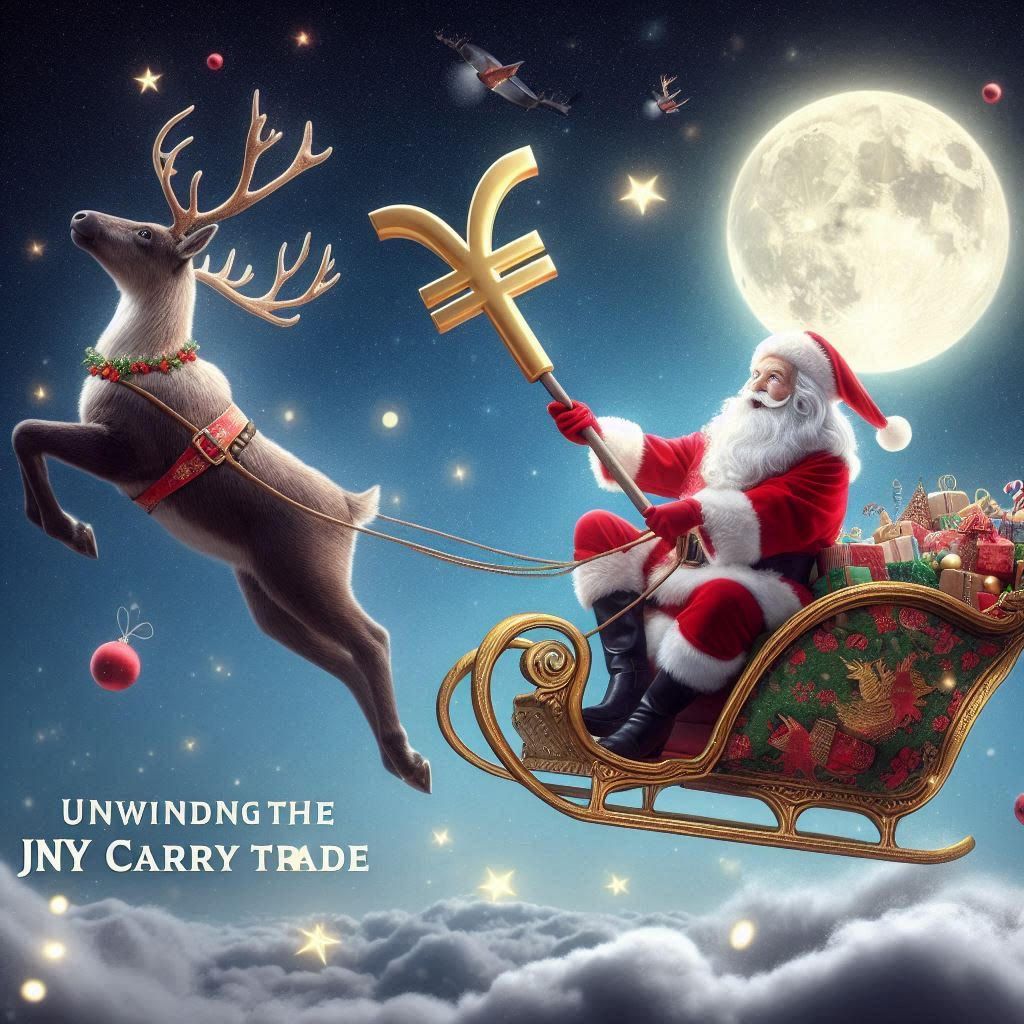
Because of unwinding of the yen carry trade
Image created using Bing
Kazuo Ueda, Governor of the Bank of Japan, introduced a stimulus package, and has clearly hinted at an interest rate hike, currently 0.5%, at it’s December 19th meeting. Traders estimate the chance of a rate hike at 76%.
The JNY, or Japanese Yen, carry trade is estimated at $20 trillion. It’s unwinding can be the financial equivalent of Mount Sakuajima erupting.
What is the JNY carry trade? For decades the Bank of Japan has followed a very low, almost zero, interest rate policy, to stimulate its economy. Japanese institutions like pension funds got almost no interest investing in Japanese bonds. So they, plus foreign buyers, borrowed in JNY, at near zero interest, and invested in US Treasury Bills, considered a safe asset, which gave them a return of 4.5-5% pa.
This spread was enough, most times, to cover the risks. The risk of an appreciation of the JNY (which meant the borrower who, after selling the T Bills and converting to JNY, may get less than the amount he borrowed in JNY. Or the risk of an increase in the JNY interest rate, which is what Ueda has warned about. Or the risk of the USD collapsing.
Such a concatenation of events occurred in Sep – Dec 2008, triggered by the collapse of Lehman Brothers, the global deleveraging and flight to safety and the sharp unwinding of the carry trade and repatriation into JNY.
In mid 2007, a USD fetched 123 JNY. By Dec 2008 it fetched 87. So the investor who had borrowed in yen, converted it into USD and invested in US T-Bills, didn’t get the needed JNY to repay his borrowing. The Dow Jones Industrial Average dropped from 11500, in Sep 2008, to 7500 two months later, a drop of 35%.
An unwinding of a $ 20 trillion JNY carry trade, triggered by a hike in interest rates by BoJ at its Dec 19 meet, could ruin Christmas. ().
There are other problem areas in America, the world’s largest economy, including the growth of the private credit market, which has grown to a market size of between $1.7 to 3 trillion, is less regulated, and has lent to some iffy borrowers. The Commercial Real Estate (CRE) sector is again showing stress; the last time 3 Community Banks went under, such as Silicon Valley Bank. The loans taken by CRE are to be renewed, but at higher interest rates, which will further aggravate their viability.
And then there are suicidal geoplolitical moves being made by Trump. On Dec 3, Trump signed into law a new Act, the Taiwan Assurance Implementation Act, with the aim of closer, and more frequent, interaction by officials of both sides. It includes a $500 m. appropriation for defence assistance to Taiwan. China, which has stated that it considers Taiwan to be a part of China, is mighty displeased and can easily cease supply of rare earth minerals, over which it has dominant control, which are used in defence, electronics, missiles and other uses.
The US has also been, for long, seeking to oust President Maduro from Venezuela. It recently destroyed Venezuelan fishing vessels, killing its crew, on the ground they were drug smugglers. Interestingly, Russia has sent it’s naval ships, and, likely, its hypersonic Oreshnik missiles. A replay of the Cuban missile crisis.
The plight of Iran is distressing. The regime has mishandled its or any country’s) main resource – water. So bad is the situation that its President has stated that there is no option but to evacuate Tehran, a city of 10 million people. Water in Tehran is several times more expensive than petrol. It is feared that there will be an outbreak of water borne diseases like cholera, a breakdown of law and order, and civil strife as citizens of Tehran migrate to areas in the North still having some water, and face resistance from residents. ().
As pointed out by senior journalist R N Bhaskar (owner of AsiaConverge.com) in this podcast (), Indian political leaders, too, have been negligent in their approach towards water. To curry favour with farmers, politicians have been promising them free water and electricity. Anything obtained for free is not valued by the user, and farmers keep their pumps running (its free) wasting water. Groundwater levels in some states are alarmingly low. If we do not stop this we may end up in the same pitiable state as Tehran.
Last week the BSE Sensex ended flat at 85712.
Though the India story is good, there are weaknesses that, unless corrected, can derail the story. It has been over 12 years since the NSEL (National Spot Exchange Ltd) scam erupted, resulting in the loss of Rs 5600 crores to 13,000 investors. The enforcement agencies were quick to freeze assets of defaulting brokers, which were, on paper, worth more than the Rs 5600 crores lost.
With any good and responsive Government, the assets would have been sold, and the proceeds distributed to victims. This happened in the Bernie Madhoff scam in USA; but not in India. Now, after 12 years a “settlement” has been reached under which about 42% of the money will be returned. Be aware that the settlement is due to efforts of exhausted investors who got no help from anyone in Government, not PM Modi, nor FM Sitharaman, , nor SEBI, nor Government agencies nor the judicial system. Remember NSEL was recognized by the Government which failed to appoint a regulator. One doesn’t know what happened to the frozen assets. They are of no use to the investors. There are several other scams. All of them dilute the India story.
The backlog of 50 m cases paint a woeful picture of the Indian judiciary.
The grant of tax free income to farmers is an exercise of deception. The tax free status is misused to launder black money; a key reason for its continuance despite political platitudes. The solution is simple. Allow tax free income to farmers upto a limit. Say Rs 36 lacs/year. With normal tax after that. The limit would cover all small farmers.
And the Government cannot bull**** by stating that agriculture being a State subject, it would be difficult to tax. Pray, how was GST introduced? Many taxes were state subjects weren’t they? Where there is a will to tackle corruption, there is a way.
One hopes that the several financial and geopolitical risks do not make Santa withold his Christmas presents. But the signs are, sadly, ominous.
Comments may be sent to: jmulraj@asiaconverge.com








COMMENTS