























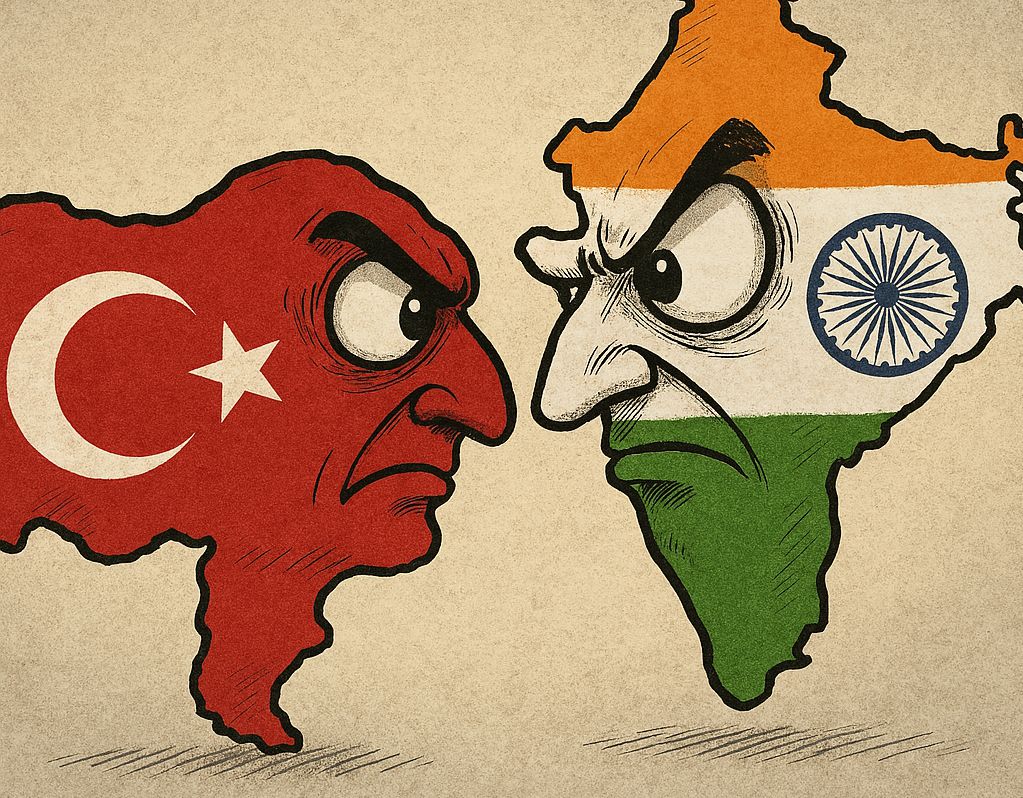
Turkey has done things that India has not
By RN Bhaskar and Sakeena Bari Sayyed
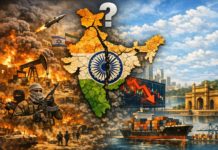
Image source:Copilot
When India snapped ties with Turkey in May 2025, it took many observers by surprise. The justification given by the government of India was that Turkey has helped Pakistan in the altercation with India.
The justification just did not wash. True, Turkey had supplied arms to Pakistan, but Turkey has been an arm supplier to more than a hundred countries. It accounts for a 60% share in military drones in the world. At no time did Turkey refuse to supply these drones to India. Moreover, if suppliers of weaponry add military aid to Pakistan was the key factor, India should have snapped trade relations with the US, China and Russia as well. That is what India did not do. This means that there were other reasons why relations with Turkey were being snapped. The only plausible answer is that Turkey is Islamic (as is Azerbaijan which too witnessed trade relations being snapped by India).
 A mistake
That decision could be a big mistake. This is so especially at a time when Turkey has been playing a crucial part in bolstering India’s exports. Turkey has been importing refined oil products from India even though this oil had been sourced from Russia. Reliance Industries was a big beneficiary of this arrangement. It bolstered India’s exports as well.
The US had sanctioned Russia. Consequently, many countries did not want products from Russia. But India imported cheap oil and oil refiners, especially Reliance, would convert the crude into value added products. They would sell them to Turkey which would do some additional value additions and export the oil products to other countries, especially to Europe. Effectively, India’s exports soared.
How could Turkey export oil products to Europe? Very simple. Turkey has special treaties with the EU. Although it has not been formally inducted into the EU, it remains a member of NATO. That relationship plus the treaties allow it to export goods to the EU. India was thus a big beneficiary of this facility.
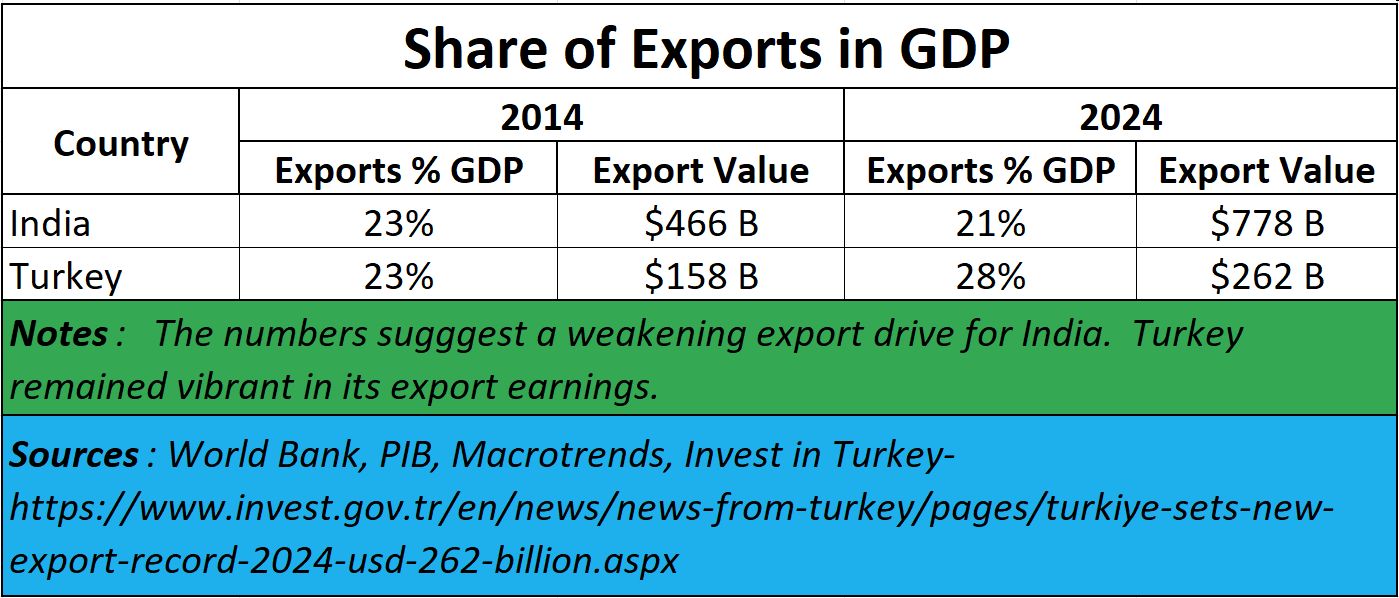
India’s exports are falling. Its balance of trade is worsening. At such a time every bit of export becomes crucial (free subscription — https://bhaskarr.substack.com/p/india-back-to-1990?utm_source=publication-search). By cutting off Turkey, India hurt its own exports. Not surprisingly, India’s exports as a percentage of GDP fell over the last ten years. In sharp contrast Turkey’s share of exports to GDP climbed during this period. Clearly, India’s failure to export more had a lot to do with the way it nurtures relationship.
Turkey is amazing
To understand why Turkey is an amazing country, one has only to listen to what Yanis Varoufakis has to say (https://www.youtube.com/watch?v=ZJS05g1THL4).
Had it been any other person speaking so glowingly about Turkey, one could have discounted such praise. Moreover, the Turkei consulate was sent this link, but did not comment on the statements, nor offered to discuss the contents with us.
However, Yanis Varoufakis is one of the finest economists in the world. He was formerly the finance minister of Greece and even today is working towards influencing his country’s economic destiny.
Turkey does enjoy some unique benefits. Its capital Istanbul was formerly Constantinople. That was where the Holy Roman Empire was formed by emperor Charlemagne in 800AD. It was wrested back by the Muslims in 1453 by Mehmed II. But through all these centuries, Turkey remained the melting pot where cultures of the west, east, Persia in the north and the Arabs in south got blended. Turkey has a cultural history that makes it a vital bridge.
Turkey trounces India
Moreover, if you look at key numbers, Turkey has done much better than India on many fronts.
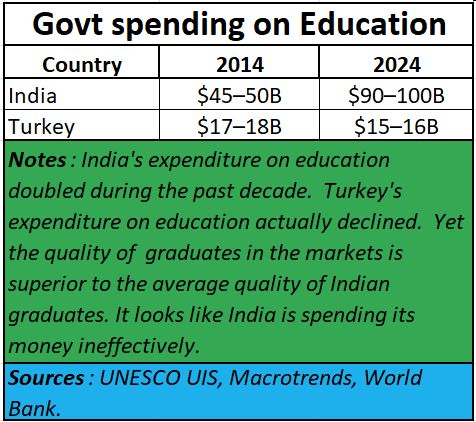 True, Turkey’s spending on education appears to have declined. But that could also be because, beginning 2013, the lira to dollar exchange rate began a slow decline, which many economists say was the starting point of the lira’s depreciation. That resulted in a higher price per dollar and hence could partly explain the decline in expenditure on education.
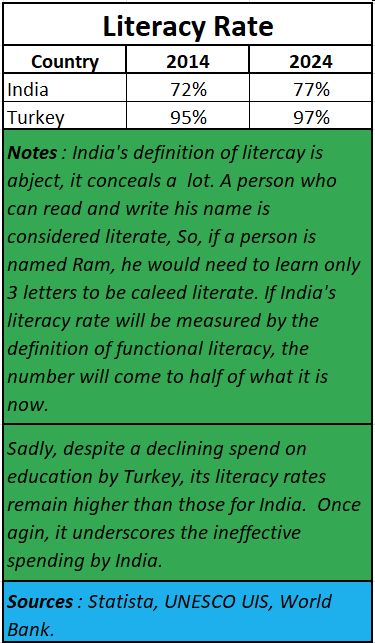 But observe how in spite of the limited amount spent on education Turkey’s literacy rate is higher than that of India. India’s literacy rate stands at 77% while Turkey’s is 97%. Also, remember that India’s literacy rates are suspect. As ASER’s finding in India (https://www.livemint.com/budget/budget-2024-strengthening-primary-education-through-nep-anganwadis-and-nipun-initiatives-for-school-children-11719206071486.html) show almost 50% of Std VIII students cannot do division sums that Std II students can. India’s poor GER (https://bhaskarr.substack.com/p/the-state-of-education-in-india?utm_source=publication-search) also confirms the incompatibility with the high literacy rates claimed.
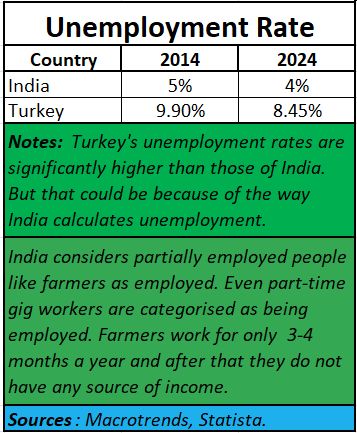 Not surprisingly, India’s unemployment rates are high. Official statistics paint a rosier picture. Unlike India the job market is vibrant in Turkey. Living standards are better and lately Turkey appears to be in the path of recovery and has halved its crippling inflation rates of 85%.
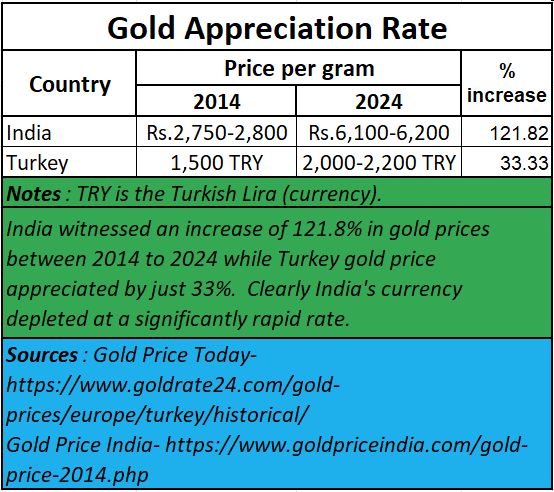 Evidence of this can be found from the way gold prices have appreciated in India and in Turkey. Turkey’s currency is more stable than India’s – as indicated by the inflation rates. Obviously, despite its claim of a low inflation rate, India’s currency is less stable.
Relationships matter
Turkey has managed to keep its head above water, despite its high inflation, by maintaining good relations with the rest of the world.
The only exception is Israel where Turkey has condemned the ongoing genocide in Gaza. It has cancelled diplomatic ties with Isreal and has issued 37 arrest warrants against people guilty of mass murder – this includes prime minister Netanyahu, his defence minister and other key officials.
But good relations have allowed it to remain close to the EU, Russia, China and a host of other countries. That in turn has boosted its travel industry. Turkish airlines take pride in telling people that it connects with more cities in the world than any other airline. These are lessons that India should learn. India is almost friendless in this part of the world and prefers to hanker around the EU, US and other white skin countries – including New Zealand — rather than looking at its own neighbourhood.
Other indicators
There are two other indicators that are worth looking at. They relate to infrastructure and defence.
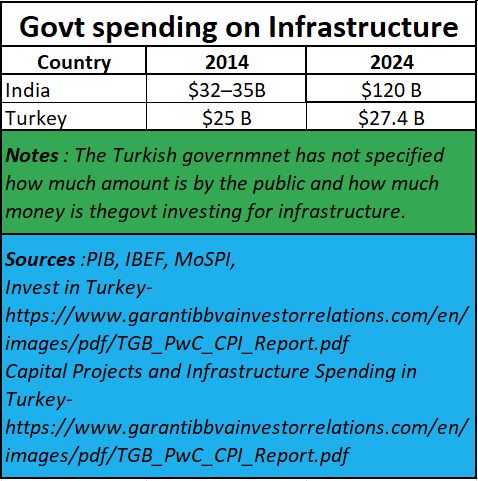 Go to Turkey and you will find good roads, fewer potholes and cleaner lakes. Hence, even though Turkey appears to be spending less on infrastructure, the expenditure appears to be wisely deployed. That cannot be said about India (https://youtu.be/GJpKwcDvw54?si=_kyFaRewvwdSX9Ni).
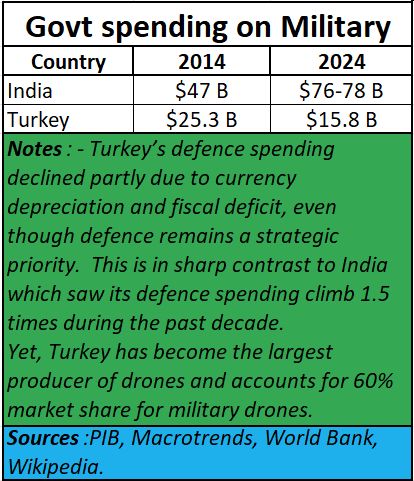 Finally, look at defence spending. India spends a lot but is nowhere in world rankings or on world market shares in respect of defence exports. Turkey’s military drones already enjoy a 60% market share. When money is spent wisely, the results can be phenomenal. That is another lesson India needs to learn from Turkey.
Conclusion
By cutting off ties with Turkey India has only hurt itself. Growth in stature on the world stage depends on the ability to forge enduring relationships, focus on higher literacy, exports and effective spending. Turkey has shown its adeptness in all these areas. Can India make similar claims?
======================
Do view my latest podcast on how India is in the danger of slipping back to 1990. You can find it at https://youtu.be/zv_3v5W_t1o
============================
And do watch our weekly “News Behind the News” podcasts, streamed ‘live’ every Saturday morning, at 8:15 am IST. The latest can be found at https://www.youtube.com/live/L6lvlE1inMM?si=gcdHv8wPD32mW4D1
==========================







COMMENTS