























MARKET PERSPECTIVE
By J Mulraj
Aug 15- 21, 2026
In a Mad World, Only the Mad are Sane
Image credit to Harsh Madhusudan Gupta, Ionic Wealth
A post by Harsh Madhusudan Gupta, of Ionic Wealth, reveals the primacy of US Dollar returns to foreign investors. He compresses US $ returns, over a 23 year and 1 month period, into two time blocks. In the first block, of 4.7 years, returns in USD were up 6.8 times, or a whopping 50.4% a year!
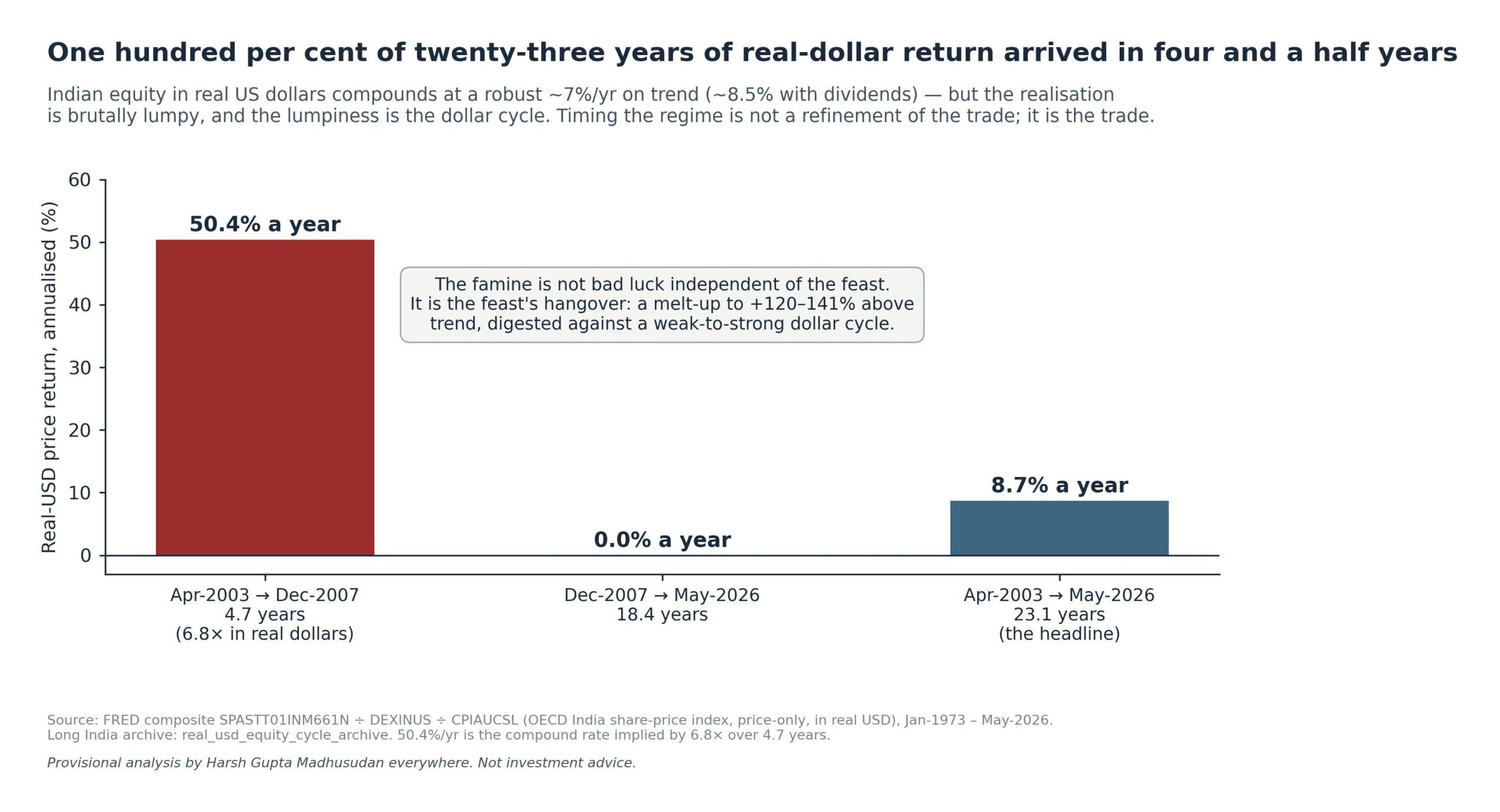 But over the next 18.4 years, USD returns were nil, over an 18.4 year period!
It is not that the companies weren’t performing. They were.
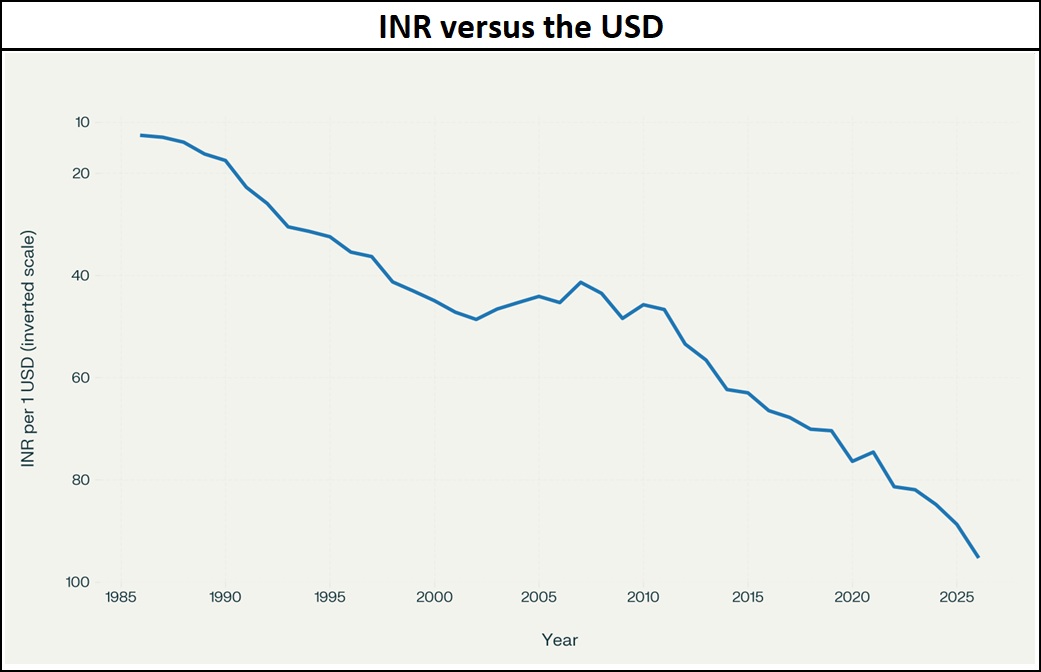
It is that the Indian rupee was not performing, except during the first block, when, thanks largely to foreign investment inflows, the INR strengthened from Rs 49/$ in 2002 to Rs 41.35 in 2007, just before the GFC (Global Financial Crisis).
The GFC hit global stockmarkets as foreign portfolio investors fled to safety. A credit crunch ensued, with firms reluctant to trade with each other, not knowing whose Balance Sheet was tainted. The Fed reduced interest rates to near zero, trying to inject liquidity. When that didn’t work, the US Fed started Quantitative Easing (QE), and bought US Treasuries/ mortgage backed securities from banks, in order to prevent a financial crash.
The INR slide was the result of several factors, including the 2013 ‘taper tantrum’ (far worse than Maggie Thatcher’s bag swinging tantrums) when QE ended, the COVID pandemic (Dec 2019 to May 2023), the continuing fiscal and trade deficits due to India’s dependence on imported crude oil.
The slide of the INR versus the USD is depicted thus:
 Given the fact that India imports some 85% of it’s crude oil needs, there is no easy fix to arrest the INR slide. The discovery of a potentially large offshore field, off the coast of Andaman Islands is encouraging, but will address only a bit of India’s needs. Then there is the possibility of using India’s vast reserves of thorium to generate cheap and abundant energy. India reached Phase 2, out of 3, at the Kalpakkam Prototype Fast Breeder Reactor. Phase 3, using thorium to produce U-233, is a decades effort. Electric Vehicles (EVs) will take time as the build up of charging infrastructure is slow. A few Indian EV manufacturers are making their mark, though, in foreign markets. The rollout of Renewable Energy infrastructure needs to be speeded up.
The USD returns don’t bother the Indian retail investor, who invests and earns/spends in INR. The rise of mutual funds and the success of the Systematic Investment Plan (SIP) scheme, has attracted an increasing number of investors. From between 1-2% of population in 2000, around 9.5% of Indians now invest in equity, most through SIP.
Under SIP, they invest a fixed sum of money, determined by them, on a fixed day each month, into a mutual fund of their choice. This reduces risk, by averaging their cost, and has worked very well. The average monthly inflow into equity SIPs has grown from ₹ 9923 crores ( USD 1.34 b ) in August 2021 to ₹ 31,961 crores (USD 3.33 b. ) in July 2026.
An inflow of over $3 billion per month from retail investors, is sustaining the bull market in India. And this is a committed flow, month over month. The resolve of the Indian retail investor has not been tested in a bear market. But, even so, one expects it to not dent the $ 3 billion monthly inflow too severely.
The possible risk comes from a threat of job displacement from AI. It is imperative that young Indians train themselves on AI models to enhance their skills and become more productive.
In global news, both the Russia-Ukraine war and the US- Iran war continue to drag on, killing thousands, destroying economies, decimating infrastructure, displacing lives and harming growth, with no end in sight. One wishes that wars come with an “end by” date; if coerced into putting one, the leaders initiating them would reconsider a thousand times before embarking on one.
News reports say that Ukraine is running out of interceptor missiles; the US is unable to replenish them having drained it’s stockpile in Iran. So, energy infrastructure and water pipelines would be targeted by Russia, and the Ukrainian winter will be brutal. In the Iran war, reports state that the economic blockade imposed by USA is squeezing revenue, creating a dilemma for IRGC leadership on how to spend limited resources. Perhaps such factors may lead to a cessation of hostilities, though it would be folly to hold one’s breath, even for those with large lungs.
Last week the BSE Sensex closed at 77540 for a weekly loss of 1469 points.
In global news, the US government debt hit $ 40 trillion. There will be high demands on global debt markets to finance roll-overs of the debts of various countries, plus the humongous appetite for it from the AI sector. Yield on 30 year US Treasury bonds hit a peak of 5.3% last week. If these persist, it will make roll-over of debt more expensive. Over $ 4 trillion of US Fixed debt is falling due for repayment in 2027. Simultaneously, rising inflation in Japan makes it likely that the Bank of Japan may raise interest rates, currently a low 1%. This, in turn would impact the yen carry trade, in which foreign investors borrow at low rates in Japan and invest in US Treasuries at higher yields, earning a healthy spread. So long as there is a good interest rate differential, and so long as currency movements are favourable, it is money for jam. But when these differentials change, and the yen carry trade unwinds, something smelly hits the fan.
Investors should expect turbulence and stormy weather, not only due to El Niño and the vicissitudes of the on-again-off-again peace deal with Iran. Tread with caution.
As Japanese filmmaker Akuri Kurosawa said, ‘ In a mad world, only the mad are sane.
——————————————————————————————
Comments may be sent to: jmulraj@asiaconverge.com













COMMENTS