





















27 July 2026
India cannot implement projects as promised
By RN Bhaskar and Sakeena Bari Sayyed
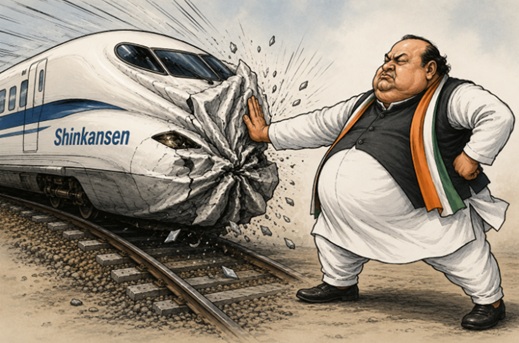
Image: Chatgpt
On July 15 2026, Indians were surprised to see former Japanese Justice Minister Hideki Makihara (@hmakihara) commenting about poor project implementation by India. He mentioned this in a tweet on X (https://x.com/hmakihara/status/2077132668156969210). Ministers from Japan rarely express their views on social media. This time was different; and explosive for India.
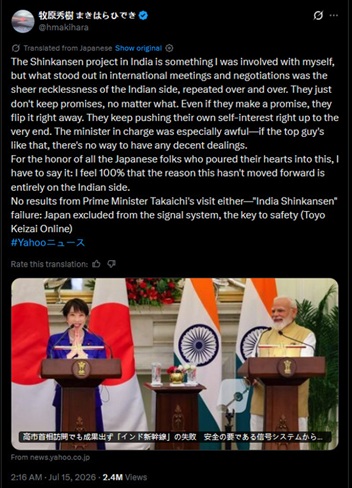 “The Shinkansen project in India is something I was involved with myself, but what stood out in international meetings and negotiations was the sheer recklessness of the Indian side, repeated over and over. They just don’t keep promises, no matter what. Even if they make a promise, they flip it right away. They keep pushing their own self-interest right up to the very end. The minister in charge was especially awful—if the top guy’s like that, there’s no way to have any decent dealings. For the honor of all the Japanese folks who poured their hearts into this, I have to say it: I feel 100% that the reason this hasn’t moved forward is entirely on the Indian side. No results from Prime Minister Takaichi’s visit either—”India Shinkansen” failure: Japan excluded from the signal system, the key to safety (Toyo Keizai Online)”
The statements were damning. The government of India promptly came out with its clarification. Stated Randhir Jaiswal, spokesperson for the Ministry of External Affairs (MEA), “We have seen the post. This is an individual opinion and is at considerable variance with facts. India-Japan discussions on Mumbai-Ahmedabad HSR are progressing well,” Jaiswal said during a press briefing.”
In a subsequent statement, the MEA affairs stated that discussions between the two countries on the Mumbai-Ahmedabad High-Speed Rail project were moving forward as planned. It stated, “India-Japan discussions on the Mumbai-Ahmedabad high-speed train are progressing well. Japan will provide the E10 series train in the early 2030s. The train is still under development. Meanwhile, construction work has rapidly progressed. The first section will be opened in 2027. Therefore, both sides agreed to start the operations with the Indian high-speed train. The project execution is in line with the common goal of starting the high-speed train project at the earliest. ”
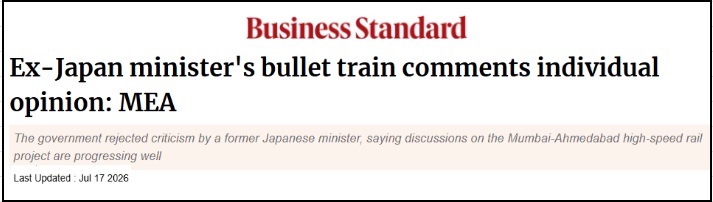 This statement could be found all over the country as media headlines (one instance is the one by Businesss Standard — https://www.business-standard.com/external-affairs-defence-security/news/no-japanese-offer-received-for-bullet-train-signalling-equipment-says-mea-126071701202_1.html). But the official statement on the government’s website could not be found.
The fact is that the Bullet Train implementation schedule has been delayed. When the agreement was signed, there was no dispute about where the signalling system would come from. As is typical with such turnkey projects, the entire engineering system, replete by signalling systems, is procured from the vendor. You cannot pick and choose components and systems from other suppliers and expect them to work seamlessly with the system supplied by the chief vendor.
It is quite possible that India’s prime minister, eager to announce the project as one of his achievements, did not go into the details, or even consult the core technical teams in India about either the project or the agreement.
Moreover, India’s penchant for delaying projects is legendary.
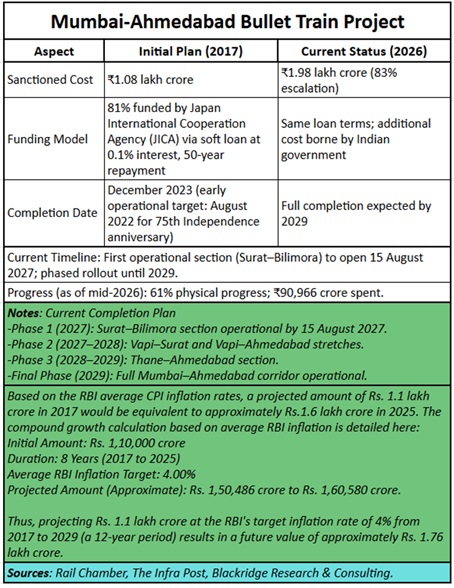 Just look at the table which gives you a snapshot of the original project cost and what it costs currently. Look at the manner in which there has been a project cost escalation. Sadly, based on the Reserve Bank of India (RBI) average Consumer Price Index (CPI) inflation rates, a projected amount of Rs. 1.1 lakh crore in 2017 would be equivalent to approximately Rs. 1.6 lakh crore in 2025.
The compound growth calculation based on average RBI inflation is detailed below:Initial Amount: Rs. 1,10,000 crore; Duration: 8 Years (2017 to 2025); Average RBI Inflation Target: 4.00%; Projected Amount (Approximate): Rs. 1,50,486 crore to Rs. 1,60,580 crore. That is lower than the revised cost estimate of the government of India. This would suggest that either the RBI data is wrong and misleading. Or it could mean that the government estimates are inflated and are thus higher than should have been the case. Either way, a formal explanation from the government of India on such costs is desirable.
 DFC
DFC
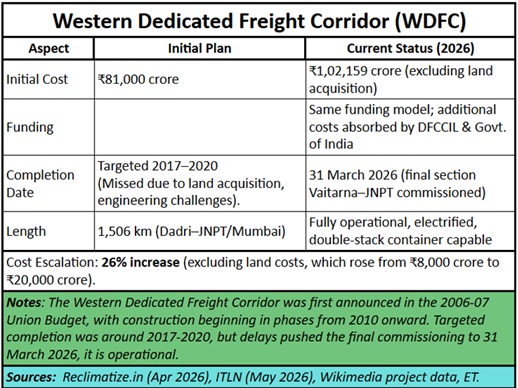
But why talk only about the Bullet Train or the Shinkansen. Look beyond this project to what could be considered the biggest project India and Japan planned to set up. This was the Dedicated Freight Corridor (DFC) and the supplementary project known as the Delhi-Mumbai Industrial Corridor. More details about this project can be found in the article we had done earlier (https://bhaskarr.substack.com/p/indias-two-dfcs-politics-trounces). .
The project was conceived of in 2006. India had a big problem. Its biggest industry belt was the region between Haryana and Mumbai. Transportation by railways is always cheaper than road transport. The trouble with the railways in India was, and continues to be, that when passenger trains travel, priority is given to them, and goods trains are asked to stand by. This causes the entire journey between Haryana and Delhi to take as much as 10-12 days when the journey could be completed in 18 hours.
Since delaying passenger trains would not be politically desirable, it was decided to have a dedicated freight corridor under a new department which would be coordinated by both the government of Japan and India. This would help industry reduce logistics costs, and make Indian goods more competitive in both domestic and export markets.
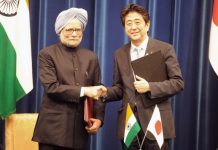
Both Shinzo Abe the Prime minister of Japan at that time, and Manmohan Singh, the Indian prime minister concurred on this strategy (https://asiaconverge.com/2020/05/investments-land-smallest-part-problem/). In April 2005, both leaders agreed to set up the Western Dedicated Freight Corridor (WDFC). RITES of the Indian Railways was made the nodal agency for the surveys and feasibility studies. At that time, the belief was that the project would be up and running by 2017 (see table).
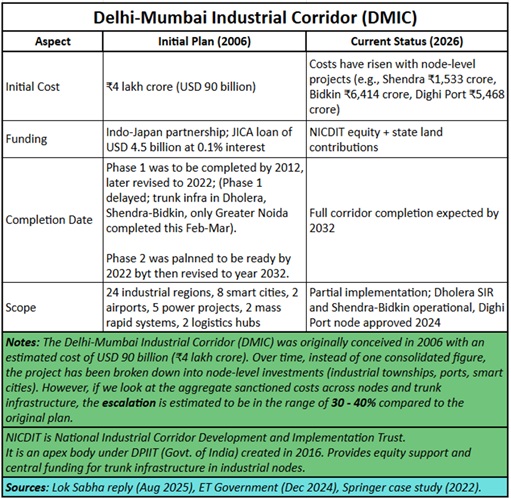 The two countries went a step further. They agreed to set up the Delhi Mumbai Industrial Corridor (DMIC). It was to build an economic powerhouse around the DFC. Instead of allowing the growth of housing along the railway tracks – as has been the case all along – the focus would be on organised housing in well planned cities (https://asiaconverge.com/2011/02/dmic-delhi-mumbai-corridor-will-create-new-best-class-cities/). Much of the funding and technologies would come from Japan, at very concessional terms.
By January 2020 (https://asiaconverge.com/2020/05/investments-land-smallest-part-problem/) the 24 townships (including Dholera) were expected to cost around $90 billion (https://asiaconverge.com/2020/05/investments-land-smallest-part-problem/). Dholera was touted as the largest SEZ in the world – larger than even Shenzhen – and the entire project that had been taken over by the DMIC was expected to be ready by 2024 (https://dholerasmartcityproject.com/delhi-mumbai-industrial-corridor/). But that was in 2020.
Constitutional shelter
All the cities were to be built using the provisions of Article 243Q (specifically the provision to Clause 1) of the Indian Constitution. Introduced by the 74th Constitutional Amendment Act of 1992 (Part IX-A), this section grants state Governors the authority to designate urban areas as Industrial Townships instead of standard, democratically elected municipalities.
These townships are recognized as exceptions to traditional self-governing bodies. They are typically managed by unelected corporate boards, development authorities (like Jamshedpur, NOIDA or CIDCO. Since they are not managed by politicians, they are free from the political compulsions for promoting slums (https://bhaskarr.substack.com/p/property-taxes-land-and-corruption), and the fiddles relating to property taxes and rentals that almost all cities are notorious for. That is why Indian politicians do not like industrial townships created under the shelter of Article 243Q of the Indian Constitution. They reduce the potential for grease.
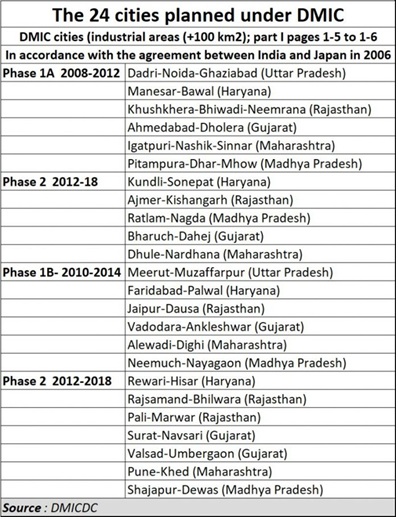 That could be the reason why none of the 24 cities came up. India’s promotion of corruption is more acceptable politically, than the promotion of organised urban centres.
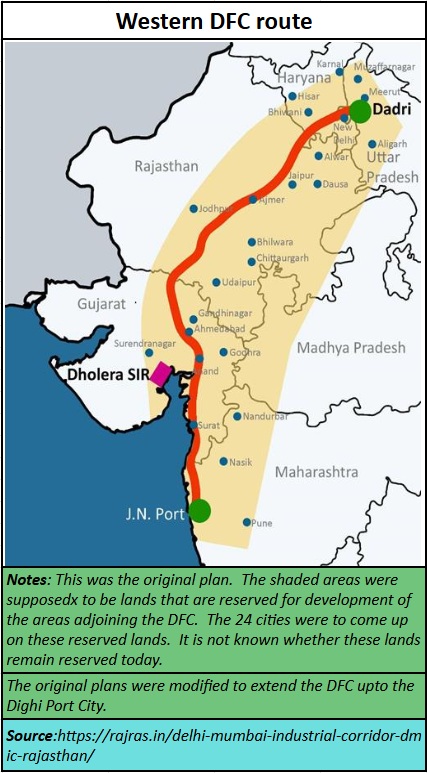 Moreover, the DFC was gradually extended up to Dighi, the port city. That is where many politically connected parties had acquired huge pracels of land. They knew that if the DFC were to be extended to Dighi, the value of their holdings would go up substantially.
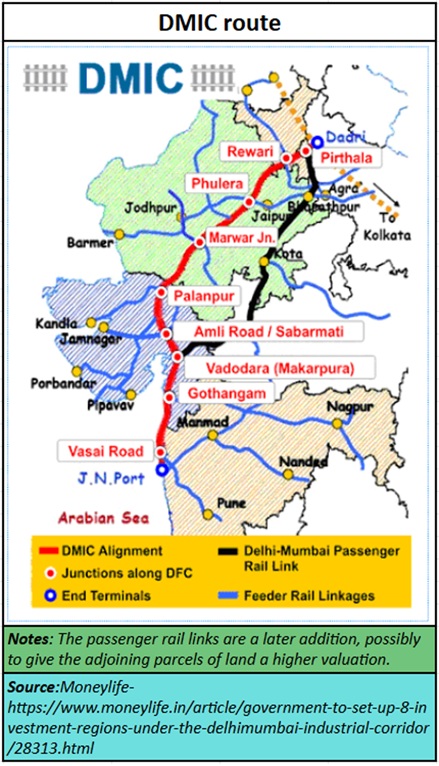 Today, neither the DFC nor the DMIC has been completed. Political priorities made the government look at profit maximisation (both political and monetary). Effectively, political compulsions made the Indian government to kiss goodbye to all the promises and assurances made to Japan.
Not surprisingly, the WDFC has not seen the light of day as yet, though some sections have been opened up. The cities are nowhere, as no politicians want industrial townships under the protection of constitutional clauses. Instead, the government of India, once again for political reasons, began promoting the Eastern Dedicated Freight Corridor, running from Haryana to Daikuni in West Bengal, primarily because it would pass through densely populated states, which would thus become vote catching projects as they would provide employment to the locals.
The consequences were inevitable. Indian industry could not get the benefit of lower logistics costs. Land grab continued unabated along the route of the DFC, and the project kept getting delayed. The country lost both in terms of competitiveness and huge cost escalation. One still does not know when the DFC will get completed. As for the 24 cities, it could just remain a pipe-dream. India will lose all the synergies that are peculiar to organised industrial townships, along for better vendor management and even lower manufacturing costs. It would increase the clout of land sharks, many of them with very strong political connections.
That is why, when the MEA claims that Hideki Makihara’s statement “is an individual opinion and is at considerable variance with facts”, such claims sound hollow.
Conclusion
If India has to become a rising star in the world, it must first learn to be transparent about its agreements – the full text of the Manmohan Singh-Shinzo Abe agreement was put up on the website for all to peruse. It has to learn to abide by the commitments made. Most importantly, it must learn to make its politicians focus on national benefit more than political or monetary benefits.
Former minister Hideki Makihara’s statements are correct. Politicians and powerful bureaucrats “keep pushing their own self-interest right up to the very end. The minister in charge was especially awful—if the top guy’s like that, there’s no way to have any decent dealings.”
Politicians may raise full-throated cries about Viksit Bharat” (a developed India). But the above examples show that India has a long long way to go.
=============
This week we have a podcast on the crisis that India is facing. It analyses the options India has for a rescue. Do watch it at https://www.youtube.com/watch?v=hYz40_XnFec
=============
Also watch the no-holds-barred discussion that Neeraj Jha has, on his “Beyond the Brand” show, with RN Bhaskar. He quisses Bhaskar on a variety of issues. You can watch it https://www.youtube.com/watch?v=Hf4ySTtbHY4 .
=============
Plus, do view our News Behind the News:
- The mess in education; will the education minister resign?
- Even the budget allocation reflects disdain for education
- Educated unemployment is soaring
- Despite El Nino, North India may be flooded
https://www.youtube.com/live/3d-jV9aj59I?si=t9zcmGil12lOTnsj
=============








COMMENTS