





















09 February 2026
US trade deal — a sellout?
By RN Bhaskar and Sakeena Bari Sayyed
Image: Bloomberg
A month ago, before the US trade deal with India — we actually believed that India had rediscovered its spine. This was because
- India had refused to condemn Iran for the way it dealt with the riots.
- India had refused to join the Gaza peace board, a creation of Trump who has designated himself as lifetime chairman (this decision may get reviewed as India is being enticed with platitudes).
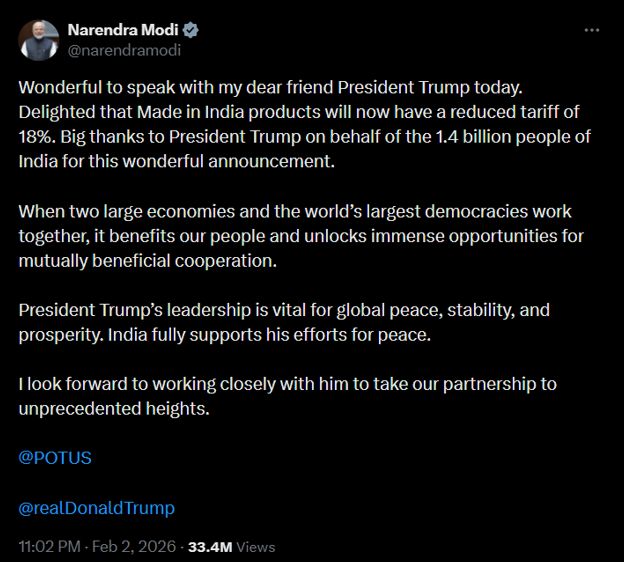
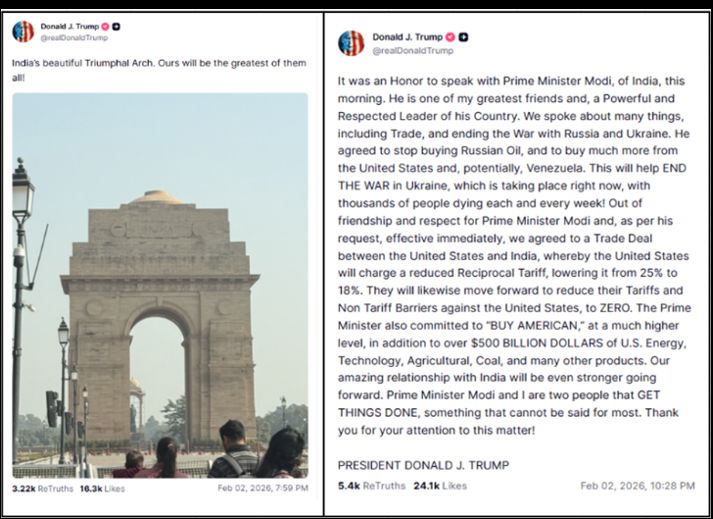 But it appears that our hopes have been belied. India just capitulated by accepting an obnoxious US trade deal that the US announced and India cherished, celebrated and even defended. Prime minister Modi called up US President Donald Trump to thank him for agreeing to the deal.
 Abject surrender
While Indian officials insist that the text is still being finalised, and that the only decision taken was to reduce Indian tariffs for US imports to zero over the next few years, tariffs for India would be pegged at 18% (against the 25% to 500 % that had been talked about earlier). That is certainly not a reciprocal deal. It is iniquitous. Moreover, other clauses that US sources say have been agreed as part of the deal indicate that India just did not bow. It crawled.
Other details were available from US sources. They included the following:
- India agrees to increase total imports from USA to $500 billion each year.
- Imports on the US will include a variety of sectors, including defence equipment, animal husbandry and agricultural produce.
- India would stop importing oil from Russia.
- India would stop having any deals with Iran. This appears to make sense considering that no allocation of funds was made for the Chabahar port in the recently announced budget. This was despite India’s external affairs ministry confirming barely a week before the budget session, that it was still committed to the deal.
The government has maintained a studied silence in respect of all the issues mentioned above. Nor has it clarified who the signatories to this US trade deal are. Didn’t Modi thank Trump for reducing just the tariffs to 18%? Does that mean that it agrees to reduce US tariffs to zero, even while the tariffs for India will remain higher?
India had obviously capitulated.
Details of the deal given out by the US were almost identical to the disclosures made by Pravin Sawhney in February 2025. He was the first to disclose the figure $500 billion. We also talked about it in our columns in February 2025 (https://bhaskarr.substack.com/p/the-indian-government-has-inflated).
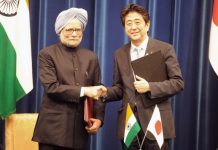
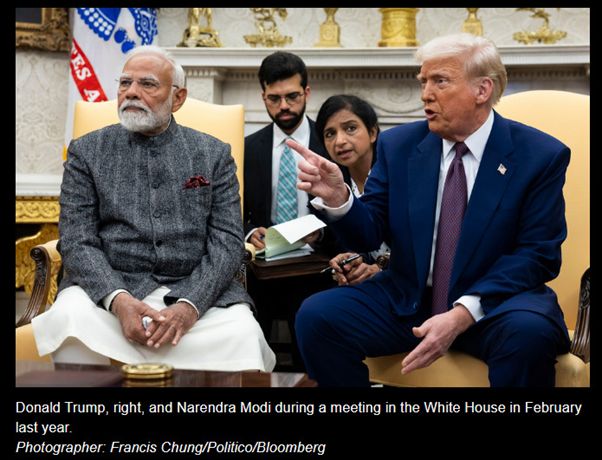
The picture above is a Bloomberg picture taken in February 2025 at the first meeting between Trump and Modi. Modi’s discomfiture is quite obvious. As narrated by Sawhney, Modi was told that India would have to import goods worth $500 billion each year. And, that this import would cover defence, agriculture and other items. It is possible that the draft agreement was ready by mid-2025 as suggested by Faye D’Souza in her podcast (https://www.youtube.com/watch?v=CoqpzGvYuD8) . According to her sources, the deal did not get signed because Modi failed to call Trump. Maybe, the recent phone conversation with Trump settled this issue.
After Modi’s return to India, it is possible that the government developed cold feet and tried to back out of the agriculture deal (https://asiaconverge.com/2025/04/indias-agriculture-under-immense-threat/). When India protested, there were people who actually believed that India would be emphatic about its red lines. Today, even that hope appears to be an illusion.
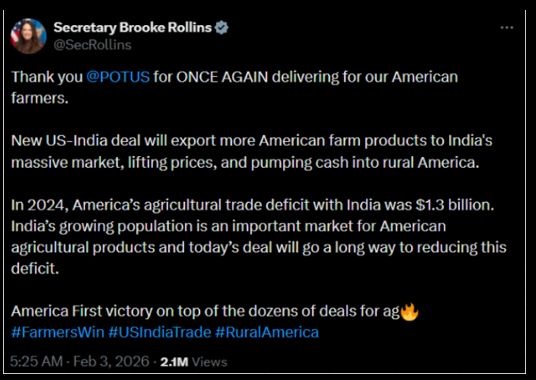 Just look at this tweet from Secretary Brooke Rollins, US Secretary of Agriculture, she thanks the US president for protecting the interest of US farmers. (https://x.com/SecRollins/status/2018473256122986610) One wonders of Indian farmers would do the same for the Indian prime minister. Effectively, the Indian government appears to be working for the US farmers and not Indian farmers.
India’s continued silence both in respect to the discussions that Modi had with Trump in February 2025 and to the details of the trade deal that Modi thanks Trump for is baffling. It leaves most India flummoxed. When governments try to keep details secret, the normal assumption is that something is fishy. Today, the stench is overpowering.
Defence deals
It is conventionally believed that most defence deals signed by India involve kickbacks. This was the case with the Bofors deal (https://www.bbc.com/news/world-south-asia-12109932). It is exactly what happened in the Agusta Westland case as well (https://web.archive.org/web/20160306162026/http://uk.reuters.com/article/uk-orsi-finmeccanica-idUKBRE91B09K20130212). Such allegations were rife even when Modi clinched the Rafale deal with France (https://timesofindia.indiatimes.com/india/operation-cover-up-by-modi-govt-in-rafale-deal-once-again-exposed-congress/articleshow/87604353.cms) and later increased the order size (https://www.thehindu.com/news/national/modis-decision-to-buy-36-rafales-shot-the-price-of-each-jet-up-by-41/article61544034.ece). Ironically, the Rafale jets failed to perform satisfactorily in the skirmish between India and Pakistan following the Pahalgam incident (https://www.aljazeera.com/news/2025/6/30/political-limits-why-did-india-lose-jets-to-pakistani-fire-in-may-fight).
Moreover, US, UK and EU military hardware have demonstrated their limitations in the recent war theatres in Europe (Ukraine) and the Middle East (Israel). Iranian, Russian, Chinese and even Turkish equipment has fared better. Interestingly the price of the military equipment’s from these countries were also a fraction of the price tags quoted by the US, EU and the UK.
In spite of this, India has already committed itself to defence purchases from the US (https://thewire.in/diplomacy/trump-narendra-modi-trade-deal-tariff) . Many believe that the initial order was to confirm the trade deal discussed by Modi and Trump in Feb 2025. What is horrifying is that the FTAs signed recently, and which Piyush Goyal has been exultant about, have all included clauses that suggest that India is willing to purchase defence equipment from them.
Is India’s security up for sale?
Have India’s policymakers forgotten that when it comes to defence imports, no country has genuinely engaged in technology transfer to India. The only exception is Russia and, to some extent, Israel. At best countries in the West have given India knocked down kits which have to be assembled in India. The West calls this technology transfer.
 Agriculture
India has been lying. Or at best it has been disingenuous. After telling Indians that agriculture and animal husbandry are not part of the FTAs signed with both New Zealand and the EU, discloses made by those parties have stated the opposite. It would therefore appear that Piyush Goy, India’s commerce minister, has continued to promote agricultural imports into India.
He did that in the case of edible oil imports (https://asiaconverge.com/2022/01/the-government-lets-down-indias-edible-oil-industry/). More importantly, he almost did this as part of RCEP negotiations when he wanted New Zealand to export its dairy products to India (https://asiaconverge.com/2019/08/indian-bureaucrats-almost-shortsold-the-milk-industry-at-fta-cpec-negotiations/). In the latter case the farmers howled in protest and the deal was called off.
However, Goyal had his way, eventually. He allowed New Zealand the right to export some of its dairy products – they are likely to hit Amul badly (Amul spray is one of its key profit centres (https://bhaskarr.substack.com/p/india-new-zealand-fta-will-it-destroy?utm_source=publication-search). Oversight? Or a deliberate attempt to mislead Indians?
Is the US too being allowed to push its agricultural exports into India?
Is India on its way to put up a “FOR SALE” notice?
 Oil
Oil
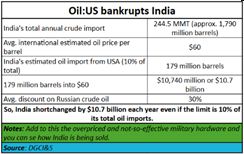
India is also believed to have signed a deal to source 10% of its oil from the US. It has reduced imports from Russia. This means that India will pay at least $3 billion more every year for this sourcing of oil from the US. If the US insists that India should purchase its entire Russian import form US/Venezuela, India’s additional forex outgo could be $12 billion (Russia accounted for 40% of India’s oil import, sold to India at an average discount of 30% to market prices).
The additional cost India will be required to pay for LNG imports from the US has not been computed. But they are likely to be higher, given the additional costs on account of freight and insurance (US is further away from India than Qatar, its principal supplier of LNG).
Watch India’s balance of payments swell to even more uncomfortable levels.
Why $500 billion?
There is one issue in the trade deal that baffles many experts. How did Trump arrive at a figure of $500 billion. That is too large a figure, and average exports and imports together over the past few years seldom exceed $100 billion. So, what can India import worth this mind-boggling number.
The refusal of the US to agree to renewing a START treaty should provide an interesting and plausible explanation. START stands for Strategic Arms Reduction Treaty (START) entered into by the US and the erstwhile USSR to reduce strategic offensive arms, like long-range nuclear missiles and bombers. START is linked to SALT (Strategic Arms Limitation Treaties) which is aimed at curbing nuclear arms races.
By not ratifying a renewal of START, the US wants an arms race. True Trump has suggested a new Treaty instead of the old START framework (https://www.thehindu.com/news/international/trump-urges-new-nuclear-treaty-after-russia-agreement-ends/article70598440.ece). But that is a method to delay such a treaty. Discussions will take time. The US will introduce terms that Russia and China may not accept. So, an arms race is inevitable.
This is precisely what the US wants. It wants to sell more arms — especially to India — through this trade deal. This is its most lucrative money-making machine. That explains why the US loves promoting wars. That allows it to sell more arms, often at prices that are twice as those offered by better technologies from Russia, China, Iran and Turkey (https://bhaskarr.substack.com/p/india-slips-on-oil). The other money spinner the US has in oil. But it has the world’s lowest oil reserves among the big producers. That is why it wants control Venezuelan oil. Moreover, it holds equity stakes in most oil and gas fields in the Middle East, except for Iran and Saudi Arabia (https://bhaskarr.substack.com/p/iran-was-once-an-ugly-duckling).
Finally, the US is financial down on its knees (https://bhaskarr.substack.com/p/the-dollar-and-the-us-could-stumble). It needs money, and India is the perfect target. It is not as strong as China and Rusia and does not have its own arms industry either. India will pay for reviving the US.
If START is not renewed the arms race will compel India to purchase more weapons, and which US will arm-twist India to purchase. That is where the money will be spent.
India has opened itself for becoming a bankrupt country.
Is India being blackmailed?
There are good reasons to suspect that almost every Indian politician and policy maker was become a blackmail target for the US. We wrote about this in February 2025 (https://asiaconverge.com/2024/09/india-china-and-russia-could-be-dancing-together-finally/ ).
Our suspicions were triggered when we carefully listened to the public utterances of Sergei Lavrov, Russia’s highly respected foreign minister. He made these remarks at a public forum in New Delhi in March 2023. At that conference, he stated the following:
“The West started blackmailing them, threatening them, sanctioning those who wouldn’t have sanctioned Russia. Many friends of mine in the developing world tell me how this is being done. When the West says the Americans tell them you must vote this way or else… and they say okay, I will vote the way you want me. Because I believe this can be explained by the United Nations chapter and so on and so forth but what do I get in return and the answer from the Americans is you would not be punished. Fair deal, very fair deal. Then I have quite a number of friends in New York, and when I was there for the last General Assembly, I talked to them and they were many if not most of them were saying that they fully understand what is going on and that we should not be angry. The way they vote — and they told me what arguments the Americans have been using when they persuaded people to vote in the general assembly against Russia. The arguments were very straight, don’t forget that you have a bank account and such and such bank and don’t forget that your kids go to Stanford, bluntly, and I am sure that there are many people in this room who know that this is true”.
Subsequent developments which have shown India to be subservient to the US in respect of the trade deal. This appears appears to bear Lavrov out. Remember how Modi remained silent when illegal Indian immigrants were shunted out of the US in handcuffs and shackles? Even a small country like Colombia protested (https://thehill.com/policy/international/5110287-colombia-president-gustavo-petro-compatriots-returned/). The migrant is not a criminal, they said.
Had Sushma Swaraj, the former foreign minister for India, been alive, she would have protested cehemently. Nobody should be allowed to humiliate Indians. After all, many of them left India to seek out employment that India could not provide. Then look at the way dairy products have been included in the FTAs. And the way India has obviously buckled and has reduced its oil imports from Russia. Lavrov remarks assume greater relevance.
So, is the US weaponizing the information about bank accounts lists of where the children of Indian policymakers are studying (often through the grant of US scholarships)? Are India’s interests being compromised?
Or could it be that the disclosure of the Epstein Files has rattled key people in power and those close to them? BJ:P member of parliament, Subramaniam Swamy is convinced that they are truly shaken, not just stirred. https://youtu.be/17wu79laUZ0?si=6_66YNH84Un_IIWK ). It is also worthwhile viewing Swamy’s own posting at https://www.youtube.com/live/BInA4n8j31s?si=LGn8LBM-6gYPnySe , where Swamy talks of the implications of the Epstein disclosures for India’s leaders
Conclusion
Shockingly, the entire Indian government could be facing an internal security threat. The abject surrender to the trade deal suggests this. This time, the roots could lie in the relationships, USA has cultivated with key Indians, and the way its strategies are aimed at weakening potential rivals. Today, the very survival of the Indian state could be at stake.
===========
My latest podcast is on how myopic the Indian government has been in trying to marginalise Verghese Kurien, the man who created the milk miracle for India. You can find it at https://youtu.be/AYR_2a4K_TQ
Listen to our budget review at https://www.youtube.com/watch?v=lgXIeCcMSf0
There is another interview given to Republic TV (Republic World) on the START that USA does not want to sign with Russia. Tune in at https://www.youtube.com/watch?v=LWutQgbwCIo
============================
And do watch our weekly “News Behind the News” podcasts, streamed ‘live’ every Saturday morning, at 8:15 am IST. The latest can be found at https://www.youtube.com/live/XJe01wcMgT8?si=psxbR4aUUdxUSqqM
============================







COMMENTS