

























MARKET PERSPECTIVE
By J Mulraj
Aug 29- Sep 4, 2026
Good Governance is More Essential than Ever
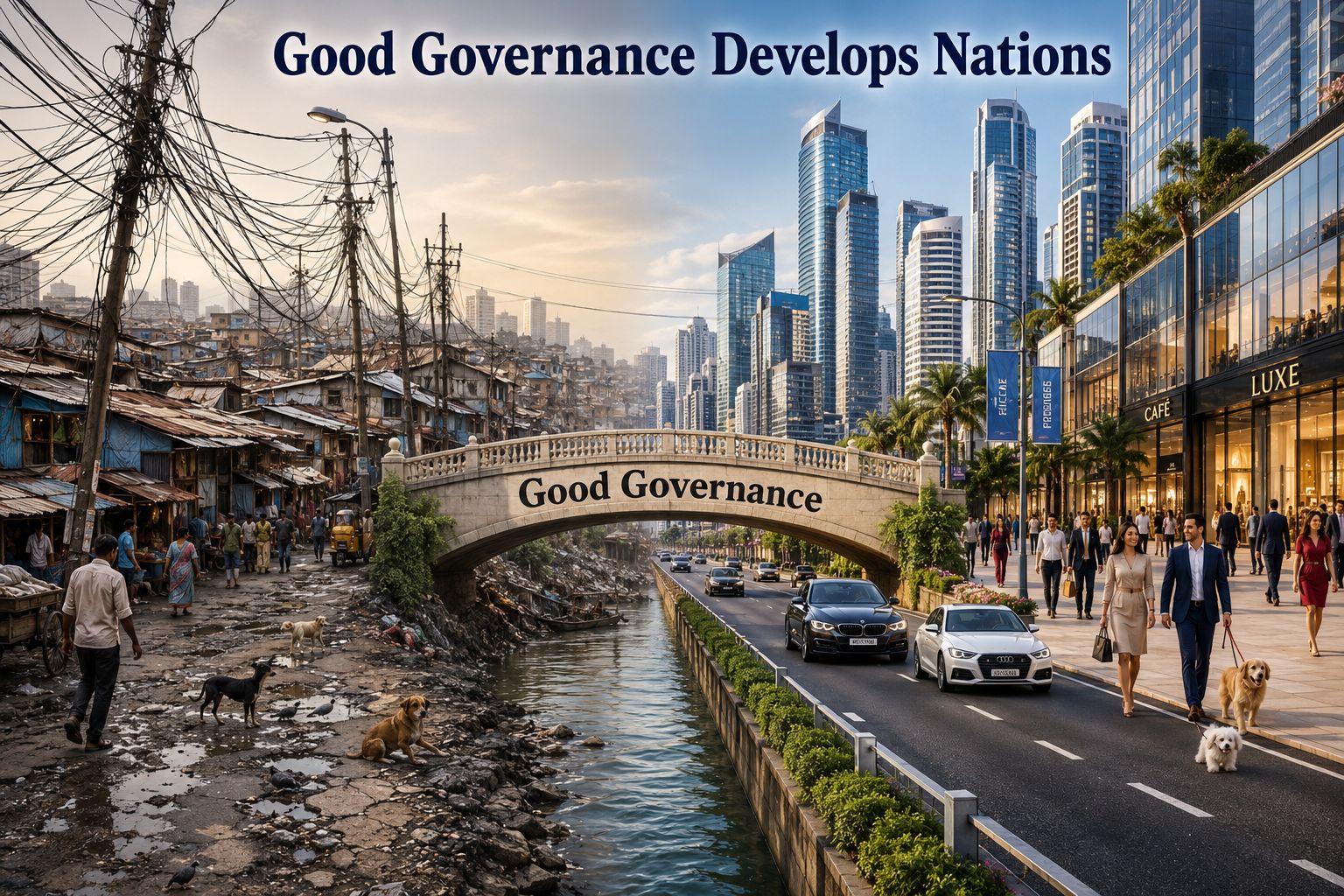
Image created by ChatGPT
It is good governance, and sensible economic policies that help transform an emerging economy into a developed one. It is important to analyse the wrong steps taken by past Indian policymakers, which, even though known, must be retained in public memory, to avoid a repetition.
Let’s compare India’s path with two countries, one much smaller, the UAE, and the other, comparable in population with India, China.
Today, the UAE has a per capita income of $ 54200, or 19X that of India, at $ 2800. Even if computed on a PPP, or purchasing power parity basis, it is 6.8 times. It was not always the same. Before the UAE discovered oil in 1958, there was a point in time India, and other countries, extended financial aid to the Emirates comprising it.
The oil discovery in the UAE propelled its per capita GDP growth by a whopping 140% in the 1970s, during which time, India’s per capita GDP growth was only at 12%. Interestingly, in the 5 decades that followed the 70s, India’s per capita GDP growth is significantly higher.
So what were the policies in the 1970s that dragged our growth down? For most of this decade Congress, under PM Indira Gandhi, was the party in Government.
The policies that stifled growth included the license- permit raaj. Anyone wanting to set up or expand a manufacturing unit had to first obtain a licence to do so. This took a lot of funding, on both sides of the table, and thus restricted growth. Especially for new entrepreneurs who did not have the funds nor the political connections to weave their route through the labyrinthic corridors of power. Manufacturers were penalised for producing more than their licence stated they could. How, pray, would GDP grow if manufacturing was thus stunted?
Under the license-permit raaj, the licence was granted if the company borrowed in INR from select 6 institutions. Three of them were lending institutions comprising IDBI and IFCI (both Government owned and managed) and ICICI, a listed company with private shareholders, plus 3 others, Unit Trust of India, Life Insurance Corporation and General Insurance Corporation, all Government controlled. The lenders of rupee loans carried an option to convert, if they so chose, 20% of the loans into equity.
So success, instead of being lauded, brought with it the millstone of a dilution of equity. Another discouragement to growth.
Corporate taxes were high, between 55 and 70%! Dividends were taxed. Income tax reached the insanely high level of 97.75%. Even after that, the Government levied a wealth tax, a gift tax of 30% to dissuade succession planning and no escape for the dead, on whom a progressive rate was adopted, going up to 85%.
Such policies and tax rate resulted, quite obviously, to unreported income and wealth, with Switzerland becoming the preferred destination for its beauty, its chocolates and the secrecy of it’s banks.
Should the company make good profits despite this, and want to make an equity IPO (Initial Public Offer), in order to raise equity and repay debt, there was, between it and the stockmarket, an official called the Controller of Capital Issues (CCI). The CCI used an obnoxious and antiquated formula to assess the price at which the shares could be sold. Companies thus got far less money from selling stock, than they deserved. The conversion option mentioned earlier gave the 6 institutions a considerable voice, as well as seats on the Board of Directors, to influence corporate decisions.
The Government gained a chokehold in 1969 when it nationalised 14 private sector banks. The ostensible reason was to prevent crony capitalism in which private control of banks would direct loans to favoured borrowers. As is now evident, the Government itself resorted to crony capitalism, directing loans to favoured borrowers, mostly in the private sector. Its control over the banks led to “phone banking”, no, not the modern, digital version, but one in which unwritten instructions were given to Bank Chairman to approve loans to select persons with greasy fingers. The result? In the past 10 years, Public Sector banks have written off loans amounting to ₹ 12 trillion, of which 61% was to large industry and 39% to all others. In the private sector banks, ₹ 4.1 trillion has been written off in the last decade, of which 31% is to large industry.
Mrs Indira Gandhi did one more unconscionable act, abolishing privy purses. This was a promise given to the 560 semi autonomous states ruled by princes, in order to get them to acquiesce to the formation of a unified democratic state that is India. Abolishing them, in 1971, was not a financial, but a political decision , as was the bank nationalisation case, but it revealed the willingness of the Government to break promises.
Now take China. In 1979, the first full year of China reforms under Deng Xiao Ping, initiated in Dec 1978, India had a per capita income of $ 228, larger than China’s $ 174. Deng opened up the economy in Dec 1978, a decade ahead of India. Today, China’s nominal per cap income is $14,800 versus India’s $ 2800. Because Chinese policymakers opened up their economy 12 years ahead of India.
What were India’s policy and social issues in the 80s? The PMs were Indira Gandhi (1980-84), RajivGandhi (1985-89) and then V P Singh. The license-permit raaj continued, and so did the MRTP (Monopolies & Restrictive Trade Practices Act), even though the Indian giants were global pygmies. large companies were protected by high import tariffs (going to 129%). It was the Indian consumer who had to suffer long wait times for delivery of poor products like the Ambassador/Fiat cars or Bajaj scooters.
High import duties prevented competition, and also modernisation, relegating Indian industry to ossify at a time when a liberalised China was modernising and opening it’s markets. India raked up huge fiscal deficits, but the INR was overvalued due to RBI currency restrictions.
Corruption scandals emanated in the ‘80s, like the Antulay cement scandal (1981) and then the Bofors scandal (1987). China dealt with corruption with finality; India with banality. It runs rampant.
The ‘80s saw the rise of militancy in Punjab, terminating with Operation Blue Star (1984) which led to the assassination of Indira Gandhi.
India’s polity continued to focus on caste politics to obtain and retain power whilst China went about modernising it’s economy and creating huge trade surpluses. It is now dominant in several sectors, cement, steel, electric vehicles and refining of rare earth minerals.
India, too, has several advantages. It has the largest, and youngest population, with over 65% of population under the age of 35. It is a world leader in digital infrastructure and financial technology, backed by the India stack, comprising UPI and Aadhar. India has half the global share of instant real time payments.
India has a dominant global share in polished diamonds (90%), vaccines (60%) and pharmaceuticals (20%). It has a vibrant start-up ecosystem.
It was weighed down by bad policies, which stunted growth, horrible taxation policies, self defeating high import tariffs, an unbelievably slow judicial system with a backlog of over 50 million cases, and corruption at the State level.
The polity must study the past mistakes so as not to repeat them. It has to prepare the populace for an AI world which, according to Elon Musk, has the potential to add $ 15-20 trillion to global GDP.
Focus on how much of that India can grab, what are the skill sets required to grab that, and what the Government needs to do to prepare the youth to achieve the grab. In this, politicians across the board should lend support for a national endeavour. Not indulge in imbecilic protests on petty issues that waste time and effort.
Last week the BSE Sensex closed at 76515, down 749 points over the week.
AI promises to find solutions for global problems, on a faster timeline. It also has the potential to add to global GDP. For AI to be able to add $15-20 trillion to world GDP, the biggest hurdle is a shortage of power. The other hurdle is social acceptance of the resulting job losses and the need to motivate the employees to retrain. This is what the polity must concentrate on.
—————————————————————-
Comments can be emailed to: jmulraj@asiaconverge.com
——————————————————————













COMMENTS