

























2026-10-05
Can Saudi Arabia survive?
By RN Bhaskar and Sajeena Bari Sayyed
Image: Copilot
Of all the countries in the Middle East, there is none that is more endangered than Saudi Arabia. It may see its borders redrawn. It could return to the state it was before 1930.
To understand this, one needs to know a bit about the conversion of the Arabian Peninsula – or Arabia as in the movie Lawrence of Arabia – into Saudi Arabia. This requires a bit of history.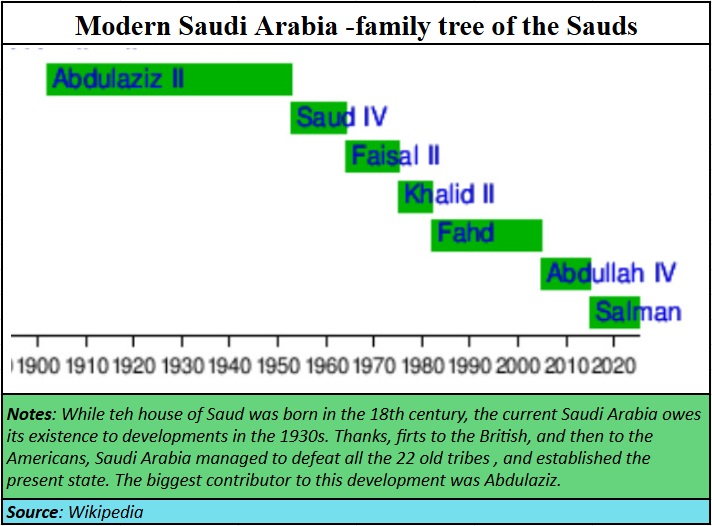 History
The House of Saud owes its beginnings to Muhammad bin Saud, founder of the Emirate of Diriyah, known as the First Saudi State, (1727–1818), You can find much of the history in “The House of Al Saud – A View of the Modern Saudi Dynasty”. Frontline. PBS. 18 September 2015 (https://www.pbs.org/wgbh/pages/frontline/shows/saud/tree/).
At that time, the entire Arabian Peninsula comprised warring tribes, each with its own territory fiercely guarded from wannabe interlopers. It might have remained that way, but for the British, who had already conquered much of the middle east. It decided to provide arms to the then Emir Abdulaziz. Machine guns were a rarity in those days. Legends say that he actually machinegunned all other tribes into submission. Saudi Arabia was born. To mollify the defeated tribes, and in order to bring them into a family structure, he picked a girl from each of these tribes and married them (that is how he had so many wives). The tribes were restive. But superior weaponry, and now with the family ties, resistance remained muted. Abdulaziz was also blessed by the fact that he enjoyed one of the longest reigns within the House of Saud.
 By 1938, The US discovered commercial quantities of oil in Saudi Arabia at the Dammam Well No. 7 site in Dhahran (https://en.wikipedia.org/wiki/History_of_the_oil_industry_in_Saudi_Arabia). Thereafter, it was the US which became the biggest benefactor of this kingdom, and also recipient of funds from this source.
Succession was always a contentious issue. At first, the rule was that kingship would pass down from father to son. It then changed to kingship going to brothers and then to descendants. In 2006, a royal decree laid down another rule – that the new king would be elected by a committee of Saudi princes (https://www.washingtonpost.com/news/worldviews/wp/2013/07/22/meet-the-worlds-other-25-royal-families/).
That is how the present ruler King Salman became the head of Saudi Arabia, till his son – the current crown prince MBS (an acronym for Mohammed bin Salman bin Abdulaziz Al Saud) became the head of state through a clever stratagem of getting the consensus of other Saudi princes. Since his father was ailing, he grabbed power, got the heads of all the 20 odd tribes arrested and locked up inside Ritz Carlton Hotel as house arrest. No phones were allowed, and nobody was allowed to meet any of them. They were finally compelled to sign a declaration which gave consent to the appointment of MBS as the new heir. They are also reported to have paid MBS huge sums of money which could be called ransom. (timeline 16:42 where Alastair Crooke, a brilliant analyst of middle eastern affairs, explains what happened at https://www.youtube.com/watch?v=KYSnUEiNy6M). It was only after MBS was satisfied with their declarations and their affirmation of loyalty that they were released one by one.
The tribal leaders were humiliated, furious and almost dispossessed. As Mitraraheb, scholar, professor, & consultant, puts it (https://www.asiaticglobalorder.com/p/the-end-of-the-saudi-crown-prince?triedRedirect=true), “For nearly 100 years, the modern Kingdom of Saudi Arabia was grounded in a sacred 1932 Covenant that tied the monarchy, the tribes, and the religious establishment into a single, unified power structure. . . . . That foundational arrangement, however, was torn down by Saudi Crown Prince Mohammad bin Salman (MBS), who, in his quest to centralize control, dismantled the very pillars that had defined Arabian society for more than a millennium.
It is this background that must be kept in mind when one discusses Saudi Arabia today.
Quite solid initially
Despite rumblings of discontent, MBS was confident that he could remain unchallenged. Then the black swan incident happened. The US and Israel decided to attack Iran, without provocation, even while negotiations were underway. They were confident that Iran’s leadership would be decapitated and the US could appoint a puppet head of state once again – just as it had done with Shah Reza Pahlavi decades earlier.
If the Islamic revolution of 1979 was the black swan event for the US and the world, the Feb 22 attack on Iran was to become another major reversal for both the nuclear-powered states. It exposed the hollowness of their inflated self-confidence. Iran had been preparing for such an attack for decades. It had fortified itself. It also enjoyed a geo-strategic advantage in the Strait of Hormuz. The attacks were shrugged off. And Iran responded with a deadly counterattack that left Bahrain, Kuwait, UAE, Israel and even Saudi Arabia reeling (https://bhaskarr.substack.com/p/blockading-iran-a-chimera).
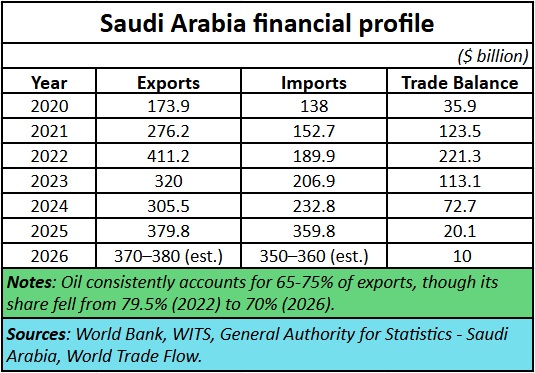 Not surprisingly, the balance of trade for Saudi Arabia worsened.
Iran’s attacks were aimed at US bases in each of these countries. Suddenly, the US — which was seen as a protector of kingdoms in the middle east — became the biggest risk factor. US bases attracted missiles and bombs. They imperilled the very nation states that did not want the US there anymore. The damage they suffered was extensive. Iran threatened to continue reprisals, with each attack being fiercer than the previous one. Good sense prevailed. Both Israel and the US sheathed their claws, hoping to find another way to counter Iran. The fact is that they cannot overwhelm Iran.
The first formal retreat was from Iraq (https://www.reuters.com/world/middle-east/us-forces-exit-iraq-after-two-decades-leaving-opening-iran-2026-09-29/).
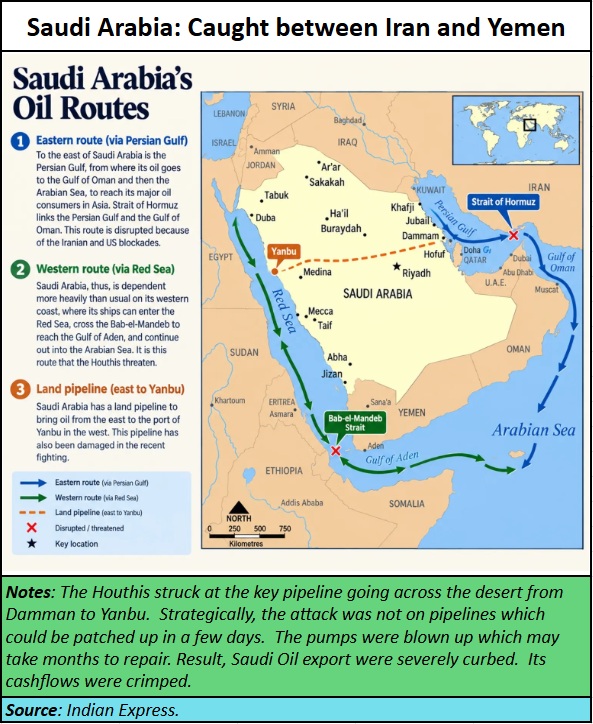 If that were not enough, The Saudis made the mistake of attacking the Sana’a airport in Yemen in July to stop an Iranian aeroplane from landing (https://sanaacenter.org/publications/perspectives-and-analyses/27981). The Houthis responded with a scathing attack. Key pipeline and pumps of the Saudi oil network were damaged, as were Saudi oil installation. This time the attacks also came from Iraq (a sworn enemy of Saudi Arabia).
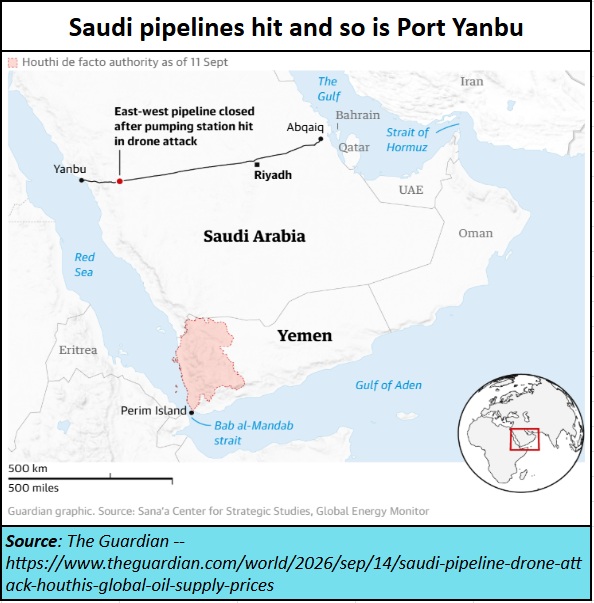 Saudi Arabia yelled to the US for help. None was forthcoming. On 17 September 2026, the Saudis made a third, fervent, appeal for help. The US assured them that it would retaliate on the coming Sunday (20th September). But the reprisal failed to arrive. The US got cold feet. Why?
This is explained quite starkly by John Mearsheimer, noted geopolitical analyst (timeline 13:57 — https://www.youtube.com/watch?v=2FbN9_wZOtw&t=785s). In that podcast he explains why the US backed out: “Because it would not have worked militarily. . . .and … we have a shortage of munitions and the last thing we want to do is engage in an air war against the Houthis that we can’t win and where we will expend precious munitions. You want to remember that last March shortly after President Trump came back into office, he decided to wage war against the Houthis and by May he recognized that he could not defeat the Houthis. So, he quit that war. He declared victory of course which is his modus operandi, but he didn’t or we didn’t win that war against the Houthis, and we were expending massive amounts of ammunition in the process. So, the last thing he wanted to do was start a fight against the Houthis again that he can’t win. So, he turned down MBS two times. Then, MBS came back a third time, he indicated that he might do it, but then at the last moment he backed off.”
Beginning of the end?
History has a strange way of repeating itself and unravelling the attempts of people to change the course of events.
Had the Saudis not attacked the Houthis, there is a chance that its existence would not have been threatened.
Had the US and Israel not attacked Iran in February this year, it is possible that world trade would remain comfortable, and the turmoil in the markets would not have been as severe as it is today. Both had stirred a hornets’ nest. Now they were scurrying for cover.
Making enemies
Moreover, had MBS not locked up the Saudi princes and forced them into accepting his leadership, there is a chance that they would have rallied to his support.
Now, many of the princes are beginning to extend support to Yemen. The House of Saud is unravelling.
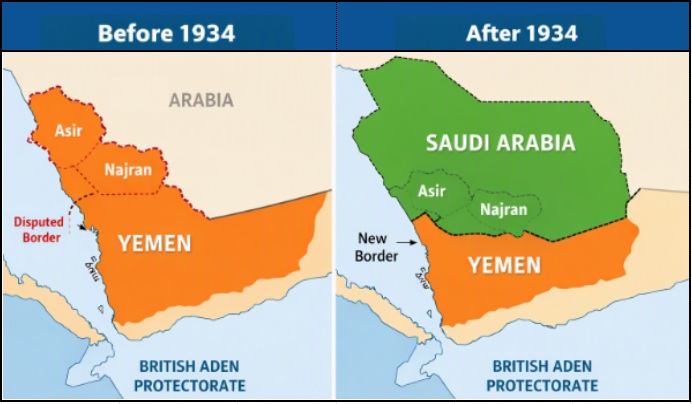
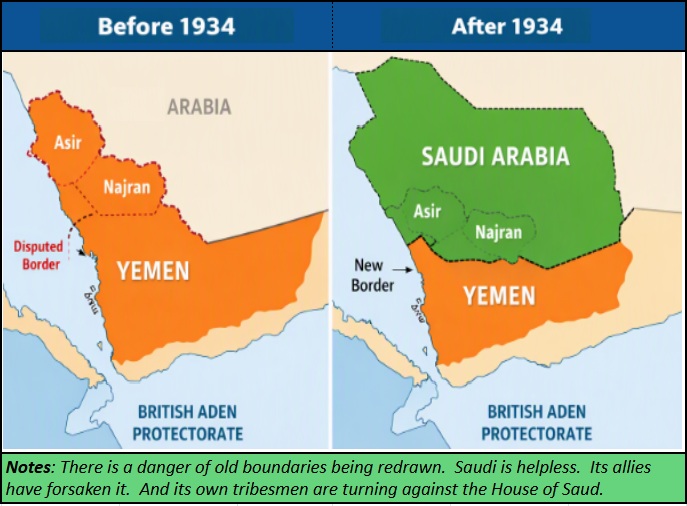
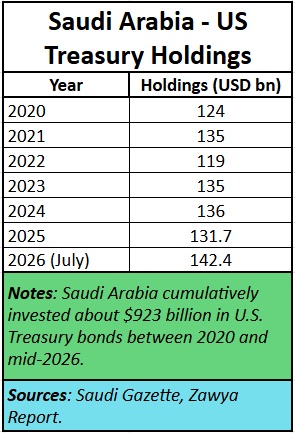 Saudi Arabia faces another problem. It cannot even hire mercenaries to fight against the Yemenis. First, because the Yemenis are battle-hardened. Second because the Yemenis, especially the Houthis, enjoy the support of Muslims. They see themselves as custodians of Islam. They were also the first to protest against what was happening in Gaza. Third, because Saudi Arabia has little money left. Almost all its funds are locked up in US treasuries. The US will not allow MBS to sell them, because its bonds are already under pressure and its yields have shot up to their highest ever. Lastly, Yemen now wants return of the territories that the House of Saud annexed in the 1930s.
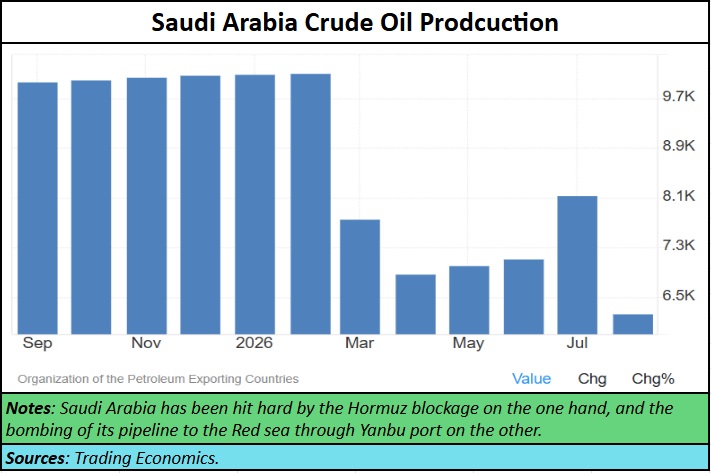 Moreover, oil incomes have collapsed.
In 1802, the House of Saud also committed a sacrilegious act in the ransacking of Karbala, one of the holiest of shrines for Muslims. The raid was ordered by the ruler Abdulaziz bin Muhammad Al Saud and commanded by his son, Saud bin Abdulaziz. The assault was deliberately timed to coincide with the anniversary of Eid al-Ghadir, when most of Karbala’s men had travelled to nearby Najaf for pilgrimage. The city was left largely undefended. Saudi forces demolished the sacred tomb and golden dome of Imam Hussain ibn Ali (the grandson of the Prophet Muhammad). The invaders stripped the shrine of its vast historical treasures, loading up to 4,000 camels with gold, silver, emeralds, Persian carpets, and weapons (https://ballandalus.wordpress.com/2014/08/02/the-wahhabi-sack-of-karbala-1802-a-d/). Iraq and Iran have not forgotten or forgiven that sacrilege.
Suddenly, Saudi Arabia is without friends, funds and protection. Ironically, Israel has offered to help. But the Saudis have (wisely) turned down such offers (https://www.timesofisrael.com/saudis-reportedly-wont-budge-on-israel-normalization-as-they-seek-help-against-houthis/).
Is there a way out?
Yes, there is. Saudi Arabia has to make peace with Iran. Saudi Arabia, unlike Europe, has the Arab tradition of negotiating its way out of any crisis (https://conversationsamongtheruins.substack.com/p/the-saudis-know-they-lost-europe?triedRedirect=true). Do remember how it (and Iran) had buried the hatchet a few years ago through a China brokered deal (https://www.aljazeera.com/news/2023/8/21/china-brokered-saudi-iran-deal-driving-wave-of-reconciliation-says-wang). But current tensions for Saudi have become so severe, that it needs to work out a deal which includes jettisoning the US dollar.
If Saudi Arabia swings, all the other Gulf states could follow.
The US too is stuck. If it goes to rescue Saudi Arabia, it will destroy itself. Its yields on T bills are already under pressure. Additionally, as economist Ruchir Sharma points out in a Bloomberg video (https://www.bloomberg.com/news/videos/2026-09-28/rockefeller-s-sharma-warns-of-ai-crash-as-10-yr-hits-5-video), any further increase in the bond yields could translate into devastating inflation and an economic meltdown for the US.
Fingers remain crossed. If there is war, all the oil fields in the Middle East will disappear. The entire region will become a desert once again. And the world will suffer immensely.
Saudi Arabia could also become plain Arabia.
———————
Do watch our latest podcast. It is on Germany. On how Chancellor Merz and his predecessors have propelled Germany towards self-destruction. It also talks about how Germany is about to trigger the third world war (it had triggered the earlier two world wars). You can find it at
———————
Finally, do not forget our News behind the News
You will find it at
———————









COMMENTS