






















31 August 2026
The govt’s one-eyed vision for agriculture
By RN Bhaskar and Sakeena Bari Sayyed
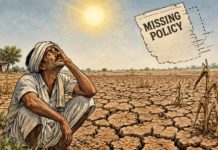
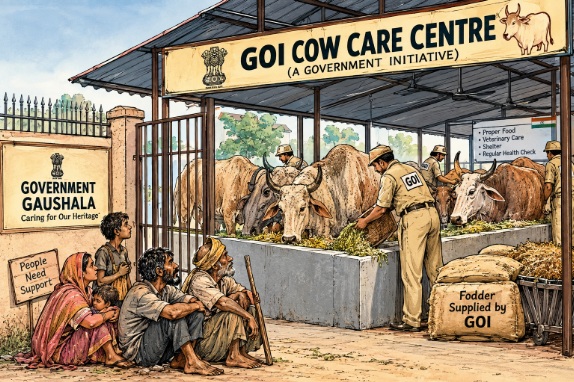
Image: Chatgpt
Last fortnight, I laid my hands on a Researchgate paper on the Size of Agricultural Economies by Mukul Asher (https://myind.net/Home/viewArticle/size-of-the-agricultural-economies-and-global-importance-of-different-agricultural-commodities-an-overview). Two charts impressed me immensely, which have been reproduced below. It let me ponder over the state of agri in India.
They tell people, what I have suspected since 2014 – that the Indian government has been shooting itself in the foot. It is wrecking its agricultural economy. In the process, it is wrecking jobs, exports, and demand for goods and services that industry produces. It is both shocking and sad that the advisers to the government have not seen this as yet. It begins with the agri sector.
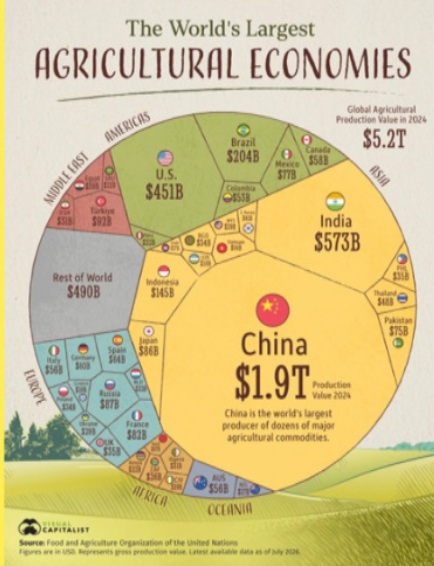 China trumps India
Take the first chart that excited me.
It told me one thing. It stares at you in the face.
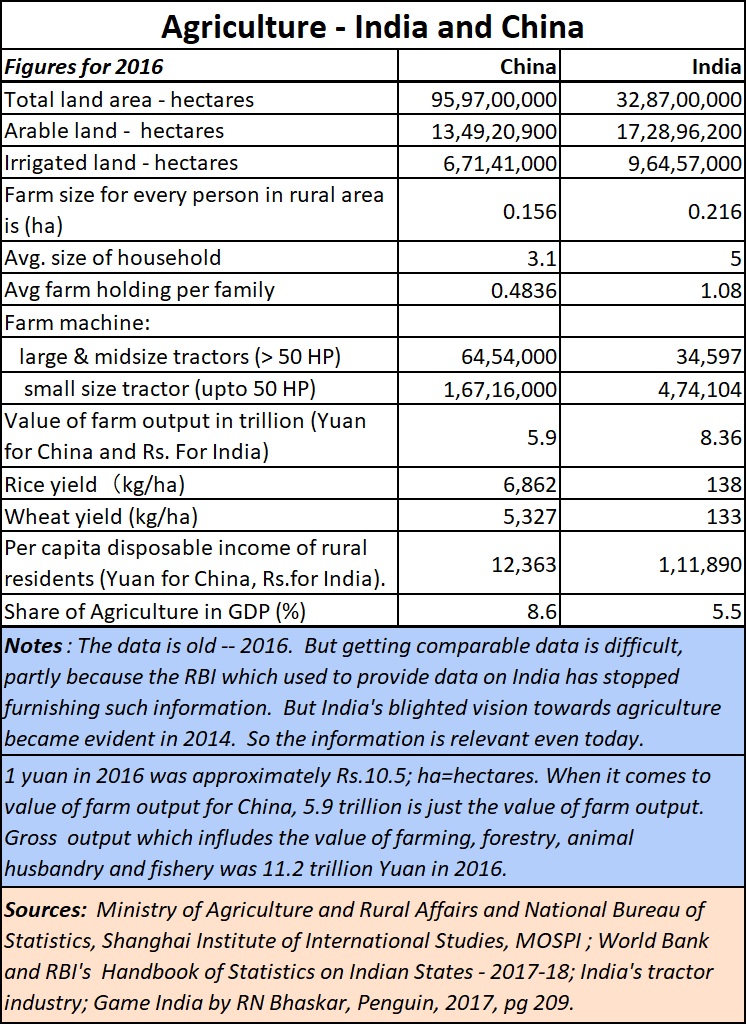
The chart tells you that China has an agricultural market that is almost four times Indian agriculture. This is despite China having less arable land than India. It had fragmented holdings that were smaller than those in India in 2016 (Game India by RN Bhaskar, Penguin, 2017, pg 209). In 2016, India had a higher value for its agricultural output than did China. The latest chart tells you that India has slipped. China is now much larger than India. Why did this happen? One reason was that China was more focussed on pushing up agricultural value than did India. India thwarted agriculture and even made farmers poorer than they were before.
 Milk and beef are big businessesT
That is when we looked at a second chart that Asher’s article has. It is about the most valuable food commodities in the world. It is this second chart that damns India’s government. It has deliberately turned a blind eye to the basic numbers any minister of agriculture should have noticed.
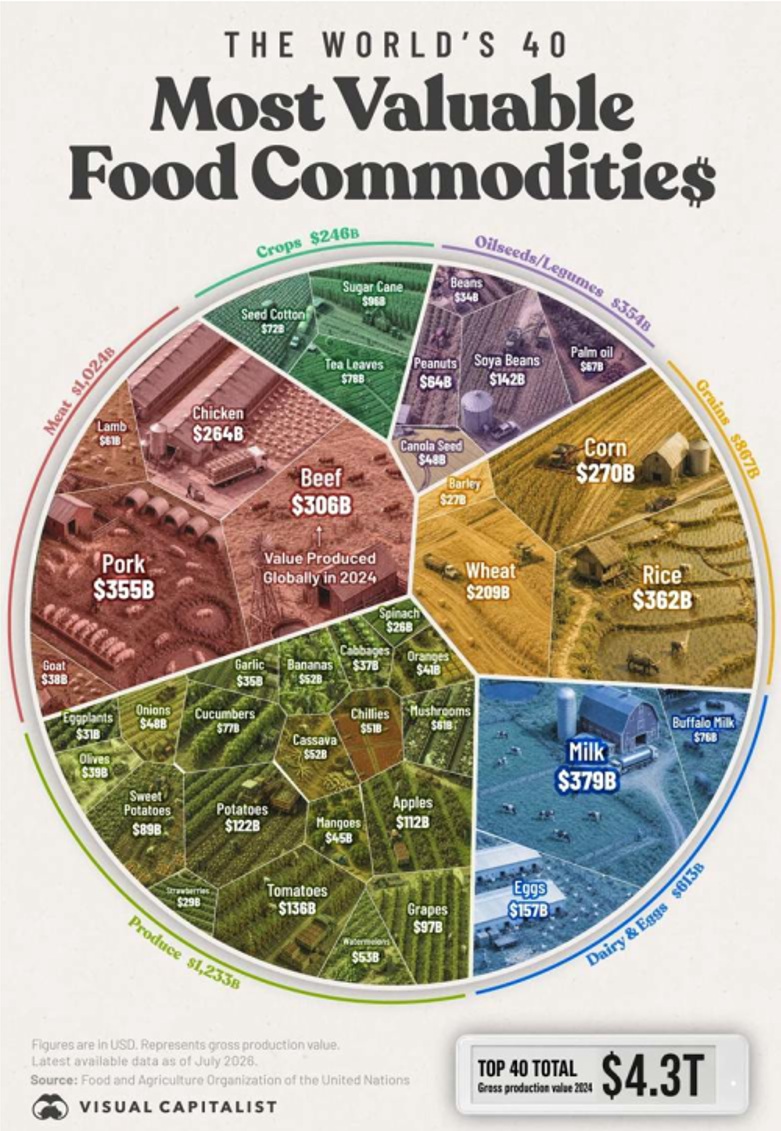 First, it tells you that two of the biggest agri markets in the world relate to milk and beef.
- Initially, one exults in this discovery. After all, Verghese Kurien with the blessings of former prime minister Lal Bahadur Shastri ushered in policies that made India the largest milk producer in the world (https://bhaskarr.substack.com/p/kuriens-amul-can-legends-be-erased). Milk is the most important agri contributor to the Indian economy.
- Second, the result of Kurien’s policies is that India had 10 crore families in the rural areas who could produce milk through the ownership of 1-3 cattle. That increased the rural incomes, and made the rural community enjoy better nutrition and better purchasing power.
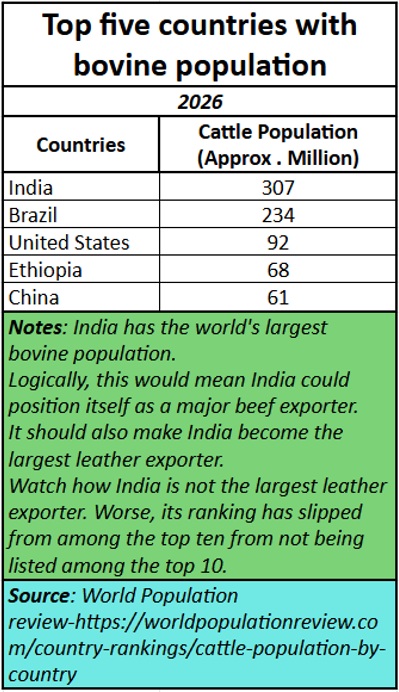
- Since India had the world’s largest bovine population, it stood to reason that India would automatically become the world’s largest beef exporter. In fact, for many years, India was invariably the largest or the second largest beef exporter globally.
- Going by the same logic it was inevitable that India ought to have become the world’s largest leather exporter.
The bubble bursts
But the elation turns to sadness once the grim reality of what India has done hits its citizens. How could any government have allowed this to happen?
Just look at the harsh reality.
- India does remain the largest producer of milk.
- India does have the largest bovine population.
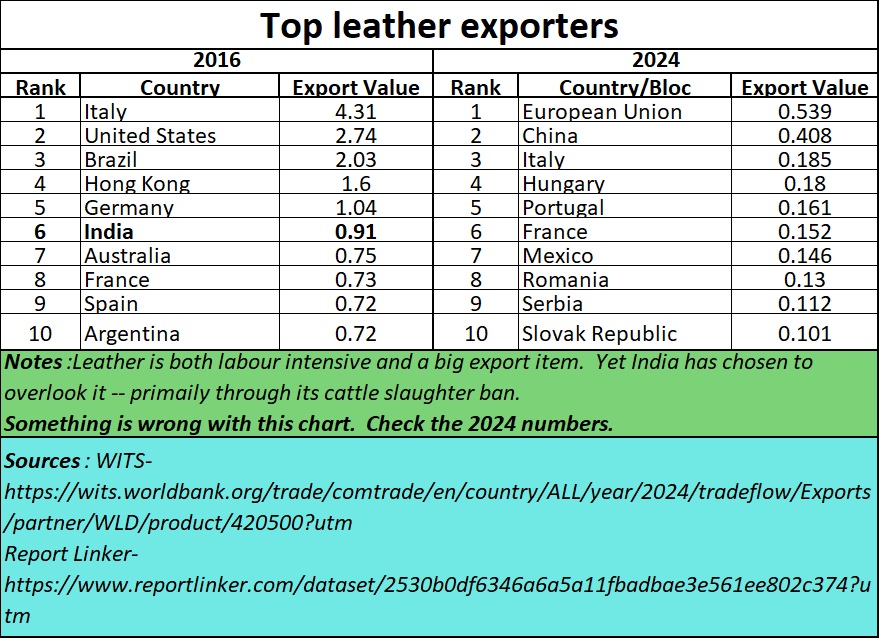 3. But India has seen seen a decline on the leather export front as well. Given the fact, that it has the largest bovine population, it did not manage to become the #1 leather exporter. What is worse, it has seen its export earnings dip between 2016 and 2024. Between 2016 and 2024, its leather exports had fallen from $0.91 bn to $0.87 bn.
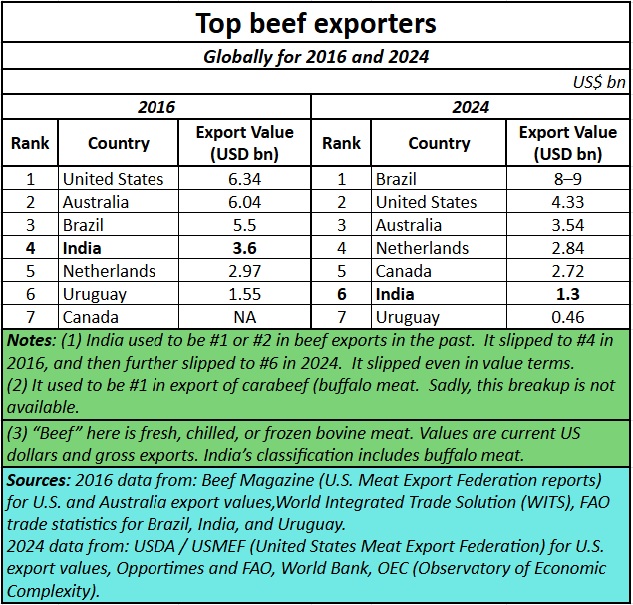
4. Ditto with beef exports. Gone were the days of being #1 and #2. It stood at #4 in 2016. But it kept on slipping. By 2024, its rank had fallen to #6. Even the revenues it garnered from exports fell sharply. In spite of having the largest bovine population, the cattle are allowed to become emaciated and even diseased. That is how the second rank holder in terms of cattle population, has trumped India in terms of beef exports.
 So, what happened?
The answer is obvious. Ideology became more important than economic vision. It allowed India’s core strengths to be trampled on.
As these columns have often explained in the past, the root cause is the introduction of the cattle slaughter laws, and the unleashing of frenzied gau rakshaks on to hapless transporters of beef. That most of the transporters were muslims could have been coincidental. But there is a lurking suspicion that the gau rakshaks targeted Muslim transporters of beef. The Hindu transporters were not really targeted. This stands to reason considering that the biggest exports of beef are Hindus, not Muslims.
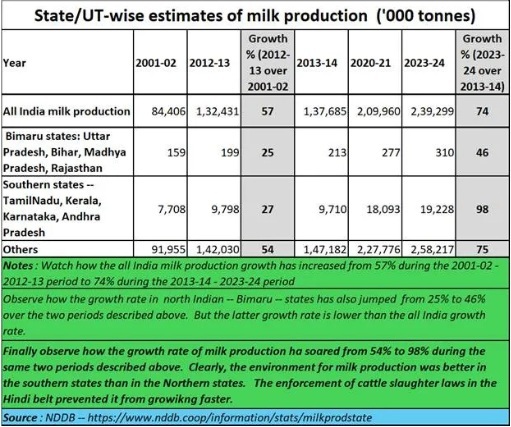
But intimidation, violence and social ostracism often drive away people who engage in the dairy business. That is why, the areas in which gau rakshaks were at the frenzied worst were the very areas in which milk production growth also slowed.
 Conclusion
In an ironic twist, the government may have coined the memorable phrase “Atmanirbhar Bharat” or self-reliant India. But the phrase sticks in the throat when you realise that it is the government itself, not an external hand, not “dimagi naxals” or intellectual Naxalites who have destroyed the very core of India’s strengths. Not a word about who destroyed India’s agri sector.
India had everything going for it. Then entered this myopic belief that stringent cow-slaughter laws should be introduced.
The result is poor beef and leather exports. Attempts to woo New Zealand may make India slip even in milk production (https://bhaskarr.substack.com/p/india-new-zealand-fta-will-it-destroy).
That has led to loss of employment (leather is a major employer, and forex earner), fall in export earnings, and poor rural consumption demand. That in turn has hurt industry and the economy.
Hence, next time you hear a minister speak about how global conditions have weakened India, just remember that this statement is not entirely true. The Indian government has grievously hurt India. Primarily through the agri sector.
Besides milk, beef and leather, India has hurt itself in two other sectors – sugarcane and grain.
But they are separate articles which shall be written in the coming weeks.
==========
Watch our latest podcast on the second part of how to make India vibrant once again. We focus on Real Estate and Agriculture. Watch the podcast at https://youtu.be/74fL6aeHG_w
=============
Finally, do view our News Behind the News:
– India’s debt: Stealing from the poor to fatten the rich
– India slips in gold production
– UPI: Even free services have a cost
– Loans grow, investment slow
#debt #Defaulter #ZeeNews #gold #China #upi #UIDAI #loan #borrowing #equity #FDI #fcnr
You can find this at https://www.youtube.com/live/kKjixZjUi3k?si=Hc84CvV5BOp4QhI-
================








COMMENTS