






















23 Feb 2026
Iran can teach India how not to do business through blackmail
By RN Bhaskar and Sakeena Bari Sayyed
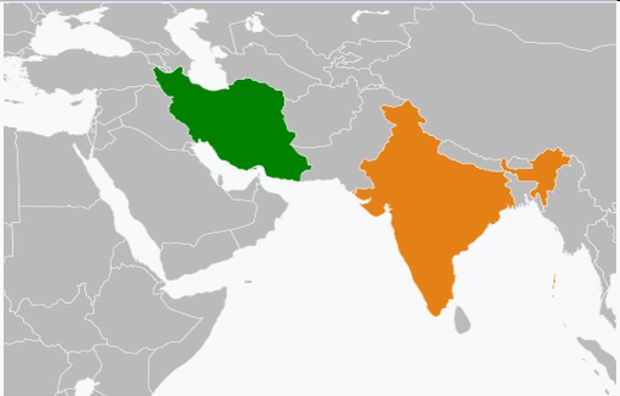
Image: Wikipedia
In early February 2026, the Indian coast guard intercepted three oil tankers (https://www.youtube.com/watch?v=KVYPRstOjGk). They were carrying oil. It was initially suspected that they were smuggling oil into India – because it is a profitable business on account of high taxes on oil within India. Within a few days, it was known that all the three ships belong to Iran carrying Iranian cargo. Effectively, they were allegedly violating the sanctions the US had imposed on Iran. The U.S. State Department continues to issue new sanctions under Executive Order 13846 and related authorities, all of which are unilateral U.S. measures, not UN Security Council actions (https://www.freepressjournal.in/world/tankers-sanctions-strategy-is-india-aligning-with-the-us-on-iran).
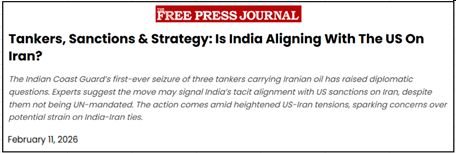 That single act of interception by the Indian coastguard left many observers bewildered. India had done something that no other Middle East country, not even Pakistan, had dared to do. So, was India trying to show to the US that it was more loyal than any other country? Was it indulging in doublespeak? It immediately raised questions about the seriousness with which India treats its friendship ties with Iran.
Mixed History
Iran and India have enjoyed excellent relations for centuries. However, when the Shah of Iran was overthrown in 1979. India refused to recognize the new government for some time (https://www.iasgyan.in/daily-current-affairs/india-iran-relations-9). But relations improved thereafter. They have survived harsh criticism from Iran about the way India was discriminating against Muslims (https://www.aljazeera.com/news/2024/9/17/india-hits-out-after-iranian-leader-criticises-treatment-of-muslims). Moreover, Iran allowed discussions of the progroms against Muslims in Gujarat in 2002 (https://www.carmah.berlin/people/ghassem-fachandi/).
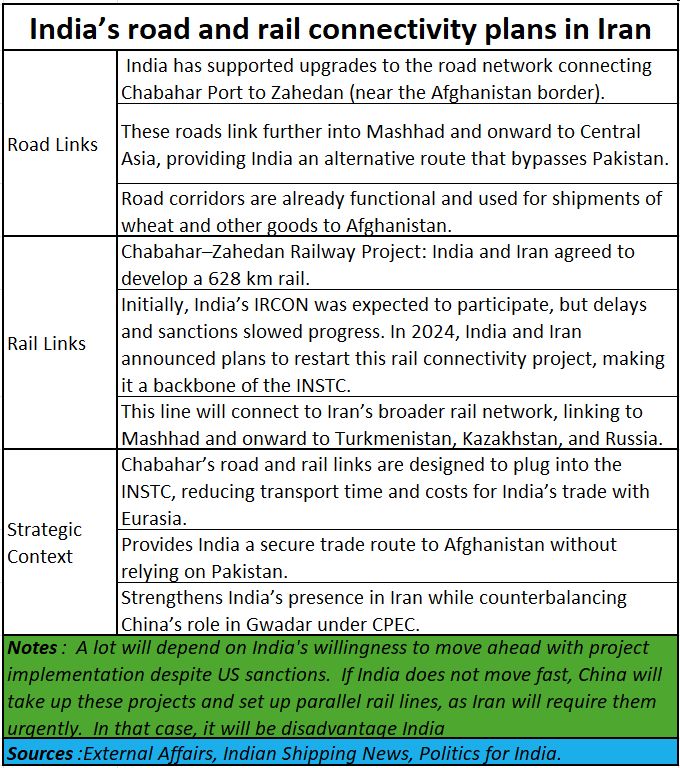
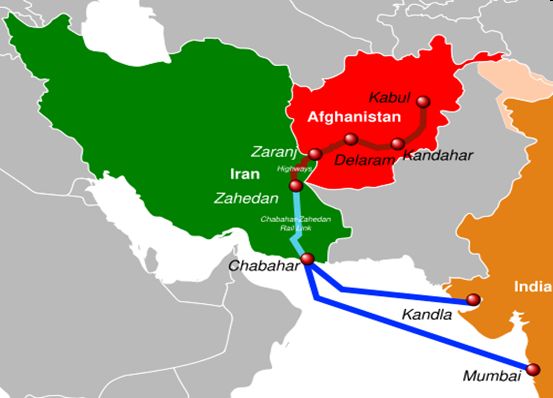
Why did the India-Iran relationship survive? One major cause is that India wants to hem in Pakistan by forging strong links with Iran which is a Shia country (Pakistan is Sunni). Various ways were sort to reinforce this relationship. For instance, India began importing Iranian oil and dry fruits during the reign of Shah Mohammed Pahlavi. In 2013, India also decided to help Iran to build the port of Chabahar as it would become the major trading port for all goods coming from and going to the landlocked Central Asian Republics. In fact, this is one of the biggest overseas construction projects India has taken up.
 India’s ambitions overseas
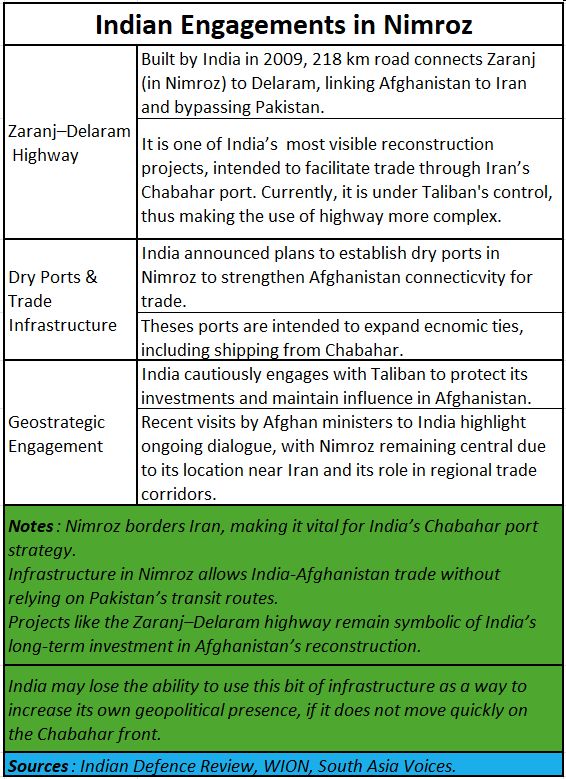
To achieve this end, India was only too willing to help build parts of a railway line and roadways from Chabahar to Afghanistan. This would have enabled India to extract and export minerals from an otherwise poverty-stricken Afghanistan. Moreover, by roping in Afghanistan along with Iran, India hoped to pinion Pakistan.
 Hinderances
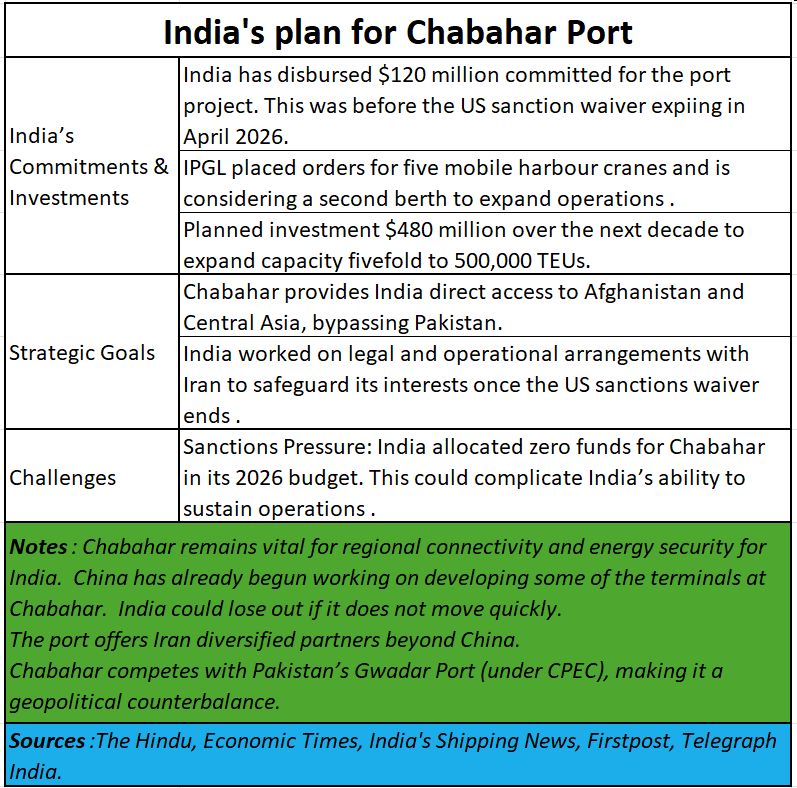
India’s plans looked good but the fly in the ointment has always been US sanctions against both Afghanistan and Iran. The threat of sanctions made India delay the implementation of the Chabahar port, the railway and road links. Chabahar is very important both for Iran and for India. Chabahar is actually two ports – Beheshti and Kalantari. Each port has five terminals. India began developing one of the two ports but did not proceed beyond developing three terminals.
 Pakistan’s reactions
Obviously, Pakistan is not too happy at India getting involved with the Chabahar port. It would now have to contend with more nuisance on that front. It already has to deal with rebels in Balochistan (Pakistan alleges that the rebels have been supported by India).
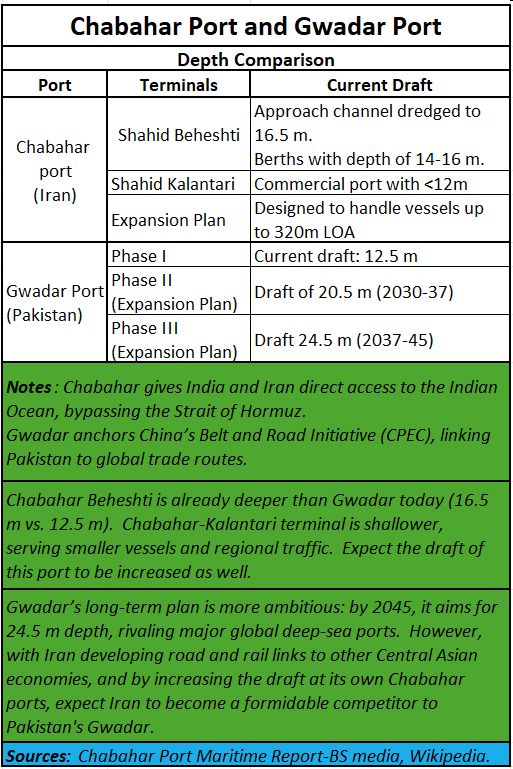 But Pakistan has put up a brave face saying that its own port Gwadar is a deep-sea-port. While both the Chabahar ports enjoy a draft at 12-14 metres, Gwadar is planning to increase the depth of Gwadar to 20 metres (with immense help from China). This is against 12.5 meters earlier. Moreover, Pakistan had the benefit of linking this port with the CPEC or the China Pakistan Economic Corridor (https://www.geopoliticalmonitor.com/background-pakistans-gwadar-port/).
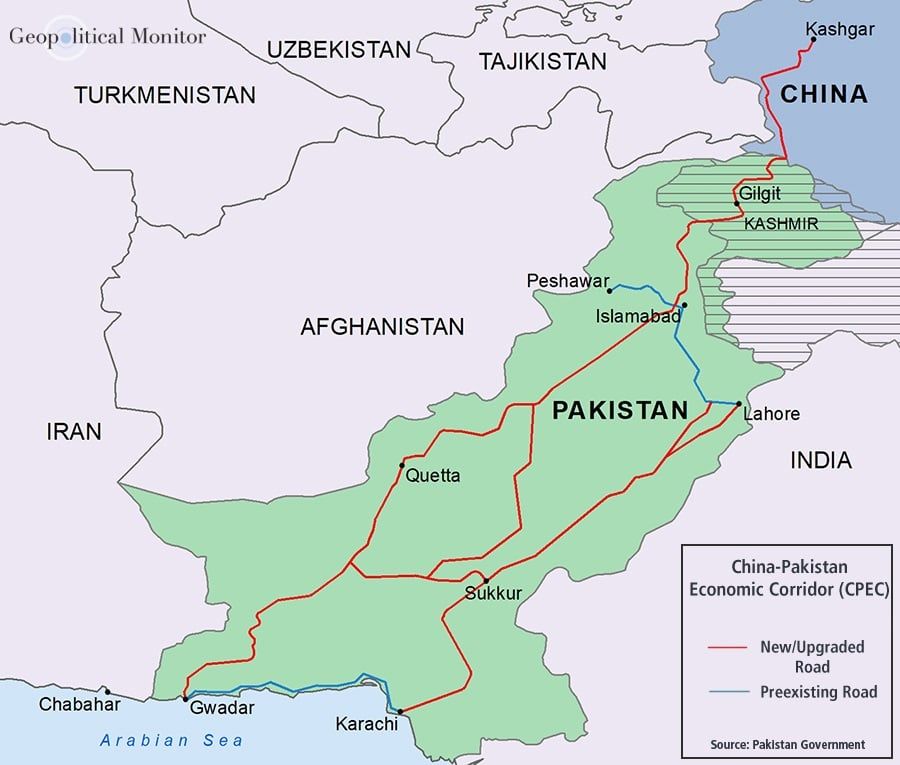 Pakistan hopes of making Gwadar a strategically significant port because of the CPEC. Till recently, even Russia was willing to link its roads to the Chabahar port. But given the current tie-ups that both Russia and China have signed with Iran, there are indications that Russia will soon begin using the Chabahar port. China’s recent announcement of a commitment of $400 billion to infrastructure development in Iran appears to be a major move in this direction.
 Equations change
Pakistan’s generals, always hungry for US dollars, have been harbouring plans for having better ties with America. China is not-to-happy about this. It will not be surprising, therefore, if Chabahar becomes plan B for China.
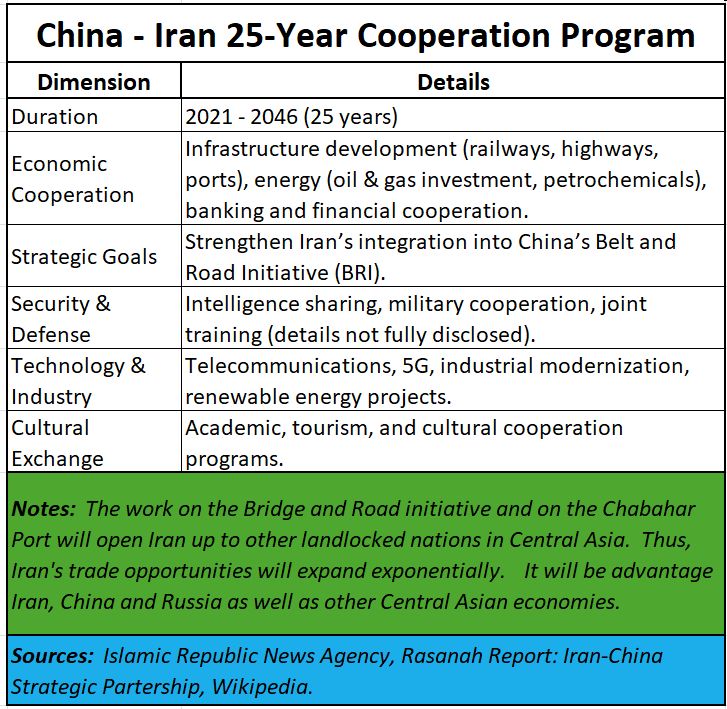
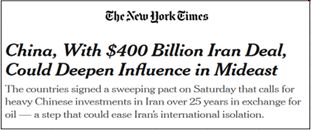 China’s commitment of $400 billion to Iran is to be spent on Iranian projects over a 25-year period. China may begin work on connecting the Chabahar and Gwadar ports (https://www.memri.org/reports/china-may-help-iran-and-pakistan-connect-chabahar-gwadar-ports-balochistan-jeopardizing-us). But if India does not step up its activity in Iran, there is no reason why Iran will not ask China to step into the groove. According to a DeepSeek reply, “The Beidou Baike encyclopedia entry presents a different perspective, claiming that China has already invested in the port’s infrastructure and that Chinese companies operate facilities there, including a石化工业城 (petrochemical industrial city) — https://baike.baidu.com/item/%E6%81%B0%E5%B7%B4%E5%93%88%E5%B0%94%E6%B8%AF/19737607
India moving towards irrelevance
China has become extremely important for Iran because of three reasons:
- Contrary to promises made by India about expeditiously building rail, road and port projects in Iran, India has succumbed to pressure from the US and had begun going slow on these projects.
- All through the time, when Iran was smarting under the sanctions imposed by the US, it was China which came forward and offered to buy oil from Iran. Iran felt hurt that a country it regarded as a friend could not help it out during such difficult times. On the contrary China has bailed out Iran through these years.
- China has been looking for a way to tap the resource rich landlocked countries in Central Asia – Afghanistan, Uzbekistan, Kazakhstan and Turkmenistan. India too harbours similar plans. China began favouring the Iran route to link all these countries – connecting Russia as well. That would make China’s BRI (Belt Road Initiative) that much more meaningful and economically relevant for all the countries in this region.
Unfortunately, India does not appear to have realised that by capitulating to the US (https://asiaconverge.com/2026/02/us-trade-agreement-india-capitulates/), it was losing opportunities not only in Iran but also in the Central Asian Republics.
The US-Israel-Iran war
In retrospect, it was the 12-day war in June 2025 (the truce was finally called by the US at Israel’s request because Iran’s missiles had begun pounding Israel with deadly precision). To ward off the combined attack from Israel and the US, Iran finally agreed to a strategic partnership with both Russia and China. India was caught napping.
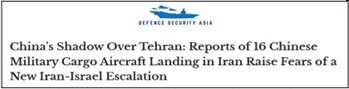 It was Russia and China that gave Iran the technology to disable the Starlink network in the recent US inspired uprising in Iran (https://asiaconverge.com/2026/01/iran-was-once-an-ugly-duckling/). Starlink was supposed to be impregnable. That claim was demolished. Moreover, immediately after the uprising – when Iran’s airspace was closed – Chinese military aircraft brought in critical equipment to bolster Iran’s defences.
Today, both China and Russia have publicly stated that they will support Iran (https://www.reuters.com/world/china/china-russia-join-iran-rejecting-european-move-restore-sanctions-tehran-2025-09-01/). This support now extends to defence as well. India is missing once again in this ongoing development.
For both Russia and China, Iran holds immense geopolitical strategic significance. It offers access to the Arabian sea and hence, the oil rich gulf states. Iran is the only country that can unlock the wealth and hence the prosperity of the Central Asian Republics. Pakistan’s relationship with Afghanistan, another key country, are not too good. The 12-day war of 2025 ended up making Iran, China and Russia stronger. That war has left both Israel and the US weaker in terms of geopolitical relevance and significance.
 Predictions belied
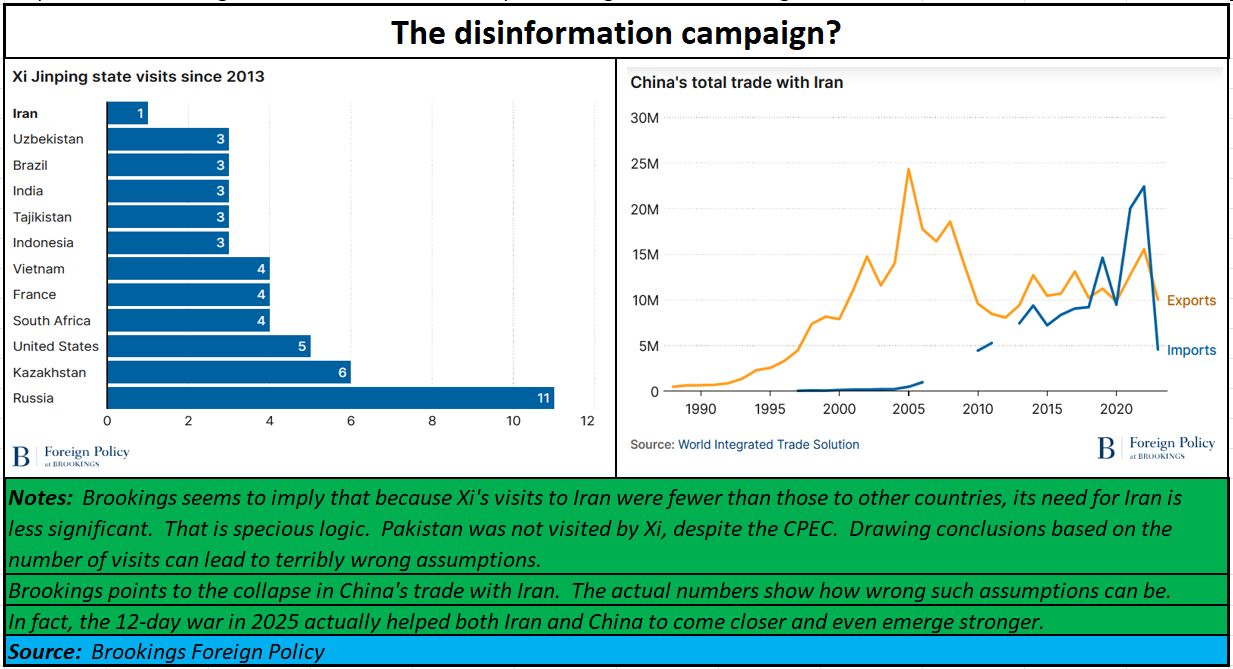
In 2013, the prestigious Brooking Institute concluded that China would not be a key player for Iran. It gave two key reasons for arriving at this assumption:
- China’s president Xi Jinping has shown little interest in Iran. He had visited that country only once. But Brookings did not realize that countries become relevant because of other reasons as well. For instance, Pakistan has the CPEC connecting China to the Arabian Sea though the Gwadar port. But no visits have been shown to Pakistan. Compare that with India, which Xi visited three times. While India-China trade volumes have grown, their relationship is not as enduring as those with Pakistan and Iran.
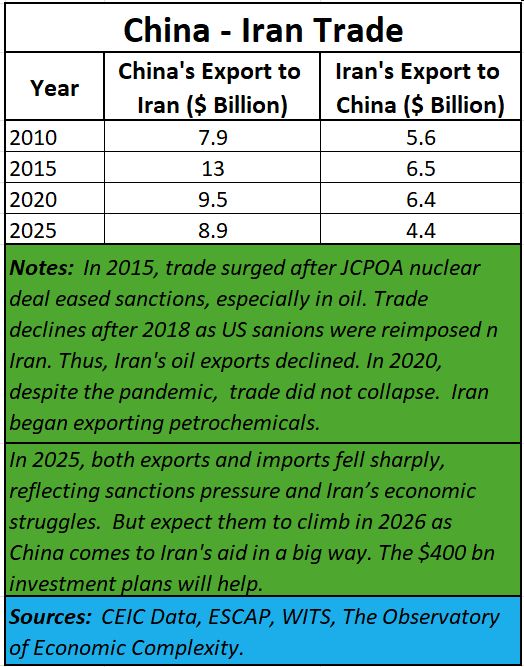 2. Similarly, Brookings points to the drop in trade between Iran and China. That too is misleading as China-Iran trade continues to grow. On the contrary, trade volumes between India and Iran have shrivelled.
 Implications
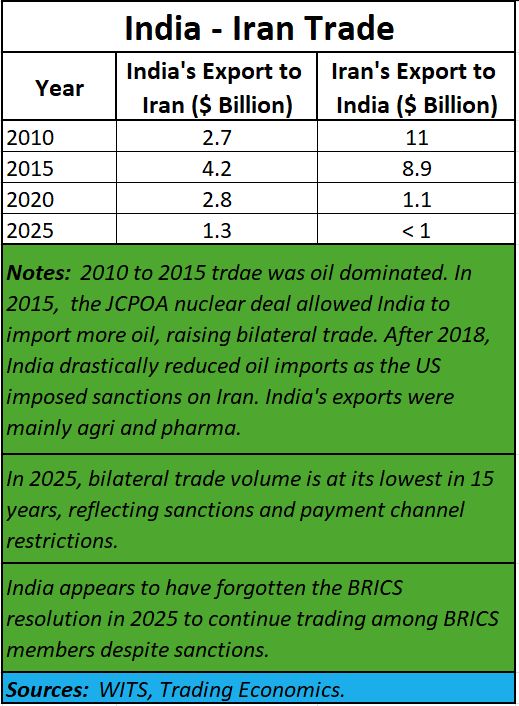
- By constantly submitting to US pressures, India has weakened its influence over Iran.
- India’s marginalisation comes at a time when Iran could become one of the most vibrant economies in the Middle East and the Central Asian region.
- It is true that Iran is struggling against sanctions and has been debilitated economically by the US. But the $400 billion injection by China will open trade possibilities among all the Central Asian Republics. It will also make both China and Russia that much stronger. Iran does not have to pay in hard foreign currency for developing this infrastructure as over three-fourths of the oil it produces goes to China. Thus, China finances its infrastructure without Iran suffering any debt burden.
- Currently, Russia, China, Pakistan and Iran have begun using the far superior GPS technology from China – BeiDou Navigation Satellite System (https://www.bgr.com/2093464/china-advanced-alternative-gps/). India has been left out with a far inferior and hacker prone US system. The Chinese system is immune against Western hacking and far more secure and effective than the US system.
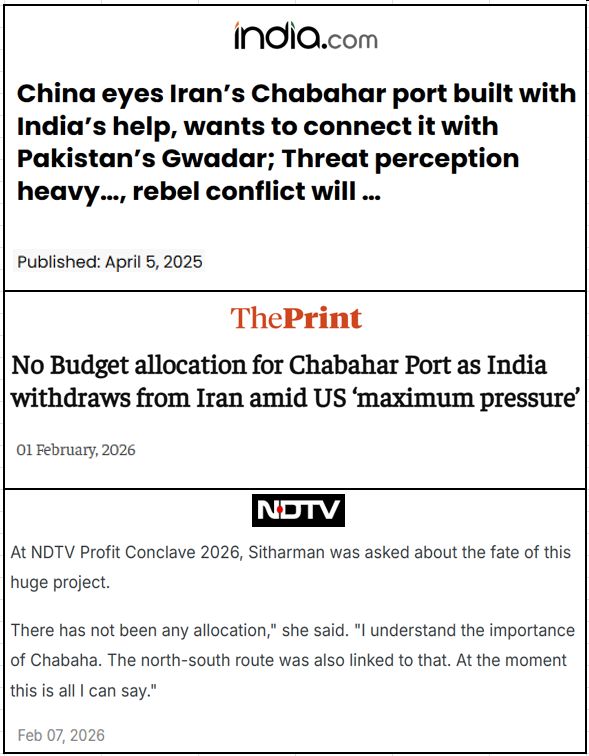
- India’s external affairs ministry continues to maintain that it is committed to the Chabahar project (timeline 6.53 from https://www.youtube.com/watch?v=oTbAjrOFoQ0&t=63s) . But the latest budget has no financial provision for this.
- India intercepted three Iranian oil tankers ostensibly because they have been sanctioned by the US. India ignored or forgot a 2025 BRICS resolution challenging such sanctions and calling them illegal.
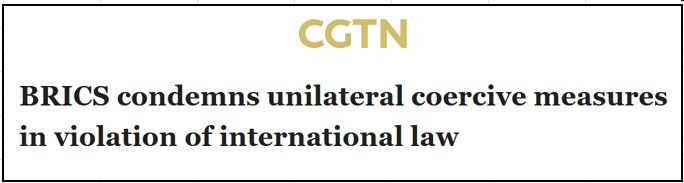 By doing this, India has further alienated itself from Iran on the one hand and even the BRICS membership on the other. It is worth remembering that India was a sole dissenter at the BRICS Kazan Conference where an alternative to the Dollar was proposed. If India does work with the majority in BRICS, it won’t be long before BRICS becomes an acronym for Brazil, Russia, Iran, China and South Africa.
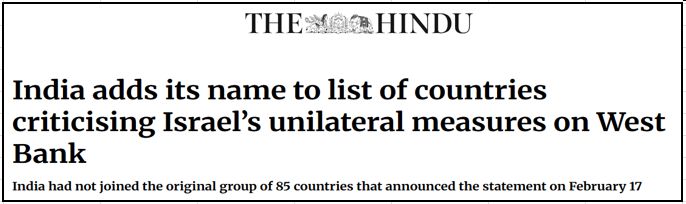
- However, there are some actions that India has taken that allows it a fig leaf of protection. It refused to support a US lead resolution at the UNSC condemning Iran’s handling of the riots this year (https://thewire.in/diplomacy/india-votes-against-unhrc-resolution-condemning-iran-crackdown). Similarly, after dragging its feet initially, India protested against the illegal occupation of West Bank/Gaza.
 War clouds
There is still the possibility that the US will attack Iran anytime between now and August-September, just before the mid-term polls, if the US believes that there is a chance of military gains. Israel has been egging on the US, using the AIPAC’s formidable financial clout to push the US president. Trump needs AIPAC’s money for the mid-term elections. He may not be able to resist the lure of this money. Isreal appears to hold the keys. But such plans could be extremely destructive, primarily for Israel which will cease to exist may be even Jordan (it is the only Arab state to offer the US military a base to operate from). In fact, unlike the 12-day war, Iran has refused to show any restraint this time (see timeline 6:39 for two minutes at https://www.youtube.com/watch?v=T21RWeiArmc).
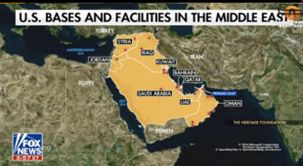 Iran’s targets will include every oil field in the Middle East – most of them with US equity interests. The US will certainly lose some battleships and ground staff running into tens of thousands. The US will see a surge in the arrival of body bags. That will sink Trump and America. Nuclear weapons may be used, and Iran may get scarred badly. But Israel and Jordan may cease to exist. If the war escalates, Saudi Arabia may invoke the Islamic NATO (https://www.firstpost.com/explainers/islamic-nato-turkey-pakistan-saudi-arabia-defence-alliance-13968489.html), and gain access to nuclear bombs from Pakistan. US will fail in destroying Iran completely. The real winners once again will be Russia and China. Both will emerge stronger post this war.
It is therefore sad to see India wagging its tail before the US and not committing itself to purchasing some of the world’s most sophisticated arms from Russia. Instead, this year, India has committed itself to arms purchases from USA and France. Both countries don’t even offer full technology transfer the way Russia does. India may find itself at the wrong end of the stick.
Australia’s analysis
Some of the most prescient remarks have come from Australia, which point to how any conflict in the Middle East could adversely affect America’s ability to project strength in the Asia Pacific region (https://www.internationalaffairs.org.au/australianoutlook/if-iran-falls-or-fractures-what-it-means-for-australia/#:~:text=If%20Iran%20Falls%20-%20or%20Fractures:%20What,Australia%20-%20Australian%20Institute%20of%20International%20Affairs.). China will certainly emerge stronger. So will Russia and BRICS – with or without India.
 The US will be badly scarred, and its financial mess will worsen. The carnage in the Middle East will create at least three million refugees with the number going up to ten million. That will alarm all neighbouring countries. With no Israel and Jordan, the Middle East will look unrecognizable. Burning oil fields could mean the death of the entire planet.
Hence, it is sad to see Trump refusing to rule out the possibility of military attack. It is ironic that India too should be willing to look to Israel for guidance and support. It needs to be underscored that Israel has been considered guilty of war crimes. Netanyahu has been tagged as a war criminal.
 One explanation, from sources who prefer anonymity, is that India is trying use Israel to curb Trump’s damning disclosures of Epstein papers which could prove terribly embarrassing and ruinous for India’s policy makers? Even though mainstream media has not dwelt on the cataclysmic consequences of the Epstein disclosure, social media has been quite vocal about them. Take a sampling,
- Ravish Kumar https://youtu.be/izCqqjmXx48?si=cO14x57aJy7hH2S8
- Dhruv Rathee (Timeline 4.20) https://youtu.be/VIDh6X3xPfI?si=nEdMzNo7XzsYKKo3
- Akash Banerjee https://youtu.be/4u90WcDPfB4?si=BPoVR6Pk9JLFm0aA
Conclusion
India and Iran have much to offer each other. Unfortunately, a terrified Indian government, unwilling to cross swords with the US, is jettisoning this country’s relevance to a post-US world. Without Iran, it will lose access to the Central Asia Republics. India has even jettisoned India’s farmers. It will thus be left poorer, weaker and increasingly irrelevant if the present drift continues.
===========
My latest podcast is about an entrepreneur – Murtaza Bhopalwala. Do watch it. It marks the start of a new series, promoting entrepreneurs. We believe that India’s salvation lies in the encouragement of more entrepreneurs who create jobs, and not people who want the government to give them jobs. It also points to the difficulties promoters face when dealing with government policies. You can find it at https://youtu.be/5kQX-uI1xGo/
============================
And do watch our weekly “News Behind the News” podcasts, streamed ‘live’ every Saturday morning, at 8:15 am IST. We have covered FTA, corruption and the Indian economy this week. The latest BKBB can be found at https://www.youtube.com/live/mKQjrIISqNQ?si=GTShPwyvp9QDBDXz
============================







COMMENTS