




























12 Oct 2026
India’s affordable housing – dehumanising
By RN Bhaskar and Sakeena Bari Sayyed
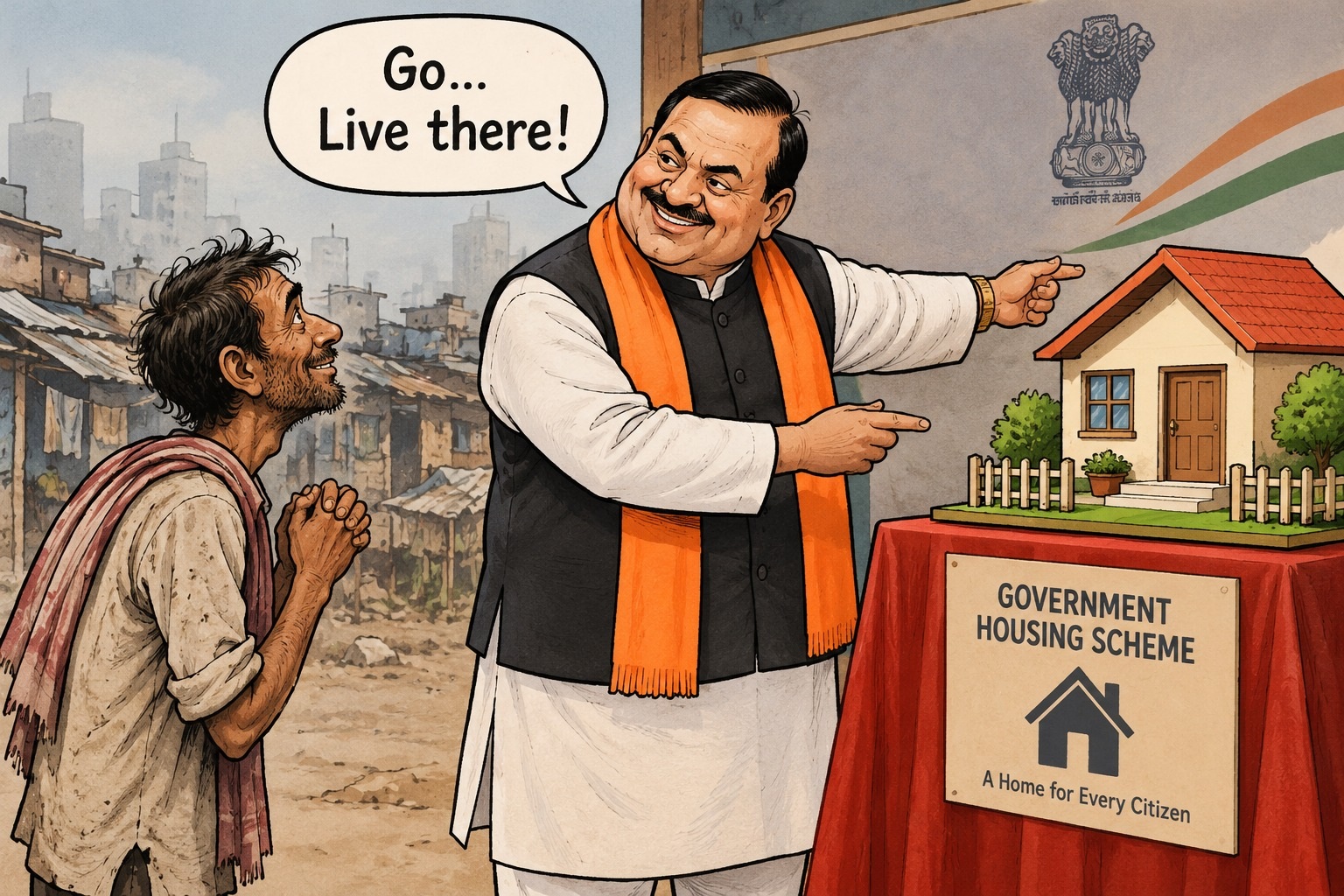
Image: Chatgpt
While food may be essential for survival, clothing and housing are the first crucial steps towards treating citizens as humans.
This fact hit us hard when we began considering the approach to housing that Iran adopted almost three decades ago, as part of its affordable housing scheme. Under the Meherbani scheme, Iran began building millions of houses for its youth (https://asiaconverge.com/2015/11/housing-lessons-from-iran/). Each house had over 900 sq. ft of liveable area. Houses for richer folk were even larger.
India has a policy of offering poor people, even slum-dwellers, just 325-400 sq. ft of dwelling. Its affordable homes are like matchboxes. It is only when one comes to higher income groups that you see flats of over 1,000 square feet.
Pressure on land is an excuse
Government officials claim that this is because of the huge pressure on land. We decided to check this out. It wasn’t easy because the government does not provide all data in just one place. Gradually, we began realising that one way of making people eternally grateful to the government was by making them accept small housing.
The insensitivity of the government is more discernible when one looks at people travelling in trains. It is there that one witnesses people herded like cattle into train compartments. Many fall off the train, and die. The irony is that the government has norms for transportation of animals. It specified how much space must be allocated to the transportation of cattle, camels and goats.
But there is no norm for human beings. The assumption is that they can be herded together, and treated worse than cattle. They can be forced to get into already cramped compartments. No official has ever been booked for this oversight or callousness.
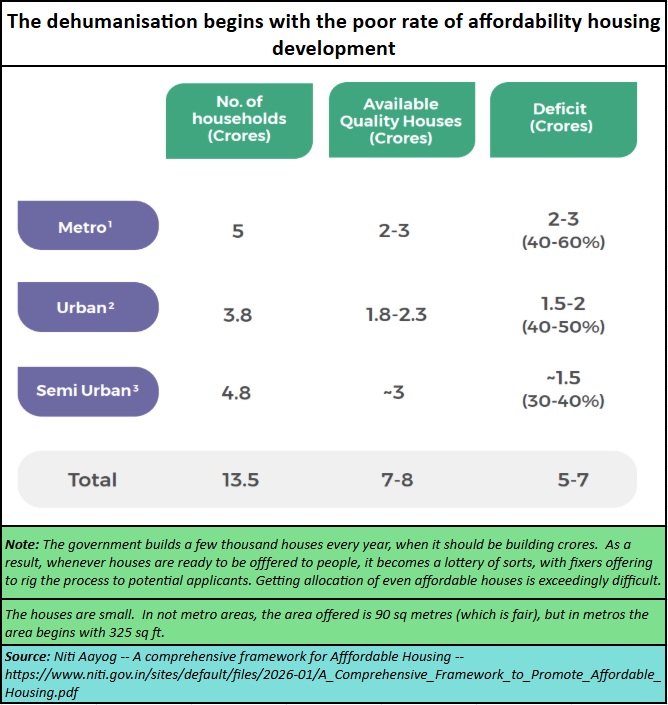 Dehumanisation through housing
The dehumanisation of humans is best witnessed in India’s housing policy. Just look around cities. Most houses in Metros offer small houses – 325 to 350 sq. ft large – as part of slum redevelopment programmes.
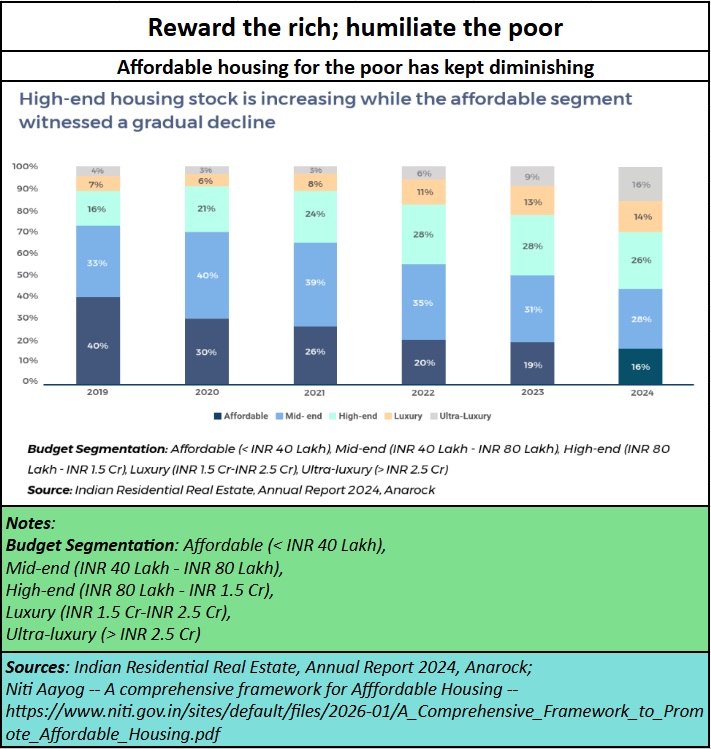 But this is only part of the problem. Look at the number of affordable homes constructed. The number falls for flats meant for the poor. But they increase in respect of flats for the rich.
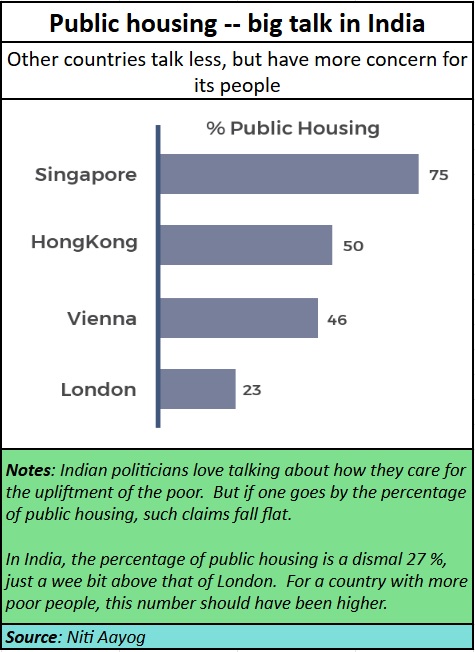 The hypocrisy is borne out by yet another number. Other countries focus on public housing much more than India does. India promotes a cynical philosophy – privatisation of profits and socialisation of poverty. As the subsequent tables will show, India has learnt how to play politics through selective grant of doles and freebies. At times, this also includes housing.
The irony this time is that the report from where this table was taken does not mention an equivalent figure for India. We could get the figure of “the percentage of public housing is a dismal 27 %” has been taken from another Niti Aayog report (https://www.niti.gov.in/sites/default/files/2026-01/A_Comprehensive_Framework_to_Promote_Affordable_Housing.pdf). One does not know for sure whether this figure is comparable with those found under Annexure 2 page 48 (https://www.niti.gov.in/sites/default/files/2026-01/A_Comprehensive_Framework_to_Promote_Affordable_Housing.pdf). ,
 The global experience
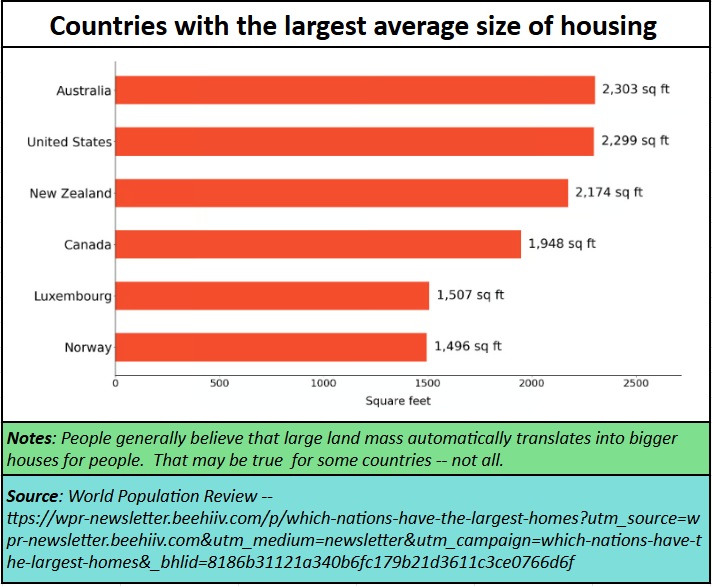
A good indicator of how people live can be seen from the average size of houses. As can be expected, countries with a large land mass do tend to have larger houses. This is especially true of Australia, USA and Canada. Then there are countries with smaller populations – New Zealand, Luxembourg and Norway. They too have large houses on average.
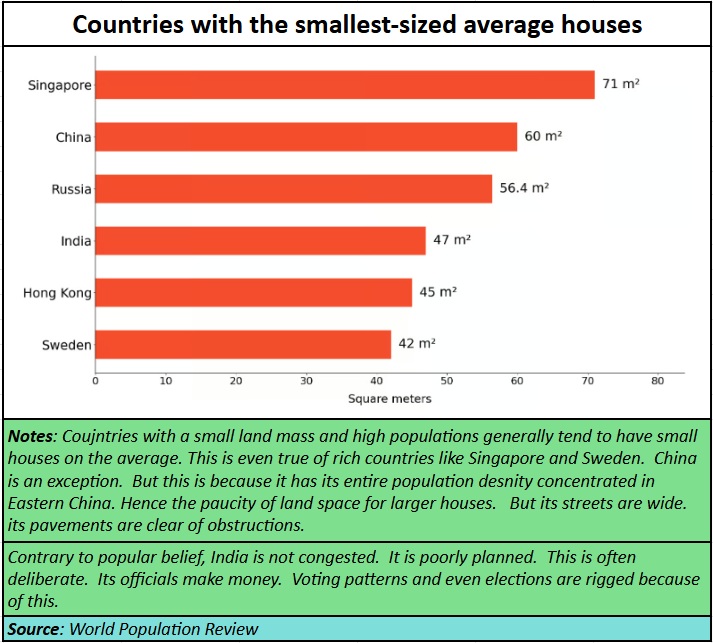 The picture becomes clearer when one looks at the list of countries with the smallest average housing. This list has at least two countries with large land areas – Russia and China. But China, it must be noted, has much of its population densely populating the eastern coast. Hence even though the country is large, land availability on the eastern coast is quite strained.
In Russia, the situation is quite different. It was under the socialist regime which was always strapped for funds. Hence most houses are small – often in government-owned buildings.
In India, the situation ought to be different. It has the land – never mind what policymakers say. It has a dispersed population as well. So why could it not focus on larger houses?
That is something that should become clear from the next two charts.
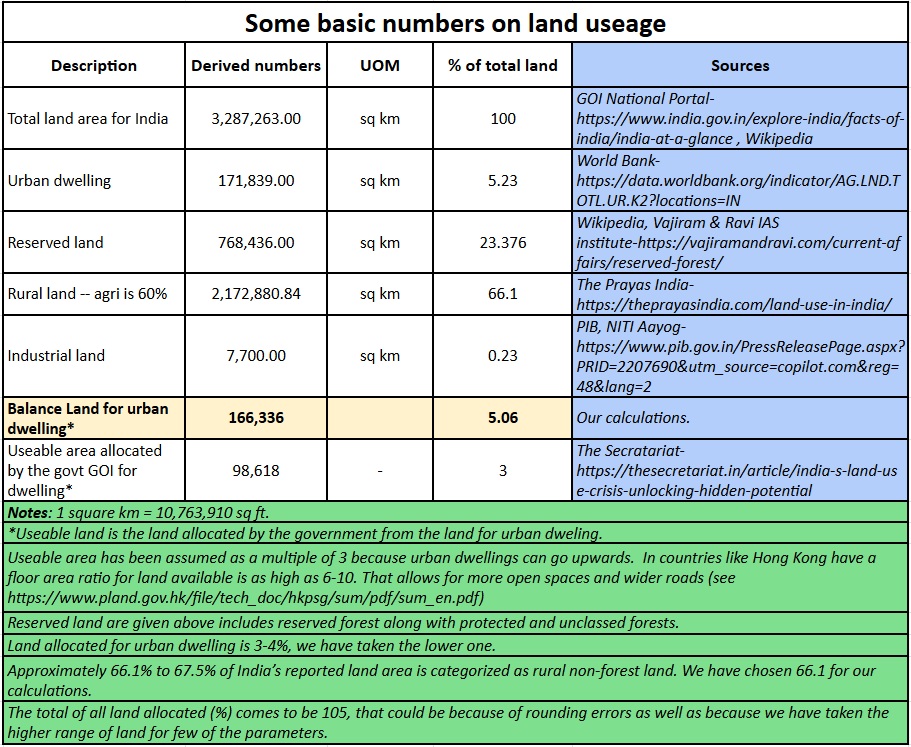 India has more land, but less generosity.
First, it is time to discard the recurrent myth that India has a huge population and hence less land per capita. That is not really true. The truth is that the government does not allow for policies that could pave the way for larger houses.
There are two reasons for this. First, the government’s own appetite for funds and taxes (even graft). These are easy to collect when it comes to wealthier populations. That is why – as another chart above shows – India has tried to reduce the number of homes built for poor people and has focussed more on homes for the wealthy.
There is a second reason. It wants to use land (including housing) to distort voting patterns. The present agitation against “vote chori” (roughly translated as “theft of votes”) is only the most visible part of the vote chori. The tinkering with demography can be traced to the 1970s. Unfortunately, neither the courts, nor even the Election Commission, has woken up to this sad, even despicable, practice (see https://www.youtube.com/watch?v=OSu5jzFlF8A).
Vote chori
The real reason for houses to remain small in India is because the government does three things.
First, it encourages the creation of slums. No, slums do not grow because of the migration of people looking for jobs. They get created because they are incentivised to create slums. Why? Read on.
Let us assume that you are a popular leader in your constituency. That is why you have been winning elections term after term. If a politician wants to win the elections in your constituency, he has two choices. First is to work harder for your constituency and become more relevant for the people living there. But that is hard work and takes decades. So, he opts for the second alternative. He fiddles with the demography.
How? By enticing five times the number of people to migrate to your constituency by encouraging them to become slumdwellers. He will protect them. He will ensure that they are not evicted. The government and the election commission have also played their part. They have allowed voting from anywhere, not strictly from the place where they were registered. And they have not insisted on proof of residence in a legitimate dwelling. This was further compounded through bogus Aadhar cards which led to more election cards. It then led to the introduction of the SIR (Special Intensive Revision) and Form 7 which allowed for deletion of names from the electoral rolls. The way the Election Commission has permitted all this is frightening and worrisome
Overnight, you get marginalised. And the next elections will be won by the politician, with the backing of the slumdwellers.
There is another reason why slums become attractive. They allow for more graft by taking from the exchequer ten times more subsidies that would normally be possible (https://www.youtube.com/shorts/8ulv8jwGrwA). That is what leads to cities becoming unliveable (https://bhaskarr.substack.com/p/the-inevitable-decay-of-indian-cities).
There is a third reason too. By passing suitable legislation, he gets the slum dwellers resettled in concrete houses (350 square feet) in the limited land available in the same constituency. This is called redevelopment in situ – or redevelopment in the same place where the slum existed. This way his vote bank remains intact. The politician also has the opportunity of working out a deal with the real estate developer for the new houses. And he works out a way to sell some of the redeveloped houses on the black-market (because there is always a shortage of houses in India).
Thus, houses remain small (slums account for 50% of Mumbai’s population). The cities become unliveable. And the real estate developer mafia ensures that school playgrounds and public spaces also get usurped.
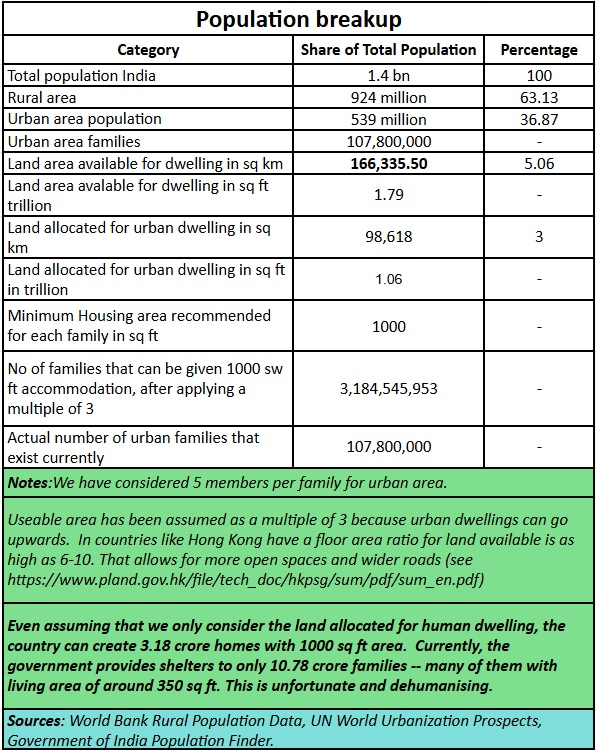 Enough land for 30 times more urban families
Land available for urban housing is a lot more abundant than people think. It has just not been made available.
Moreover, even the land that is made available can accommodate many more families – enough for the next several generations – if a FAR or FSI of 3 is made applicable. That number is lower than 6 or 10 in neighbouring countries. It is then that you realise that there is enough land for wider roads, good pavements, playgrounds for children and parks for the population.
As mentioned above, on account of these malpractices, India’s cities become unliveable (https://www.youtube.com/shorts/8ulv8jwGrwA0). That is how the government promotes very small houses. And that is why the government does not release enough houses for affordable homes. Nor does it build enough affordable homes. There is nothing like a shortage to allow making money on the black market.
Thus, the government has deliberately created policies that create the right conditions for small houses, even a shortage of houses, theft of subsidies, collusion with the real estate developers, and conditions for graft from slum dwellers, unlicensed hawkers and illegal structures on footpaths.
Sadly, the courts have not yet woken up to this reality.
================
Do watch our latest podcast. It is on Saudi Arabia. It is on how this oil rich country could be in big trouble. And how Saudi Arabia may become plain Arabia once again. You can find it at https://youtu.be/3iA-GA7ehiU
———————
Finally, do not forget our News behind the News
- After Iran and Mizoram, Starlink could become a bad name in India too
- Trump tries bullying India through H1B Visas
- El Nino could cause problems for food security, farmers and economy
- Govt finally compelled to humanise GST
You will find it at https://www.youtube.com/live/-BWt22dayxg?si=N3bYNmPmQnzOE1ZS
=============









COMMENTS