


















MARKET PERSPECTIVE
By J Mulraj
May 16-22, 2026
Influence Shorter and Longer Term Vision
In the early 90’s both Japan and Germany were rising economically, posing a future challenge to American hegemony. They followed the system of stakeholder capitalism, under which the interests of all stakeholders (employees, customers, suppliers, investors were looked after. In order to counter this, the US promoted shareholder capitalism, which considers the interest of investors as primacy and those of other stakeholders as subordinate. It worked, inasmuch as it helped American companies and it’s economy, to retain dominance, even as the Japanese economy stagnated for a decade.
All systems have advantages and disadvantages. Whether it be the form of capitalism followed or whether it be a democracy or an autocracy.
Shareholder capitalism, by focusing primarily on returns to shareholders, led to excessive short termism. Institutional shareholders, like mutual funds, owned large chunks of corporate shareholding in their hands, giving them the power to sway management decisions, and pressuring them to give shareholders more dividends/stock splits even at the expense of deferring capex for the long term.
A classic example is the fate of the vaunted Bell Labs, a division of the then telecom giant AT&T. It was the font of innovation, unhindered by shareholder pressure for quarterly performance. However, the US Supreme Ccourt split AT&T into 7 Baby Bells, in order to foster competition, and hived off Bell Labs as a separate listed entity called Lucent Technologies. Under shareholder pressure for improved quarterly performance, Lucent provided better results for 14 quarters by, essentially, cutting capex on promising discoveries. It had, ultimately, to be sold off to Alcatel.
Among things considered to be efficient allocation of capital, under shareholder capitalism, was ‘outsourcing of production’ to other, cheaper, destinations and demanding ‘just in time delivery’ to cut stocking costs. These were later shown to be weaknesses. Global supply chains failed to deliver eg in March 2021 when a container ship, Ever Given ran aground and blocked the Suez Canal for a week. It caused a major supply chain disruption, high prices, and a slowdown. The Ever Given is never forgiven.
China is an autocracy where the output is often driven by diktat. The risk in such a system is the absence of a corrective feedback loop for a failing, but powerful, leader. For example in failing to check the absurd overbuilding by companies like Evergrande. Democracies have elections and incumbent leaders are often removed by a disgruntled electorate.
Yet, Chinese leadership had long term vision right in industries such as solar, electric vehicles and in mining and refining of rare earth minerals, which Western countries didn’t promote as these projects didn’t meet ESG norms. In EVs the only significant competitor to China is Tesla, thanks to the grit and genius of founder Elon Musk. Biden, in fact, had, stupidly, not extended Tesla a meet to discuss EVs because Tesla was not unionised. China also successfully concentrated on industries such as steel and cement, (building dominant capacities in both), high speed rail, ship building and others. Surplus capacity, with surplus profits from exports, were deployed in it’s Belt and Road programme, building global influence.
Western democracies did get things right when the system pursued advanced semiconductors, computer infrastructure, data processing and, now, space and AI (artificial intelligence). America has also developed awesome military capabilities, and, with it, a taste for wars, rather like a man eating tiger that has first tasted human blood and now can’t stop wanting more. And, with wasteful spending on futile wars, USA has built a burden of unplayable debt.
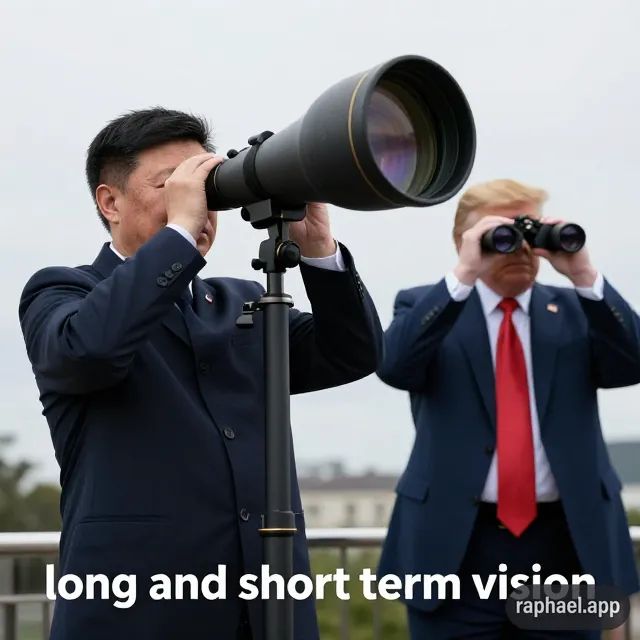
The recent summit meeting of Donald Trump (alongwith leading American business leaders) and Xi Jinping, revealed US these vulnerabilities. Trump’s main purpose was to seek Xi’s help in getting Iran to forswear it’s nuclear ambitions and to remove its stranglehold on the Strait of Hormuz. A fifth of global oil demand (which is 102-3 million barrels per day) passes through the Strait. Without free passage in the Strait the world is staring at high oil prices, leading to a slowdown/recession, plus a shortage of fertiliser trade will impact agri/grain output and lead to riots or famine.
Xi, of course, wants control over Taiwan, in return. He, too, has a stranglehold over supply of rare earth minerals. Amongst various uses for these is weapons manufacture and electronic warfare; so other countries are constrained to meekly accept it. The dominance of China in this sector can be seen in this chart.
This is where the short and long term vision is revealed; the US was too busy chasing short term profits, as demanded by their institutional shareholders, to invest in the dirty mining and refining of rare earths, and gain a long term edge.
The BSE Sensex closed the week at 75415, for a weekly gain of 178 points.
The Indian Government recently hiked import duty on gold and silver from 6% to 15%. The intention is to curb Indian citizens’ desire to hold bullion as a hedge against a debasement of currency and against inflation. The Indian ₹ seems to be sinking faster than the Titanic, and is now around ₹96/$, an 11% drop over a year. Duty hikes have been tried in the past and haven’t reduced the demand for gold but have increased the smuggling of it.
Once a smuggling network is established, the pipeline is used for other, worse, activities. The smuggling of weapons, of terrorists, of illicit drugs and others. But policy makers never learn past lessons.
Australia, too, has recently raised tax on cigarettes to 60%!. Smuggled cigarettes meet most of the demand now.
Perhaps political leaders should be compelled to have memory chips imbedded in them, immediately after oath taking.
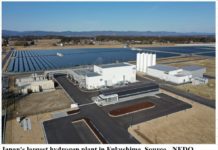
The good news for India is the recent breakthrough in a Prototype Fast Breeder Reactor using thorium, a mineral in which India has the largest reserves in the world. In the third phase of a Plan developed decades ago by renowned scientist Homi Bhabha, this paves the way for nuclear power using thorium, which will be cheap, reliable, safe and enough for a very long time. It will obviate the need for imported oil, will bring down/eliminate the current account deficit and strengthen the ₹.
The bad news is that this will be commercially viable only in 2050-2060. To stanch the slide before that, the Government needs to crack down on corruption, and the whitewashing laundry for bribe money using the benefit of zero tax on agricultural income.
India’s tax authority, CBDT, is cracking down on those who declared large, tax free, agricultural income without holding agri land. It’s high time it did this, based on common sense. This column has been advocating it for decades. Why has it taken decades for CBDT to reach an easy conclusion?
Let us see how many politicians/bureaucrats/
The Indian stock market is being held up by the retail investor, who has committed to a monthly inflow under a systematic investment plan. PM Narendra Modi has, along with several economists, warned of a troubled year ahead. The El Niño effect will hurt agricultural production, as will fertiliser shortage due to Strait of Hormuz.
The Strait needs to be reopened quickly else a global recession will occur. Diplomacy seems to have failed. It seems, sadly, that military operations will resume. Advice lightening up on shares. And, switching off the fan before something smelly hits it!
———- ——————
Comments may be sent to: jmulraj@asiaconverge.com











COMMENTS