












MARKET PERSPECTIVE
By J Mulraj
May 30- Jun 5, 2026
A Brave New World
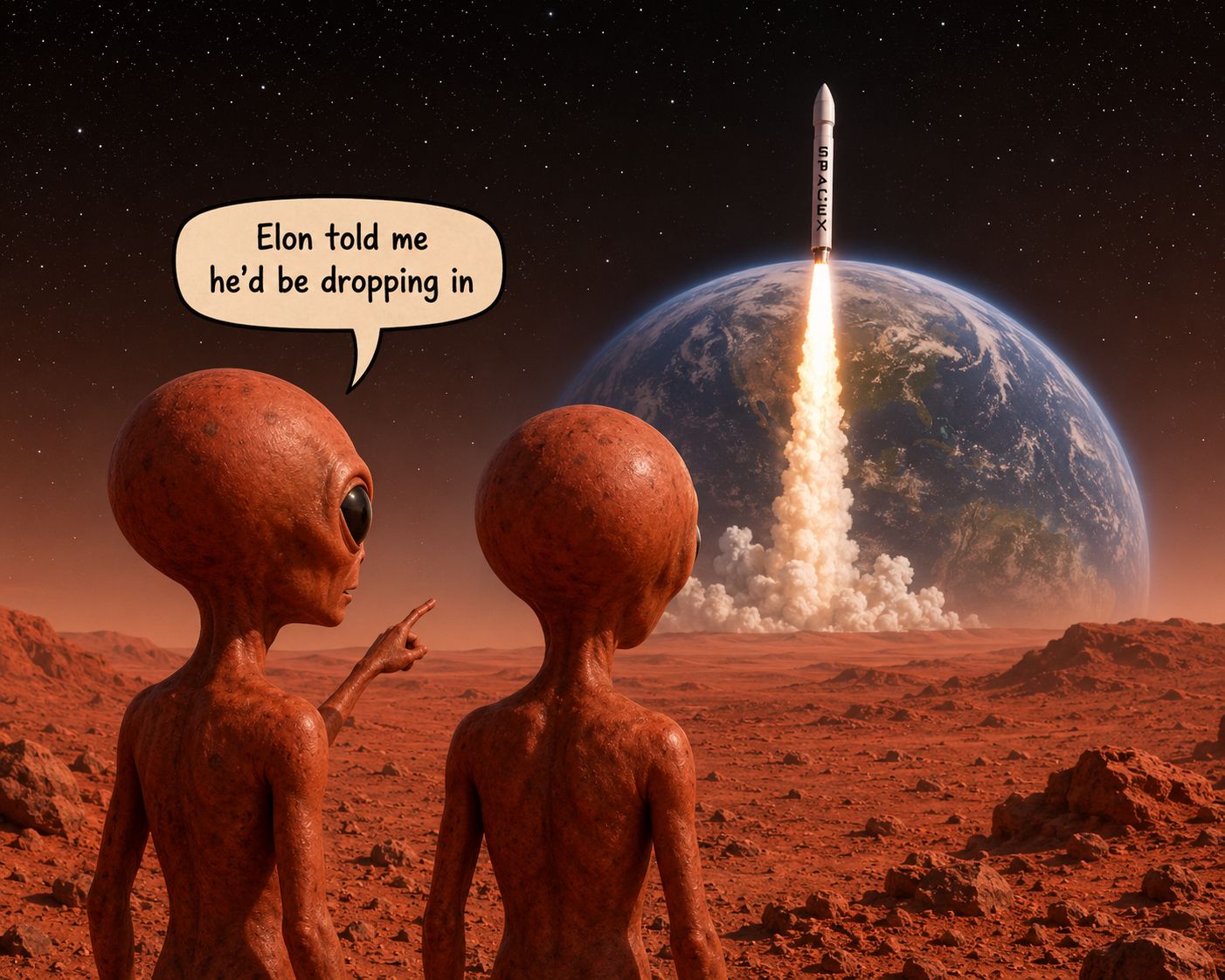
Image created using ChatGPT
The movie 2001: A Space Odyssey, produced and directed by Stanley Kubrick, is about a voyage to Jupiter by astronauts and scientists to explore a ancient monolith. Monoliths are cuboids supposedly built by the earliest, highly intelligent, species to be evolved in the Milky Way. The planet Jupiter is, at it’s closest (since planets have differing orbits around the sun) 366 million miles from Earth, and 601 m. miles at its furthest.
On the night of June 11, 2026, Space Exploration Technologies Corporation (SpaceX), a company founded by Elon Musk, will make its initial public offering, IPO, seeking to raise $ 75 billion (more than twice as large as the current leader, Saudi Aramco, which raised $ 29 b. In 2019). One of Elon’s missions is to colonise the planet Mars, in order to make the human civilization an interplanetary one, in order to preserve it against a calamity (an asteroid, or a nuclear war or other) that would destroy it. At its nearest distance to Earth, Mars is 35 million miles away, hence a (relatively) more achievable destination than Jupiter, presuming that it, too, can be colonised.
Mars is the wanderer’s dream project, a distraction, and not indicative of the size of the opportunity for SpaceX, aka TAM, or total addressable market (TAM).
SpaceX will have 3 main lines of business, viz. Launch, the rocket launch business, with reusable rockets, with the smallest TAM of the three, of $ 370 b. In this interview with Jamie Dimon, Elon said that with a reusable rocket, you only need a propellant to launch. This is liquid oxygen plus liquid propane, which makes in cheaper to reach the moon than a transatlantic flight using aviation fuel!
The second line of SpaceX business is Connectivity, using Starlink, the global satellite and broadband system. The estimated TAM is $ 1.6 trillion. The TAM would increase substantially if Iran carries out its threat to sever an undersea Internet cable.
The third, and main, line of business is AI, including enterprise software (GROK), AI infrastructure (data centres), consumer subscriptions and digital advertising. The estimated TAM is $ 26.5 trillion.
The combined TAM for all 3 businesses is $ 28.5 trillion; US GDP in 2025 was $ 30.5 trillion.
SpaceX, which acquired Tesla’s stake in xAI in exchange for its stock, has made a deal with Anthropic which has agreed to lease its two data centre clusters, Collosus 1 and Collosus 2, for $1.5 billion per month, for its Claude AI models. There is a huge shortage of compute which has been constrained by a shortage of electric power. The plan is to build compute in space and beam the results to Earth using lasers.
The IPO, to be launched on Feb 11 will offer shares at $ 135/share, to raise $ 75 b. at a valuation of $ 1.75 trillion! A successful listing will make it #8 or 9 most valuable companies in the world! On listing!!
Investors must note that the TAMs on which the valuation is based are projections.
Thirty percent of the IPO is reserved for retail investors.
Upon a successful listing, there would be selling pressure from investors who flip for quick gains and employees who have been awarded stock earlier. This would be countered by huge buying pressure from passive funds /ETFs. Because of its size, index providers have permission to include SpaceX in their indices within 2 weeks of a successful listing. Once any stock is included in any index, passive funds are compelled, by design, to buy it, in proportion to their weight.
There is also talk of a likely merger of SpaceX and Tesla. This makes sense because of synergies that would accrue if both were a single entity. Based on estimated 2026 revenues, it has been priced at 73-74 times sales! This is extremely high, as is the exuberance in stock markets. Indian investors would recall that the stock market peak coincided with the IPO of Reliance Power, the largest IPO at the time.
Elon’s ability to create value is awesome and must be acknowledged. It was in 2002, when he was 31 years old, that he exited PayPal, which he had confounded with Peter Thiel, and received $ 165 million. He deployed all of this in setting up SpaceX, in 2002 and acquiring Tesla (which had been set founded in 2003 by Martin Eberhard and Marc Tarpenning and Elon, who gained control in 2004. In 2026 Tesla is valued at $ 1.3 trillion and SpaceX at $ 1.75 trillion.
Elon has thus turned his investment of $165m into 2 companies valued at a combined $ 3 trillion, in 24 years! That’s a CAGR of 43.7%! Warren Buffet, the world’s greatest investor, achieved a CAGR of 19.8% over 60 years, which is an amazing record.
Indian bureaucracy should take away a few lessons from this. Instead of tinkering around with capital markets, instead of imposing irritants like STT (securities transaction tax), instead of withdrawing tax on corporate dividends paid out of corporate profits, already taxed and then taxing them again, instead of disdaining equity investment, which is the risk capital, and calling capital gains ‘unearned income’ why don’t they look at this example of what a vibrant capital market can do for the country?
India’s largest IPO was made by a Korean company, Hyundai, which raised $3.3 b. SpaceX will raise $75 billion! Other, large IPOs are expected from Open AI and Anthropic.
By providing risk capital for these ventures, capital markets enable a country to grow big and promote industries of the future.
STT raised Rs 37000 crores, or $ 3.9 b. But such petty bureaucratic thinking results in stunting the capital market and hence the IPO market, denying the sort of risk capital to entrepreneurs to undertake huge projects.
One hopes the bureaucrats get out of such petty thinking, and allow a free market to be free to deliver. When Narasimha Roa as PM and Manmohan Singh as FM did away with the shackles of a license- permit raaj, Indian enterprise responded with vigour. The bureaucracy and political leadership must similarly und hackle their minds, start trusting the citizens, reduce their chokeholds and let the country flourish.
Last week the BSE Sensex closed at 74243, down 533 points over the week.
The Iran conflict doesn’t seem to end. The Strait of Hormuz continues to be closed by Iran and its exit blocked by US. besides oil, passage of fertiliser has also been impeded and food crises would arise in many countries. The Strait may have been blocked for shipment by sea, but the land routes East, through Pakistan and Afghanistan, and North, to Turkmenistan and Armenia, can be used for evacuation by land. China, if convinced, can use the threat of cessation of purchase, make Iran more malleable. But it would demand Taiwan as the price.
It is good that Elon, uncontaminated by Indian bureaucratic pettiness of thought, has a vision to make human civilization an interplanetary one, so that it would survive extinction because of a meteor or a nuclear war. Given the penchant for conflicts in the global polity, the chances for the latter are higher.
Better to lighten and create space (no pun intended) for a better bargain in future.
———- ——————
Comments may be sent to: jmulraj@asiaconverge.com








COMMENTS