





















MARKET PERSPECTIVE
By J Mulraj
Apr 25- May 2, 2026
When will the polity stop jingoism?
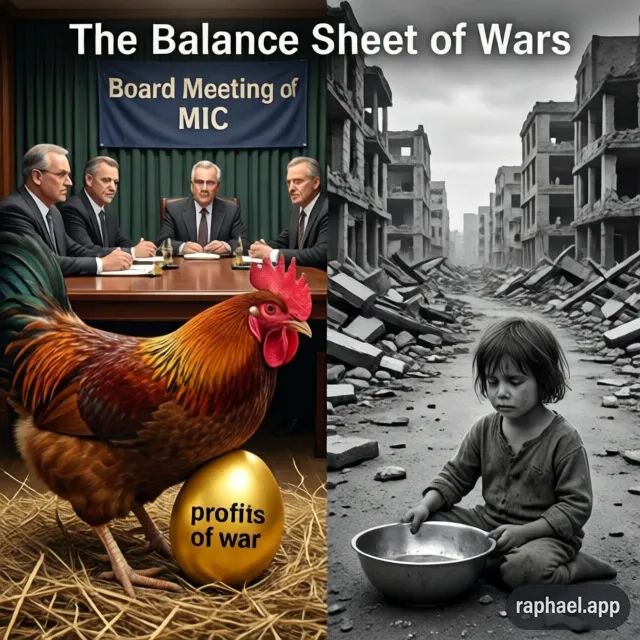
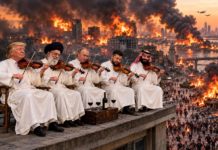
Image created using raphael.ai
As the 34th President of USA, Dwight Eisenhower said “War is mankind’s most tragic and stupid folly; to seek or advice its deliberate provocation is a black crime against all men”.
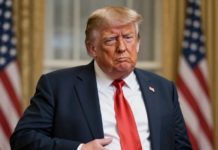
As the 47th President of USA, Donald J Trump should have considered the sage advice.
The sad truth is that, for the Military-Industrial-Complex (MIC), wars have become a profit centre. The sadder truth is that it is so, for a large part of the human race, for whom the profits from investing in the Defence Sector act as a salve on the remnants of conscience about the fate of those on whom wars are waged.
Consider that the market cap of all US weapons manufacturing companies rose by over 30% in 2025, 3 times the rise in m. cap of all listed US real estate companies. We have degraded our values to a point where destruction of homes of others is preferred to building homes of our own, in peace.
Institutional investors like pension funds invest significantly in the Defence Sector, justifying any qualms about ESG considerations by their ‘fiduciary duty to get the best possible return for their constituents’. In effect, they seek to provide their senior citizens a comfortable retirement future even as the vehicle that provides that comfort does so, perhaps at the cost of denying the victims of war any future at all. Such is the perfidy of war and investing in the infrastructure of war.
The wars are expensive, adding to US debt, now around $38 trillion. The war on terror, from 2001 till today, has cost $ 6.4 trillion, and both the Iraq war and the Afghan war $ 1.2 trillion each. Why, then, do political leaders wage them, in jingoistic frenzy?
This debt has to be serviced. Interest cost on US debt is now over $ 1 trillion per year, the largest single item of expenditure, exceeding the amount spent on social services, healthcare and defence. Taxpayer dollars can be put to much better use, such as in improving crumbling infrastructure for example.
The MIC relies on control over resources, like oil for example, to be the golden egg. After the abduction of President Maduro, Venezuelan oil reserves, the largest in the world, are now under American control. There is unverified talk about speculative gains made by large movements in oil and stock markets after policy decisions flip flop.
Jim Taiclet, the CEO of Lockheed Martin, the largest weapons manufacturer, defines. Trump’s wish to increase the US defence budget to $ 1.5 trillion as a golden opportunity.
Well known investor Ray Dalio states that 7 countries are showing signs of collapse as per his framework, which is corroborated by the study of economist Ken Rogoff and Reinhart. The three signals are a Debt to GDP ratio of over 90%, foreign exchange reserves to cover 3 months requirements and excessive money printing to resolve a debt problem. Based on this, the 7 countries at risk of collapse are Bangladesh (though it’s debt/GDP ratio is much below 90%), Egypt, Pakistan, Turkey, Argentina, Japan and USA.
Several of these countries have been, and are, involved in wars.
Last week the BSE Sensex closed at 76913, up 249 over the week.
The US blockade of the Strait of Hormuz, buttressed as it is with three aircraft carrier groups, is preventing movement of ships carrying oil out, as well as food, medicine and other supplies in, to Iranian ports. The stoppage of oil export is a double whammy for Iran’s economy. It is placing a huge financial burden on Iran. It is also utilising its oil storage facility (oil that can’t be evacuated needs to be stored) which is nearly over. Once the capacity is exhausted, oil production would need to be stopped, which will lead to degradation. So Iran is under great financial pressure to seek a deal to settle. Its problem is that different factions have different goals.
Another important development is that the UAE has quit OPEC. The UAE has expanded to produce oil, but is constrained by a low quota as determined by OPEC. A lot of discussions regarding peak oil have taken place, the consensus is around 2030. The UAE has determined, rightly, that it is preferable to utilise the resource before oil demand peaks. UAE has faced the largest missile and drone attacks by Iran, more than Israel has faced, irrespective of the fact that it neither attacked Iran nor allowed use of it’s territory for the purpose. Its record of intercepting Iranian missiles and drones has been impressive, at over 95%. The departure of UAE from OPEC would make it difficult for OPEC to impose quota discipline on remaining members and can reduce oil prices.
A settlement in the Iran war appears possible. If it is prolonged, high prices of crude oil will lead to a recession and supply shocks in fertilisers can lead to food shortages. It is a wonder that stock market bulls seem too intoxicated to foresee that. Besides this, the short term disruptions because of AI would lead to margin contractions initially; the benefits of increased productivity would take longer to manifest.
Caution is advisable.
Alongwith prayers that the global polity stops toeing the line of MIC and ushers in peace.
Hallelujah!
———————————-
Comments may be sent to: jmulraj@asiaconverge.com
———————————————











COMMENTS