























27 April 2026
Solutions require political resolve
By RN Bhaskar and Sakeena Bari Sayyed
Image: Copilot
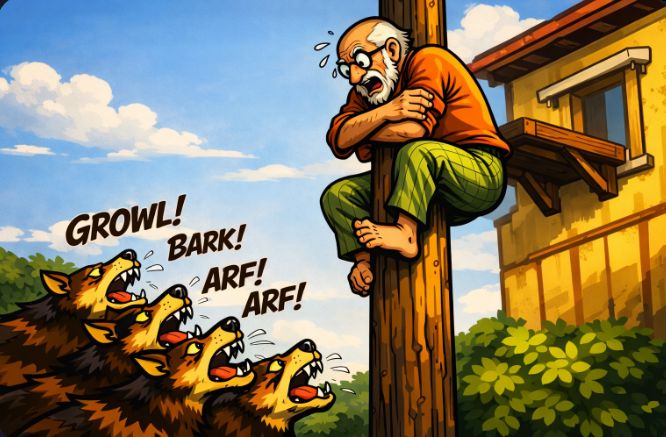
India is in grave trouble. Dogs are baying for the government’s blood. Ten years of self-aggrandisement have resulted in a situation where India is now being marginalised. Its global ranking has slipped from 4th to 6th.
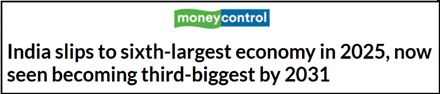 Without economic heft, India is not considered significant even internationally. Is there a solution?
Iran is becoming more prominent and powerful. So is Pakistan. BRICS may not even consider India relevant without Russia and China supporting New Delhi. The country risks being fragmented. The rupee has weakened. India’s deficit threatens to chew up India’s global standing. Is there a solution?
Missteps
This situation is largely the result of the whimsical approach of India’s policy makers (https://www.youtube.com/@bhaskarkibusinessbaatein/videos) –
- Demonetisation (free subscription — https://bhaskarr.substack.com/p/demonetisation-is-someone-flying)
- Beating of metal plates with rolling pins to drive away Covid (https://www.bbc.com/news/av/world-asia-india-51997699)
- Allowing more Aadhaar cards than populations in nine Indian states (https://bhaskarr.substack.com/p/eas-sarma-asks-home-ministry-not)
- Ordering the opening of banks on the basis of Aadhaar cards without further verification (https://asiaconverge.com/2020/11/aadhaar-pan-combined-through-article-139aa-threaten-banking-financial-integrity/)
- Allowing election cards on the basis of such Aadhaar cards and bank accounts (Aadhaar Link to Voter Lists — What has the Supreme Court said? – Supreme Court Observer)
- Allowing NPCI to overwrite (not append) older account numbers with new ones and not keep a record of transactions (https://www.moneycontrol.com/news/india/comment-how-aadhaar-and-npci-together-open-the-door-to-major-frauds-and-impersonations-2506669.html)
The list can be long. But the above should suffice for this article.
 Some of the policy initiatives were on the basis of ideology. Instances of such policies are
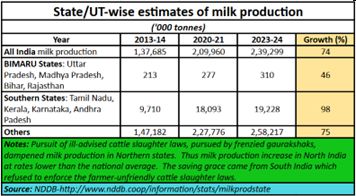
- Introduction of cattle slaughter laws – the rabid approach of the North has seen its milk production growth get stunted. The south which did not accept these laws saw the milk industry flourish. (https://bhaskarr.substack.com/p/dairy-ruminations-that-make-little)
- Deleting Mughal history and Godhra from text books (https://frontline.thehindu.com/the-nation/education/ncert-textbook-controversy-medieval-history-omission-nep-2020/article69556504.ece)
- Modifying the Indian Penal Code (https://www.pib.gov.in/PressReleasePage.aspx?PRID=2115169®=3&lang=2)
Once again, the list can be long; but the above instances should suffice.
The result of these and other economic decisions has been
- An impoverished rural India (https://bhaskarr.substack.com/p/desperate-times-for-poor-folks-in)
- An emaciated MSME sector (https://www.livemint.com/economy/india-msme-sector-global-crises-covid-war-challenges-survival-11776063073749.html)
- A flight of capital (https://bhaskarr.substack.com/p/capital-and-millionaires-flee)
- A promotion on speculation over genuine investment (https://bhaskarr.substack.com/p/the-elephant-is-missing)
- A shrinking and weakened middle-class (https://bhaskarr.substack.com/p/the-shrinking-growth-of-the-middle)
- A weakening rupee (https://www.mecklai.com/JoyToTheWorld.aspx?Type=C22)
- A burgeoning deficit (https://www.reuters.com/world/india/prolonged-energy-disruption-widen-india-trade-deficit-strain-fiscal-account-2026-04-21/)
- A horrifyingly weakened India.
Solution #1 – curb corruption
The first thing India must do is to reduce expenditure. This will mean two things. First reduce the cost of elected representatives. This cost threatens to go up even further with the addition of additional parliamentary seats. Will the government have the courage to do this?
The second is stanching corruption. Every municipal officer has become inventive in finding ways to earn money. It is well known that each middle level employee has a target for generating slush funds which then gets shared with his superiors and elected representatives. This is true of traffic police as well (https://asiaconverge.com/2024/08/mumbais-traffic-police-has-huge-gaps-in-its-service-delivery/). Everyone in the construction sector knows that 40% of the cost of real estate development is paid to municipal and state employees as graft. Drug and food authorities too have become innovative in finding new ways to generate funds (https://bhaskarr.substack.com/p/fssai-and-its-new-nutrition-ratings). Ditto with revenue officials — the shops and establishments inspectors are notorious for collecting money from each business establishment (https://asiaconverge.com/2016/06/indian-laws-designed-protect-promote-bribery-time/). Money is collected from hawkers and water tankers and share-a-cab operators. All this eventually goes to make things expensive for consumers. That is the invisible cost of inflation.
Two clauses abet corruption.
- The first is the modification in the Prevention of Corruption Act (https://asiaconverge.com/2018/08/amendments-to-prevention-of-corruption-act-protect-corruption/).
- The second is a clause which prohibits a government officer from being prosecuted or investigated without this being “sanctioned” by the immediate superior of the accused official. Since the superior office is usually complicit in the illegal funds collections, such sanctions are seldom granted. Court rulings stating that sanctions are not required are invariably ignored.
Will the government have the resolve to deal with this malaise? If it does this, half of India’s problems will get addressed.
 Solution 2: Ease investment inflows
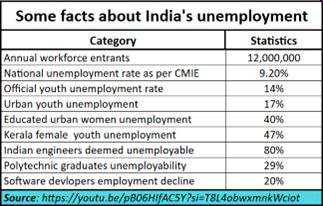
India’s unemployment crisis is getting worse than had ever been imagined. The primary cause is the way the government has blocked investments and cash inflows. Worried about money going to opposition parties, revenue authorities have been raiding anyone who gets money from overseas and is suspected of financing opposition parties. This includes businessmen, money changers, and even NGOs. Even individuals getting small contributions from overseas have to face questions from banks about the source of funds. Some banks ask customers to fill up cumbersome forms.
The big problem is that India loves to ban anything that is difficult to control. Instead of penalising just the guilty, the government inconveniences everyone who receives money. That has reduced the desire to seek contributions for services, creative work (videos, podcasts and articles) and even financial support from relatives.
But there is another bump on the road. The government has banned investment inflows from neighbouring countries. This was aimed at curbing Chinese investments in Indian companies. Result: Many startup ventures that were funded by patient capital from China suddenly lost access to funds. That reduced the number of unicorns (https://www.reuters.com/article/business/healthcare-pharmaceuticals/corrected-china-unicorn-creation-falls-to-six-year-low-as-investors-play-it-safe-idUSL4N2CV20Q/) It also curbed investments that could have funded new enterprises.
That effectively curbed employment opportunities.
Thus, you had a government which waxed eloquent about the demographic dividend India enjoys, yet did everything to stunt the potential of this dividend. The standards of education slipped (often on account of ideological reasons –https://asiaconverge.com/2026/03/ncert-and-the-judiciary/), education was allowed to become more expensive which in turn pushed up the cost of services like medicare. All that the government needs to do is to call off the hounds that plague education. Grant FSI (floor space index) benefits to government schools and hospitals (which exist in the most priced spaces in each city). Allow private builders to build over 20 floors on each of the existing structures, with the caveat that the schools and hospitals will have the best of equipment and teachers and that 50% of the students or patients get to pay a subsidised amount. The potential is there. Money is available. But will the government relax its controls? With more reasonably priced seats available for medical, nursing and engineering courses, and with good teachers getting better wages, the cost of medicare and engineering services in the country will fall. That will help the poor and the middle class.
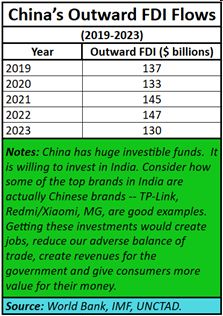
Another thing that the government should do is to immediately relax rules relating to investments from China.
 China’s outward FDI
USA is broke and deep in debt. Europe too is faltering. The UK is likely to stumble because it may not get the financial support it got from the US. Germany may recover if it can negotiate fuel pricing with Russia and get cheap energy to revive its industry. Thus, none of them will be in a position to invest in India.
But China has funds, if only the government makes things easy with China. In fact, China has already told the government a few years ago that the trade balance, which currently is in China’s favour, could be converted into investments. India can identify sectors that may be restricted ones where foreign investment is not desirable. Currently, the government through its modified Press note 3 (https://www.pib.gov.in/PressReleasePage.aspx?PRID=2237806®=3&lang=2) , allows only 10% of investments through the automatic route.
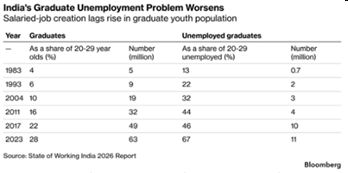 But India needs money, and China has it. Investment will create more centres of production, and hence more jobs. It will ease India’s unemployment. The employed persons will then become taxpayers and contribute to government funds. India’s economy can revive. But it needs government vision and grit.
Remember that the coming year will see a fall in remittances from Indians working in the Gulf region – thanks to the war. That plus outward FDI will hurt India even more and exacerbate the unemployment picture.
Add to this the number of jobs that will be lost on account of AI.
Obviously, a rethink is urgently required.
Can the government do that?
Is a recalibration underway?
Meanwhile the first steps towards reorientation of the Indian economy appears to be underway. In the last episode – Options before the government -part II – we had advised that the government should move away from expensive defence purchases from the West. It appears that a move in this direction is already underway. A report in Al Jazeera (https://www.aljazeera.com/features/2026/4/24/russian-troops-warships-in-india-soon-why-their-new-military-pact-matters) suggests that India has just entered into a defence pact with Russia which allows for the deployment of soldiers, warships on each other’s soil, further deepening their bilateral partnership.
That could alter geopolitics in a big way. But it won’t address the unemployment issue. Joblessness is bound to increase with more units shedding workforce, and AI too causing the loss of several jobs till new jobs appear on the horizon. Add to that returning NRIs.
 Universal basic income
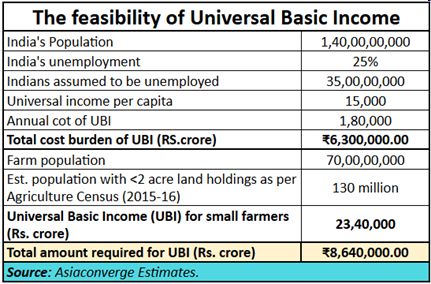
The loss of jobs caused by AI is likely to be inescapable. That is why the government needs to think of introducing some form of Universal Basic income. This could replace all subsidies of all kinds. If the government takes the subsidy amount, the amounts saved through curbs on corruption, which in turn would increase government cash inflows, and FDI from China, it could easily afford to pay the UBI bill.
That could be a game changer for India. We have assumed a minimum UBI of Rs.15,000 per head per month. Since small farmers with land holdings of under 2 acres may also be impoverished, we have tried to include them as well.
Our estimates show that India will need at least Rs.86 lakh crore to provide a decent UBI.
That will require belt tightening on the one hand, and enhancement of employment and revenue generation on the other. Both will require huge dollops of FDI. That will require the government to give up its old prejudices and arrive at a new paradigm where there is less tension.
It should use China to control Pakistan, and work out a zone of peace for India, China and Pakistan. This was mooted by Xi JinPing when he visited India in 2023 (https://www.thehindu.com/news/national/xi-mooted-trilateral-partnership-with-pak/article29713793.ece)
Without such moves, India will witness more skirmishes in its border states. Effectively, the country will lose more money on defence requirements. The need to de-escalate is urgently required. India should learn from Iran how to remain both strong and flexible.
Finally, India will have to shed its ideological baggage and take decisions based on economics and not on dogmas. India’s strength depends on the unity of its people. Look at Iran again (https://www.youtube.com/live/0z8s21o73os?si=KcI_5r2l_scttfRY). Its ability to stand up to two nuclear states (USA and Israel) would have been hit if it had not ensured harmony among its own people.
Investments and social harmony hold the key. Without either, India will soon get fragmented, Add to this the need to reinforce the moral fibre in the country by weeding out corruption. Without all the three, India will end up being a would-have-been great power.
================
My latest podcast is the second of a three-part series – tunder the umbrella heading “Options before the government – II”. This podcast is about the myopic and blighted vision of India’s policy You can find it at https://youtu.be/HOcWZYjUIlk
======================
And do view our first ever podcast on a oook at India’s defence and security. You can find it at https://www.youtube.com/live/0z8s21o73os
======================
And do watch our “Breaking News” on the danger of India getting splintered. Out next edition of “News Behind the News will be back on Saturday morning, at 8:15 am IST . The latest can be found at https://www.youtube.com/watch?v=2uaV2f4cVYs
===================








COMMENTS