


















MARKET PERSPECTIVE
By J Mulraj
Jun 27- Jul 3, 2026
For Nations Whose Leaders Prefer Governance, not Greed
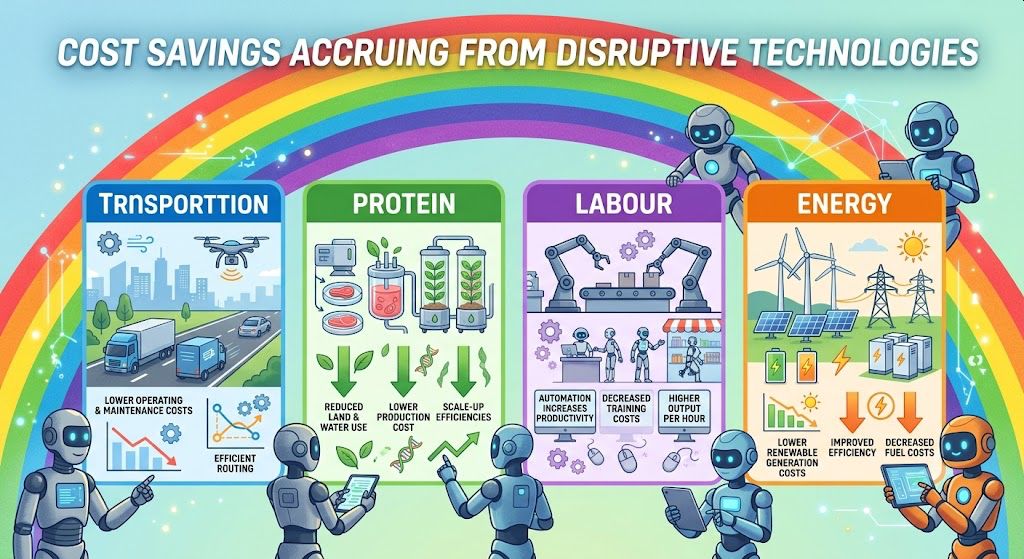
Image created by Gemini
The future is bright for those countries whose electorates elect leaders who are technologically aware and prefer good governance over insatiable greed.
These nations will lead during the technology revolution.
But those nations in which a myopic electorate, hypnotised by the seductive plea of freebies offered by those hankering for the spoils of victory, with no idea of the benefits of disruptive technology, nor interested in the welfare of the state, will trail in the revolution. Sadly, India falls in this category and, especially in State elections, votes in candidates who promise them freebies. Unless they become aware of the adage ‘there is no free lunch’ they will elect those with the strongest lungs rather than the strongest morals, and will this doom their future to mediocrity.
Take the cost of transport in USA. Today the average cost per mile of an
Uber is $1- 1.5. After the expansion of autonomous, or full self driving vehicles (FSD), and of robotaxis, this will drop to $0.30-0.60 per mile. There will be other benefits too. The owner of a FSD vehicle will have the option of offering the vehicle to an UBER like service, and will get a share of the revenue. In effect, this turns his vehicle from a cost centre into a profit centre! The wider spread, over time, of transportation as a service, on demand, will reduce the demand for private transportation. This, in turn, releases the need for parking space, which can find alternate uses like additional green spaces, or building schools/affordable housing, etc. The cheaper cost of goods transport, using cyber trucks, would reduce inflation.
In summation, the disruptive technology of FSD will lower transportation cost, will free up land resources, will flip the business model of vehicle ownership from a cost centre to a revenue centre, and will lower the cost of freight, hence inflation.
Consider the cost of producing non-animal protein. There are two new, disruptive technologies, cellular agriculture (CA), which grows animal cells in bioreactors, such as a Petri dish, and precision fermentation (PF), which uses engineered microbes to produce specific proteins, such as casein, whey etc. RethinkX, a site for explaining disruptive technologies, started by Tony Seba, an expert in the field, estimates that the cost of protein using CA or PF would be 1/10 th the cost of protein produced by animal agriculture. And, because animal agriculture uses around 80% of agricultural land (pasture to feed the cows) and about 30% of potable water. If protein can be produced using CA or PF, and if it becomes acceptable, then the amount of land and water resources released would be immense. The environment would also benefit from the reduction in greenhouse gases (methane) that would accrue.
Humanoid robots, soon to be introduced, likely by 2027, will collapse the cost of labour. A human takes 9 months to produce, over 21 years to maintain, before he can enter the workforce. After that he needs a monthly pay, an annual increment, and demands a bonus. For working a 48 hour work week, with an a 48 hour workweek, a months’ paid leave and overtime benefits. In sharp contrast, a humanoid robot would take a few weeks (maybe less) to produce, joins the workforce immediately. It expects no pay, bonus, takes no leave except for maintenance, and works 24X7X365. Hence the cost of human labour, which averages around $ 18.5 per hour, is expected to fall to between 1-3/ hour for someone who subscribes to RaaS (Robot as a Service) by paying a monthly subscription.
In Energy Disruption, Tony Sena’s RethinkX has developed a model, in which excess capacity is built in Solar, Wind and Battery Storage, SWB, built far in excess of peak demand. This will provide super abundant energy whenever demand is slack. The cost of building such super abundant energy is manifestly manageable.
These, and other disruptions, will lower the cost of inputs, improve productivity, and reduce inflation. This will generate wealth, for, as mentioned at the start, those nations which elect the right people. Not for those nations whose polity considers a victorious election as the start of an enrichment journey for themselves and care not a whit for the nation.
Last week the BSE Sensex ended at 77763, for a weekly gain of 663 points.
The negotiated peace in the Iran war is likely to be a desert mirage. Under the 14 point deal, Iran is expecting to get a release of some of its frozen funds, and will, in response, open the Strait of Hormuz, which it was not entitled to close in the first place. A time period of 60 days thereafter is meant for both Iran and USA to chart Iran’s nuclear course. The gap in perception of the course, between the two countries, is far wider than the narrow Strait of Hormuz. It seems as far apart as Earth and Mars, which Elon Musk aims to colonize. So, after 60 days, expect Iran to close the Strait again, but richer to the extent of funds released.
The momentary pause in fighting, and the consequent sharp drop in oil price, should not be interpreted as a bullish signal. It is quite likely that the hostilities will recommence. Getting lighter is an option that should be considered.
——————————————————————————————
Comments may be sent to: jmulraj@asiaconverge.com












COMMENTS