
























13 July 2026
Tamil Nadu is right in challenging the cattle slaughter laws
By RN Bhaskar and Sakeena Bari Sayyed
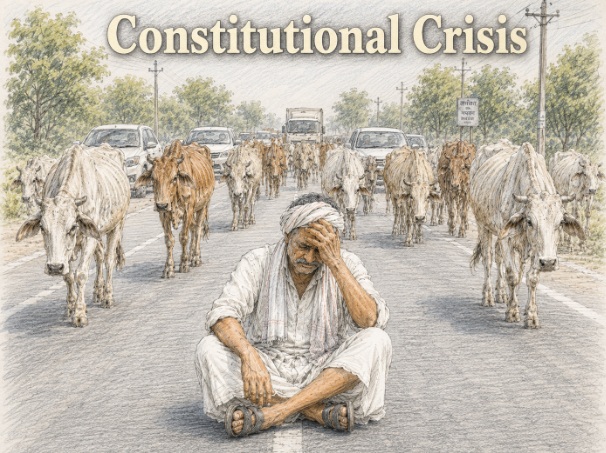
Image: Chatgpt
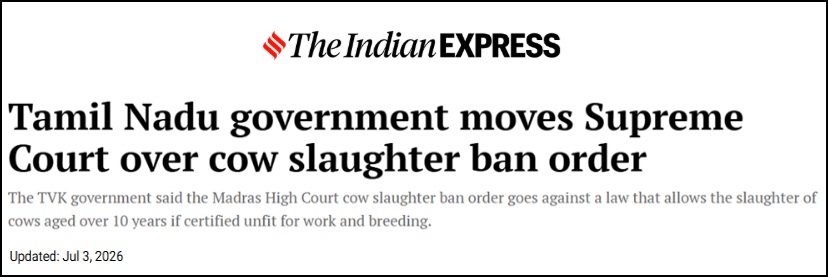
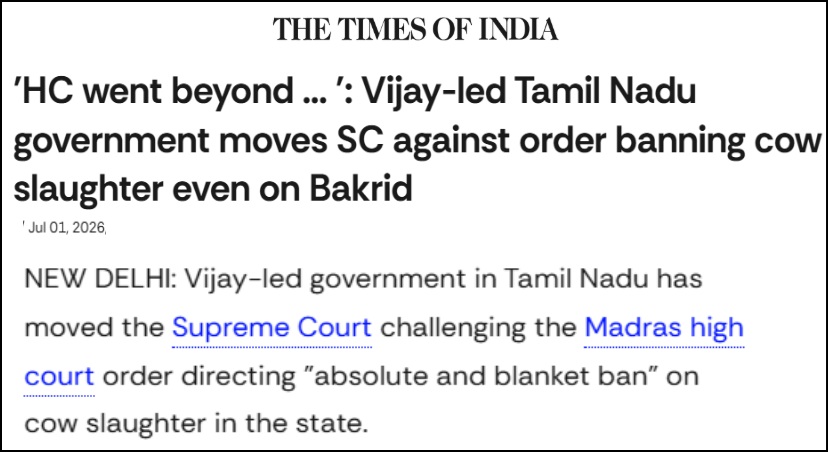
In the first week of July 2026 came the startling news that the Tamil Nadu government had approached India’s Supreme Court to ask for a revocation of the blanket cattle slaughter ban imposed by the Madras High Court.
 This startled many because of two reasons. First, the cow slaughter ban is an issue extremely close to the Hindutva brigade. Introducing it as a law applicable all over India was one of the (unfortunate) action that the Modi government took when assuming the office of the Prime Minister of India in 2014.
Second, the state of Tamil Nadu has just got a new chief minister. Few expected him to move the apex court so quickly. That he did so is good for India. It seeks a judicial review of the cattle slaughter laws.
Legal basis
The legal basis for the cattle slaughter ban is primarily found in Article 48 of the Indian Constitution, which directs the state to prohibit the slaughter of cows and promote animal husbandry. This article has been the foundation for various state laws regulating or prohibiting cattle slaughter. Currently, 20 out of 28 states in India have enacted laws that restrict or ban the slaughter of cattle, with significant variations in enforcement and even regulation across Indian states.
Says Law Legal (https://lawfullegal.in/cow-slaughter-bans-and-constitutional-rights-navigating-religion-culture-and-liberty-in-india/), while such laws enjoy the support of Article 48 of the Indian Constitution, “they do, however, pose serious questions regarding their conformity with fundamental rights under Articles 14 (equality before the law), 21 (right to life and personal liberty), 25 (freedom of religion), and 19(1)(g) (freedom to perform a profession). There are landmark rulings, moulded by cases like State of Gujarat v. Mirzapur Moti Kureshi Kassab Jamat (2005) and Mohd. Hanif Quraeshi v. State of Bihar (1958), which attempted to strike a balance between individual liberties, cultural sensitivities, and economic interests. Tensions have increased recently due to vigilante violence and strict enforcement, underscoring the gap between majoritarian policies and constitutional rights.” It adds, “To make sure that prohibitions on cow slaughter are in line with constitutional requirements and do not turn into instruments of majoritarian tyranny, judicial review under Article 13 is still essential.”
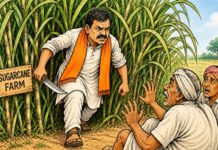
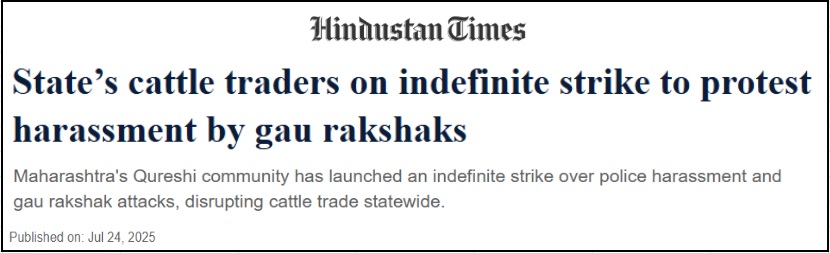
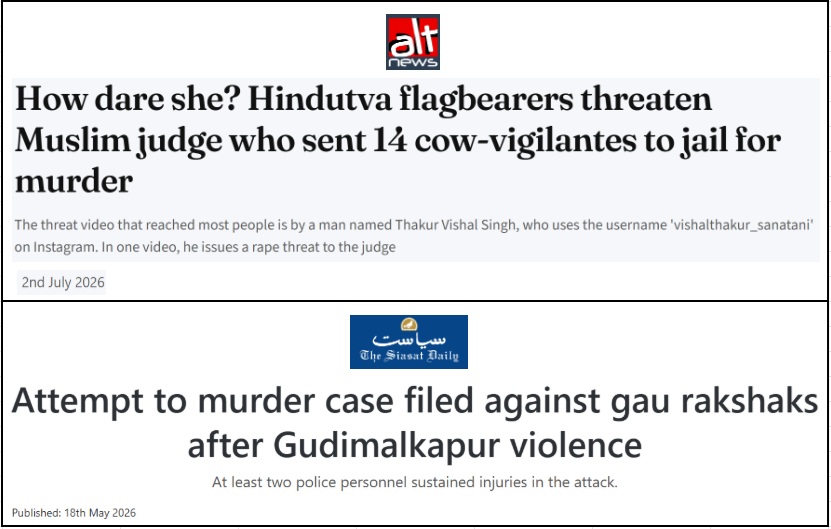 Instances of vigilante overreach are many. The incidents cited here are just two of many similar episodes. At times, courts have been compelled to rein in state governments for turning a blind eye to such gross infractions.
 Some states have refused to support the ban. The states are Arunachal Pradesh, Goa, Kerala, Meghalaya, Mizoram, Nagaland, Tripura and West Bengal. Add to this the union territories of Dadra and Nagar Haveli and Daman and Diu and Puducherry. However, since export laws are applicable for the entire country, meat of cows cannot be exported. But when it comes to buffalo meat, India remains the largest or second largest (at different times) of carabeef in the world. The ban is not applicable in the state of Jammu & Kashmir as well which was an “unexpected outcome of the Central government’s decision to read down Article 370 and Article 35A of the constitution . . . (thus,) the 157-year-old beef ban in Jammu and Kashmir has been lifted,” says The Wire (https://thewire.in/law/jammu-and-kashmir-article-370-beef-ban).
 Why did TN protest?
As Indian Express explains, “The plea, filed on June 9 through the state’s counsel, Jayasree Narasimhan, said the May 27 high court order has imposed a blanket ban on cow slaughter even in the designated slaughterhouses, and this is unsustainable in law. The state said the original plea only raised the question of whether cows and calves could be sacrificed in places not designated as slaughterhouses on the occasion of Bakri Eid, but a division bench of the high court went further and ordered an absolute and blanket ban.”
The newspaper also points out that “The Tamilaga Vettri Kazhagam (TVK) government contended that the high court order goes against the provisions of the Tamil Nadu Animal Preservation Act, 1958, which allows the slaughter of cows aged over 10 years if a competent authority declares them unfit for work and breeding. The state also argued that even legislations such as the Prevention of Cruelty to Animals Act, 1960, the Prevention of Cruelty to Animals (Slaughterhouse) Rules, 2001, the Tamil Nadu Urban Local Bodies Act, 1998 and the Tamil Nadu Urban Local Bodies Rules, 2023, do not impose any total ban on slaughter but only prescribe conditions for it.”
Clearly, the Madras High Court appears to have exceeded its brief, is what the TVK claims.
An ancient practice
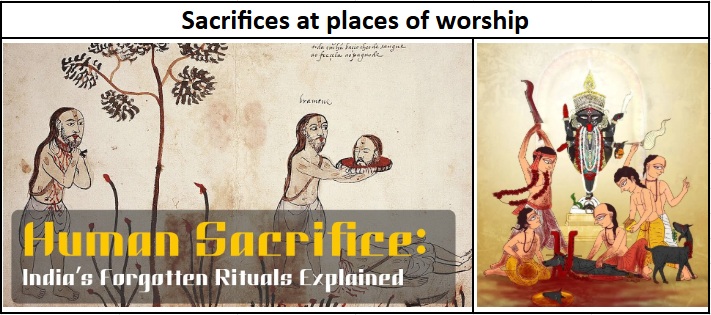
To understand Tamil Nadu’s plea, one has to go to conventional practices and the law. Sacrifices of animals at places of worship, even among Hindus, is an old practice. Many state governments say that for sacrificing animals at a designated place in temples or other places of worship, a temporary slaughterhouse licence is required. The wording is unfortunate. You cannot call a place of worship a “slaughterhouse” (https://www.youtube.com/watch?v=794SNg1qfU0).
There is another problem with the law banning slaughter of cows. As Dhruv Rathee points out in his podcast, all Hindus were not vegetarians. Non-vegetarian Hindus were commonplace in the past. This was more so, after Adi Shankaracharya decided in the 8th century to co-opt fisherfolk, seafarers and tribals into Hinduism (timeline 02:08 to 05:25) at https://www.youtube.com/watch?v=ibJJXeGyZxA). Almost all seafarers and tribals were invariably meat eaters.
Moreover, the practice of making animal sacrifices to the gods was also a prevalent practice, as brought out quite eloquently, with documentation and references by Dhruv Rathee in his podcast which raises the query “Can Hindus eat beef?” (https://www.youtube.com/watch?v=rygbPO6hM9Y).
One more fact — even human sacrifices were prevalent in some Hindu temples – though that practice has been banished. But the sacrifice of other animals is quite commonplace even today – for most religions.
 Economic factors
But there are economic reasons why the cattle slaughter ban should be considered unconstitutional.
First, look at things from the farmer’s point of view. For each aged (non-lactating) cow, the farmer got around 20,000-30,000 rupees. Let’s assume the lower level of Rs.20,000. He would sell the cattle to the trader, get his money. He would borrow another Rs.20,000 and then purchase a younger cow or heifer. However, now, with the cattle slaughter laws in place, he cannot get his Rs.20,000. He finds borrowing the entire sum of Rs.40,000 too risky. So, he does not purchase the cow. His capital has shrunk. So has the farmer’s income potential.
Gau rakshak samitis (cow protection agencies) tell me that they have been teaching farmers how to make money from dung and urine. My counter to them has always been that the samitis should instead buy the old cow from the farmers and make money themselves. It is unfair trying to persuade farmers to try experiments in which they are not interested. The Samitis don’t like this idea.
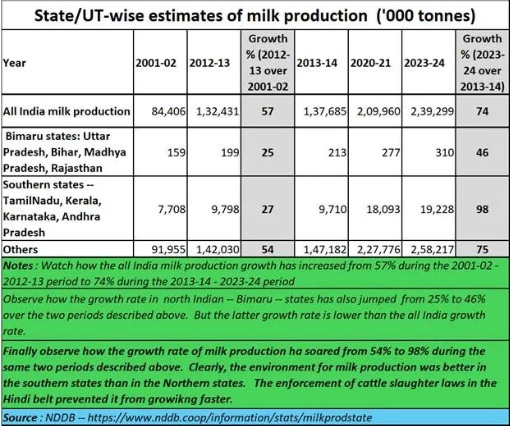 There is a second problem that the farmer faces. Maintaining an aged animal costs money. And the risk of the old cattle spreading disease among the young one is quite common. So, he faces a double whammy. He loses the production capacity from ageing cattle. And he has to pay the costs of maintaining cattle. Both impoverish him. In fact, the states which have not imposed the cattle slaughter ban are producing more milk than those which are shrill about curbing cattle slaughter. The numbers show this quite clearly (https://bhaskarr.substack.com/p/dairy-ruminations-that-make-little?utm_source=publication-search).
There is a third more compelling reason. The cattle slaughter ban has resulted in constraints on the leather industry – which does not get hides as easily. Leather is labour intensive and a major export revenue source for India. The cattle slaughter ban is hurting the leather industry as well.
The same is true of the beef industry, which earns foreign exchange from the sale of beef.
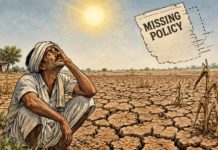
Collectively, they cause huge rural distress, which in turn causes GDP growth to decline.
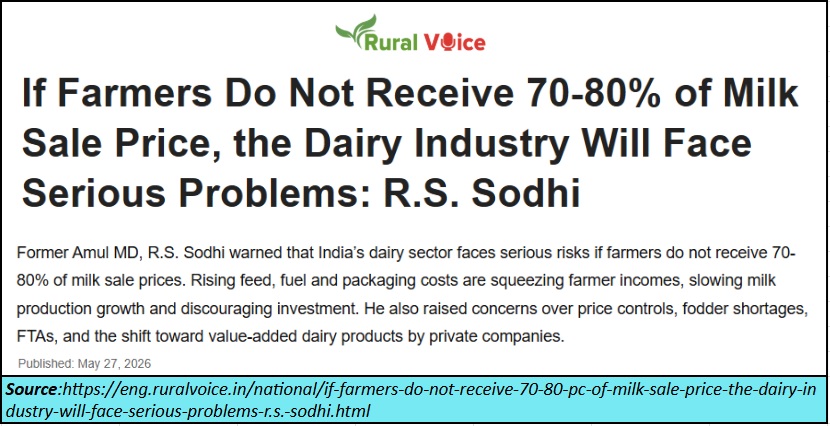 Milk fetches money for over 10 crore farmers daily. The cattle slaughter laws could cripple India’s nutrition and its economy. That is what even the former head of GCMMF (which promotes the Amul brand of products) has been pointing out. There is an urgent need to make the milk producer more profitable — https://eng.ruralvoice.in/national/if-farmers-do-not-receive-70-80-pc-of-milk-sale-price-the-dairy-industry-will-face-serious-problems-r.s.-sodhi.html.
More reasons
There are some more economic and legal reasons why the cattle slaughter ban is unconstitutional.
The first is the misplaced notion that the cow is like a mother. There is a fundamental difference that gau rakshaks overlook. You don’t buy your mother. But you buy a cow. The act of buying gives you the right to sell. Any law that seeks to allow you to buy, but not to sell, is an unfair law.
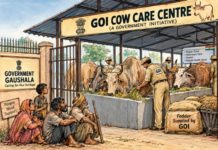
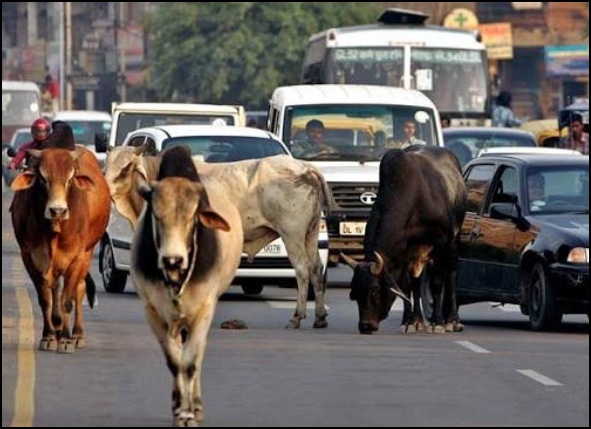 Second, many states that vigorously implement the cattle slaughter ban, have ended up with cattle roaming on the streets. They pose a danger to motorists and even passengers. They defecate on the roads, leading to the risk of infection. That in turn becomes a threat to life. Then there is the issue of interference with eating habits, which is also a crucial issue.
Sadly, such laws – backed by zealots – threaten to derail justice as well (https://www.altnews.in/how-dare-she-hindutva-flagbearers-threaten-muslim-judge-who-sent-14-cow-vigilantes-to-jail-for-murder/).
The fact is that the dairy industry is critically important for the Indian economy. It accounts for a higher share in India’s GDP than even rice and wheat put together. Any harm to this sector will pull India’s rural sector down. They go against the vision that Verghese Kurien implemented (https://www.youtube.com/watch?v=AutA01BBwd8). That vision helped India to become the world’s largest, and the most cost-effective, producers of milk (https://bhaskarr.substack.com/p/the-shameful-attempted-marginalisation?utm_source=publication-search).
Few states dare to challenge this law because of squeamishness. They fear that they would be perceived as being anti-Hindu. But the laws are clearly unfair to farmers, to the economy and even to life and livelihood. These laws go beyond religion.
Conclusion
That is why it is good that Tamil Nadu has finally escalated this issue by raising it before the Supreme Court.
When religious beliefs begin to cloud people’s minds, you can get horribly unfair economic consequences. And when people begin to distort history, the nation runs the risk of travelling blind. The consequent disasters would afflict all people in the country. Such bans have the potential of destroying the very concept of a vibrant economy.
=============
This week we have a podcast on India’s terrible infrastructure – collapsing and misaligned bridges and potholed roads. You can find it at https://youtu.be/p1RFeg69QlQ
=============
Also, do view our News Behind the News:
- GDP – India’s Shrimp story
- India’s Shrimp story is what the govt should study
- Water in Mumbai’s lakes
- SIR makes a mockery of Indian Democracy
https://www.youtube.com/live/QhsmfdIkr0g?si=4t2frYmH4jN9wRI6
=============








COMMENTS