
























MARKET PERSPECTIVE
By J Mulraj
Aug 22-28, 2026
Yes, probably, if America tames it’s lust for wars
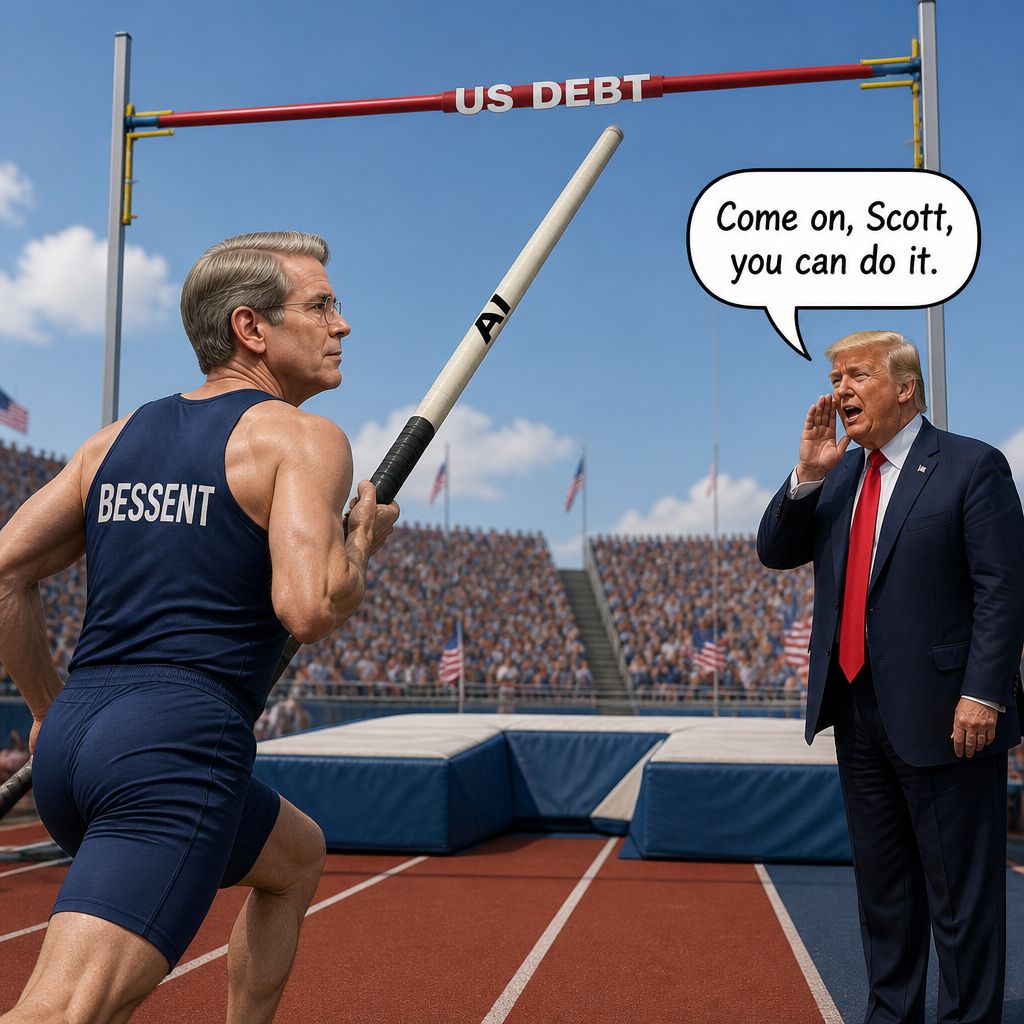
Image created by openart.ai
Just imagine that 191 years ago, in 1835, President Andrew Jackson repaid the entire US debt burden, and brought it down to zero! He achieved this by selling large tracts of Government owned land, cutting Government spending and vetoing some infra projects like roads and canals.
Somewhere over the next 191 years, US Presidents lost their values and their economic sense. Today US Government debt stands at $ 40 trillion, ($ 117000 per person) and the interest on which is at $ 1 trillion in 2026.
One of the main reasons for the debt build up are the expenses on wars, not just the cost of waging them but also the long term costs of healthcare to the wounded and payments to veterans. The cost of the post 9/11 wars on terror waged by President George W Bush, on Afghanistan and Iran, is estimated at $ 4-8 trillion. WW II is estimated at $ 4.7 trillion. The war in Iran is ongoing, and a fight to defend Taiwan against the likely attack by China, who claims it as it’s inalienable territory, will add to the debt burden.
Treasury Secretary, Scott Bessent, maintains that the US economy will grow, using technology, including AI, sufficiently enough to be able to repay the $ 40 trillion debt. As illustrated in the image above, he is seeking to use AI/technology to vault over the debt burden.
It must be pointed out that, though the US has the largest level of debt, at $ 40 trillion, in terms of debt/gdp, several countries are more indebted than it is. Like Japan (204%), Singapore (172%), Sudan (169%) and others. Whilst China’s debt/gdp ratio is officially 67%, this excludes the debt of LGFVs (Local Government Financing Vehicles) and of SOEs (State Owned Enterprises), which is hidden. Were these to be added China’s debt/gdp would exceed that of USA (124%). In China, Local Governments are the provinces, or States. They are permitted to independently borrow money to fund infrastructure and development in their province. This is done by floating companies, termed LGFV. Such vehicles funded the realty boom which created oversupply and a spectacular bust, in a sector accounting for 31% of the economy. So the LGFV debt is very much the responsibility of the Centre. Not so for the SOE debt, unless the Central Government had assumed responsibility when issuing it.
So, the million dollar question; no, make that the 40 trillion dollar question – can the US, using technology, including AI, grow it’s economy enough to be in a position to repay it?
Short answer – technology/AI can, but it depends on several factors, including the need to tame the jingoistic propensity of leaders to wage war and thus squander the economic gains. And on the societal acceptance of changes ushered in through technology disruptions.
Some examples of saving in cost and in time for the basic human needs.
Food: Traditionally, animal farming is the primary source of protein, but it consumes nearly half the cultivable land and water resources, to graze and feed cattle. The new technology of cellular agriculture, which extracts a thumbnail size of animal protein, and multiplies that in a Petri dish, yielding enough protein to replace the cow (thus also reducing their slaughter) will save between 50-90% of the cost of the protein produced by animal farming. Another technology, precision fermentation (PF), will produce proteins using advanced bio technological processes. PF will use 99% less land, 90% less water and 80% less energy than traditional animal farming.
Commute: As against a normal cost of 60-70 cents per mile for a self driven car (higher for a ride hailing service adding driver cost and profit) , Elon Musk, is targeting a 30 cents per mile for cybercabs, (target is 20 cents later), representing a saving in personal transport cost of over 50%. The cyber truck will provide the same, or larger, saving in freight cost. Hence in manufacturing cost.
Energy: Traditional grid scale power cost about 41.7 cents/ KWh in 2010. Solar power costs 4.4 cents/Kwh in 2024, a 90% fall. Energy from nuclear fusion, perhaps a decade away from commercialisation will reduce this further, to unlimited, virtually free power.
Labour: Companies like Tesla are developing humanoid robots. These will assist individuals in housework and eldercare, and factories in manufacturing. The cost of labour will collapse. The logic is impeccable. A robot is ready to work immediately after production, unlike a human, which joins the workforce after 21 years during which money is spent on his education, maintenance and vacations. The robot works 24X7X365, without pay/overtime/leave/bonus/
Housing: the advent of 3-D manufacture of houses would reduce time and cost of construction. A single family, fully furnished home, which now costs $ 160-250/ sq. foot, will drop by around $ 30/sqf.
So if all input costs, labour, energy, commute, food, housing and others are expected to fall significantly because of new technologies, and, if robotics and AI can significantly improve productivity, then the growth rate of US GDP will grow faster. It has traditionally ranged between 1-3% per year. The only exception was 2020, when US GDP spiked 5.8%, because Covid had, in the previous year, led to a – 2.2% GDP growth rate.
But, if the disruptions caused by new technologies are socially accepted (resistance to data centres to feed AI demand is growing, then the US economic growth can become sustainably higher.
It will then become imperative for the leadership to conserve the resources, stifling their urge to initiate or instigate wars, and to use surpluses emanating from higher growth to pare down national debt, as Andrew Jackson did, well, then, Scott Bessent will, indeed, go down favourably, in the history books. If Trump simultaneously undertakes a transmogrification from a hawk to a dove, well, then, America, and the world, will witness a miracle!
Last week, the BSE Sensex closed at 77264, a weekly drop of 276 points.
But before Scott grabs the AI pole to vault the high bar of US debt, Donald has to run the marathon and end the blockade of the Strait of Hormuz. Trump’s belief that he is a man of peace, on the grounds that he wants a piece of Canada, a piece of Greenland, and, now, a piece of the Strait of Hormuz, is both logically and phonetically, incorrect.
Technology offers a solution. But political leaders should become responsible and responsive enough to sensibly use it.
—————————————————————-
Comments can be emailed to: jmulraj@asiaconverge.com
——————————————————————












COMMENTS