




























24 August 2026
The proposed FCRA could splinter India
By RN Bhaskar and Sakeena Bari Sayyed
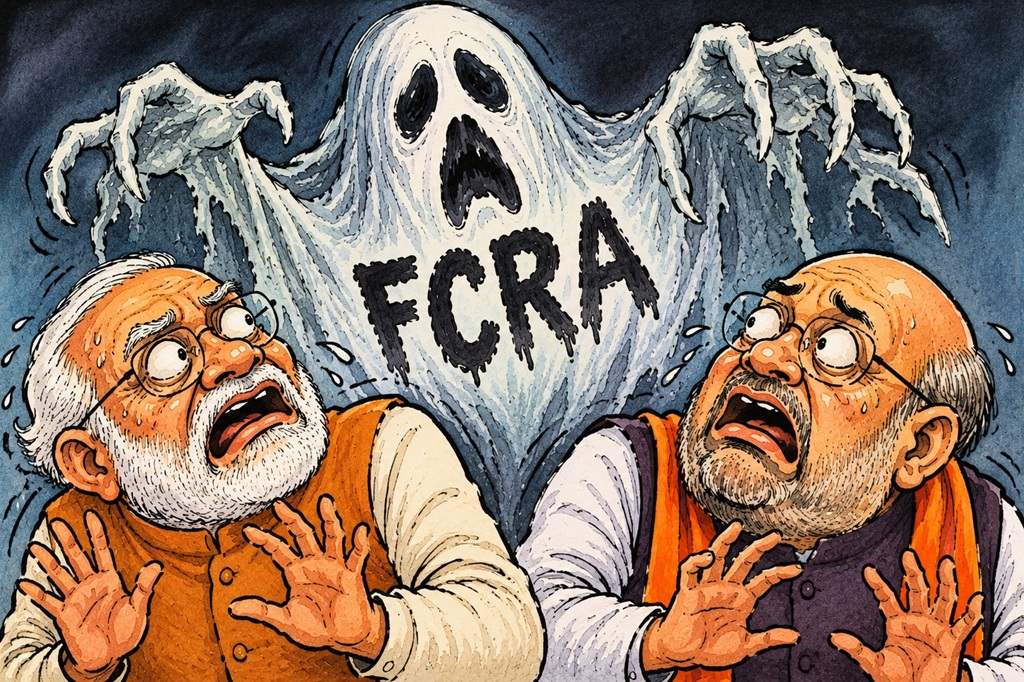
Image: Chatgpt
On 12 August 2026, the unthinkable happened. The government chose not to press for the passing of the FCRA (Foreign Contributions Regulations Amendment) Bill, 2026. Instead, it referred the bill to a 31-member Joint Parliamentary Committee (JPC). Effectively, going by the way the JPC has functioned in the past, it is probable that the bill has been deferred indefinitely.
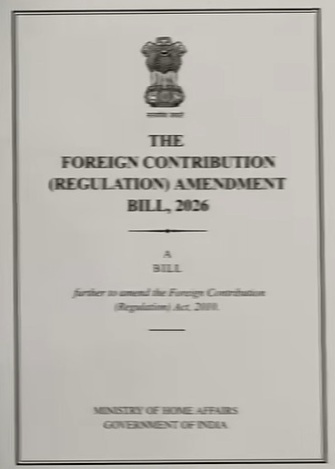 But how does the FCRA Bill become important for the entire country? The answer can be got in the huge uproar of protest by the opposition benches when the government announced that it would be scrutinised by the JPC. The opposition wanted the bill scrapped (https://www.thehindu.com/news/national/fcra-bill-sent-to-jpc-amid-opposition-protests-rijiju-challenges-parties-to-cite-provision-against-minorities/article71335945.ece). They believe (probably rightly) that the amendments were targeted at minority institutions.
 The origins
To understand this, it is important to look at how the FCRA first became an Act, and the various avatars of this piece of legislation.
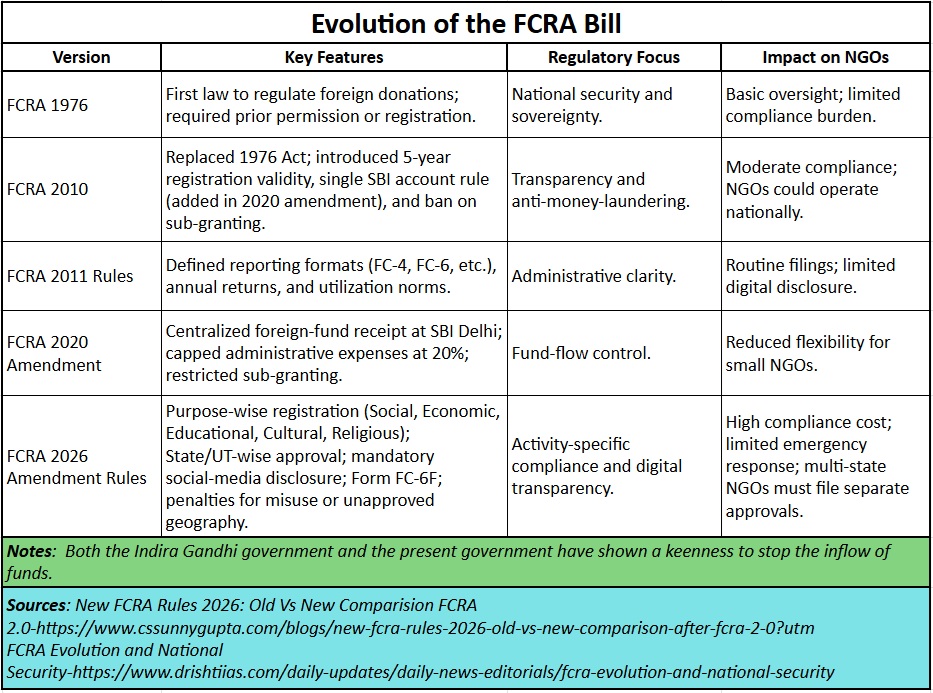
The Act itself was born in 1976 when Indira Gandhi was the prime minister of India. She was always worried about the hidden hand that was propping up parties and agitations against her government (not dissimilar to the views expressed by the current government). She had already defanged the opposition parties (especially the Swatantra Party) by abolishing Privy Purses.
It may be recalled that India as a country became a reality because 565 princely states agreed to merge into the newly formed nation. In return, the government in 1947 agreed to create a system called “Privy Purses” which offered these erstwhile princes — through a constitutional guarantee — annual payments (https://www.legalserviceindia.com/legal/article-19826-the-abolition-of-privy-purses-a-historic-clash-between-feudalism-and-egalitarianism-in-india.html).
Many of these princes decided to become part of a new political party – the Swatantra Party – which sought to challenge the Indira Gandhi government. At its peak, this new party controlled almost 20% of the seats in the Parliament. Enraged – and insecure – Indira Gandhi chose, in 1971, to abolish the Privy Purses arrangement. She did this through the 26th Constitutional Amendment. Her argument – which appealed to the masses – was that there was no need for princes in a democratic and secular India. That was one of the saddest moments in India’s history. A solemn promise made to the erstwhile prices – through a constitutional guarantee – had been broken.
By throttling their access to funds, Indira Gandhi ensured that the Swatantra Party no longer remained a threat to her government.
But funding continued to come from other sources. So, in 1976, the government enacted the Foreign Contributions Regulations Act 1976.
The noose tightens
She then went on to bring in a crippling licence raj (each industry had to be government approved, through ‘licensing’. Industrialists whose loyalties were suspect did not get such licences. She also nationalised major banks (many were owned by industry houses) to further tighten the noose of funding of opposition parties.
According to the present government, the FCRA became important in order to achieve three objectives (https://static.pib.gov.in/WriteReadData/specificdocs/documents/2026/jul/doc2026722929001.pdf):
- It identifies who may accept foreign contributions, and on what conditions.
- It specifies how that money must be received, accounted for, and reported.
- It restricts a narrow, defined set of foreign-funded activities that could affect India’s sovereignty, security or public order.
Winds of liberalisation
But back to the past. The era of economic liberalisation ushered in by the then prime minister PV Narasimha Rao, and his extremely able finance minister, Manmohan Singh, decided to make the FCRA more transparent, without diluting the challenge foreign funding could pose for India. When Manmohan Singh became prime minister, he ushered in some modifications to the FCRA in 2010. It was further modified in 2011. Both modifications were meant to bring in greater transparency and clarity, yet aimed at curbing money laundering.
Zoom to 2020, when the present government made further amendments to the FCRA, centralising all foreign exchange contributions through the State Bank of India. The idea was to better monitor the inflow of funds and identify both the source and the recipient. But with opposition to the government growing, many political analysts believe that it pushed the government to make a desperate attempt to clamp down on all sources of funding. So, explain such sources, the government decided to further clamp down on the FCRA by suggesting amendments in 2026.
It is interesting to note that in the recent agitation of the Cockroach Janata Party or CJP, government agencies promptly began hounding even suppliers of food and water to the agitating students, demanding that the source of funds for these items get identified. The desire to control the flow of funds becomes all the more urgent once a power-hungry government feels threatened. But blocking funds invariably cripples the entire economy, as economist Ajay Shah explains (https://www.youtube.com/watch?v=hK3DsqoTnNk).
Second thoughts
It is this bill suggesting further amendments that was eventually not presented before the Parliament for approval. Instead, it was referred to the JPC, with the proviso that the comments should reach the government by the first week of the Winter session of the Parliament.
That in turn raises two questions.
- Why did the government want to introduce more changes to the FCRA?
- Why was it deferred?
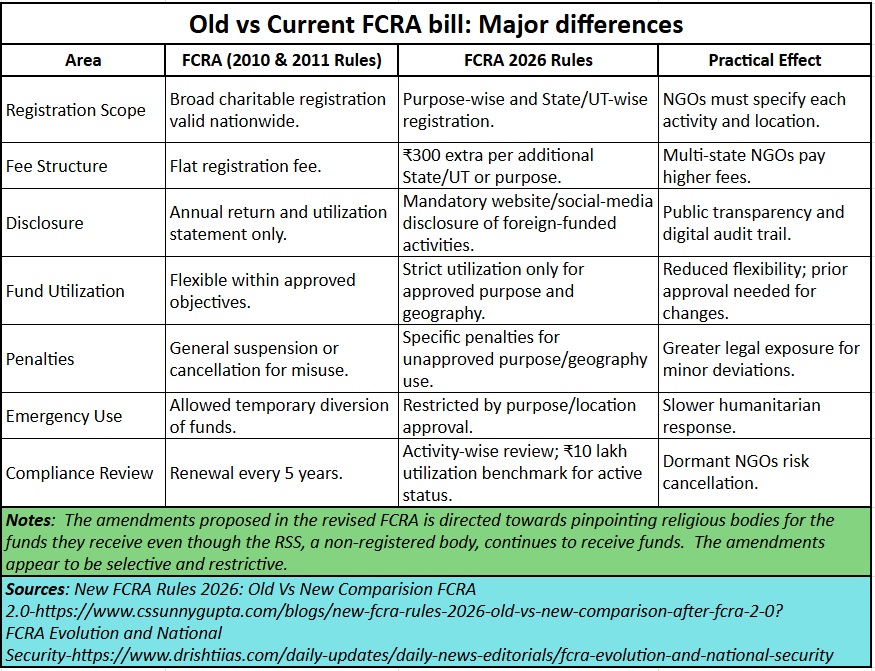 The best way to explain the changes is by comparing the two pieces of (existing and proposed) legislation.
The proposed legislation of 2026 is aimed at further tightening the FCRA,
- Instead of a general permission, it seeks to make this licence specific to a location (no all-India permit).
- It also wants a licence for each use – religious, educational, social welfare etc.
- Any violation of any clause could affect funds received in the past as well – thus giving it retrospective effect.
- Many believe that it was targeted at minority religious charities and organisations, because minority religions have been the most adversely affected.
More churches and mosques have been vandalised than Hindu shrines. The violence against minorities has been huge – even systematic.
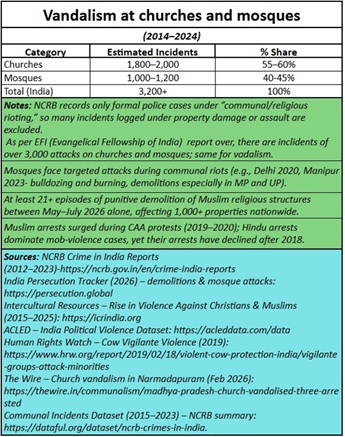 Moreover, funding for the RSS (a non-registered body) which espouses the promotion of Hindutva, continues without any controls. All other charities and institutions are registered, yet bound by such regulations (https://www.youtube.com/watch?v=IDZ0loSo8Hs).
Not surprisingly, opposition parties have been demanding the total withdrawal of the bill seeking these amendments. It is more restrictive than any bill that the government has sought to pass in the Parliament.
Cold feet?
So why did the government choose not to pass it?
By all appearances, the government wanted to pass it, else it would not have been listed.
That leaves us to speculate over the reasons why it was shelved.
One speculation – which appears logical – is that the opposition to the government has been at its strongest during the past 12 years. It was so strong that both the prime minister and the home minister refrained from appearing before Parliament. They did not want to confront the barrage of questions that the opposition had planned, and which they had articulated both within and outside Parliament. Had the Bill been put to vote, the government could lose. After all, some elected members have already begun switching sides sensing the groundswell of protest (https://www.hindustantimes.com/india-news/why-shehzad-poonawalla-quit-bjp-i-have-been-planning-this-since-nitin-nabin-politics-national-spokesperson-101787019821296.html).
Moreover, the mood across the country is rapidly turning against the government. In state after state – Delhi, West Bengal, Northeast India, Madhya Pradesh, Rajasthan, even Gujarat — anti-government protests have been becoming more pronounced. Details of these protests can be found from online posts. Mainstream media has largely maintained a studied silence.
By sending the bill to the JPC, the government has some more time to try and break up the opposition. Maybe, the opposition from unorganised students will peter out.
The second reason could be a very strong protests from the US which did not want this bill – aimed against religious minorities – to be tabled before the Parliament. Could US pressures have compelled the government to buckle?
A third reason could be the emergence of a pan-Islamic movement. The new Mecca Accord (the Islamic Nato comprising Pakistan, Saudi Arabia and Turkey, and possibly Egypt) could snowball into a major challenge to India’s moves against minorities. If India were to be held guilty of crimes against humanity, that would be both dangerous and even politically suicidal.
Listen to Justice S Murlidhar in an interview with the BBC (https://www.youtube.com/watch?v=Bk8bCgnhavU). He points out the horror that is taking place in the Middle East. He admits that he is painfully aware about India’s proximity to Israel.
While he does not say it explicitly, India’s closeness to Israel is also reinforced by a common hate – against Islam. A good example is India’s decision to erase Mughal history from schoolbooks (https://bhaskarr.substack.com/p/the-one-eyed-vision-of-ncert). This has been done even though the Prime minister’s independence address is from the ramparts of the Red Fort, a piece of magnificent Mughal architecture.
FCRA’s future
That is something time will tell. If the opposition to the present government continues to swell, the FCRA’s amendments might just die a natural death. If the bill gets defeated on the floor of the Parliament, the government’s own existence may get imperilled.
If it sails through, expect more rancour and violence on the streets of the country.
Indians may have to be reminded about Abraham Lincoln’s famous remark, “America will never be destroyed from the outside. If we falter and lose our freedoms, it will be because we destroyed ourselves.” India’s social fabric is being torn to shreds. When its own citizens are compelled to hate the state, the social divisions could wreck India’s unity.
One has only to look at how Mizoram, very recently, almost seceded from India (https://bhaskarr.substack.com/p/india-embraces-russia). Violent movements in Northeast India and Kashmir – where religious fervour is being stoked –point to the dangers of a splintering of India (https://bhaskarr.substack.com/p/options-before-india-i-indians-return).
The FCRA amendments have the potential to create more gashes in India’s social fabric. It is best not to bring it before the Parliament again.
==========
Watch our latest podcast on how India has been unfriendly to investors. True, foreign investors get better returns than Indian investors, but even that is not enough. The climate remains hostile to all types of investors. Watch the podcast at https://youtu.be/k9yvzt9h0Gs
=============
Finally, do view our News Behind the News:
– Political upheavals seem imminent
– India’s banking sector’s lack of transparency
– Sugar could turn bitter
– BMC feeds on public money
You can find this at https://www.youtube.com/live/v1_4AQaIpuA?si=Jxm_LAh7m4xX2oJB
================








COMMENTS