




















18 May 2026
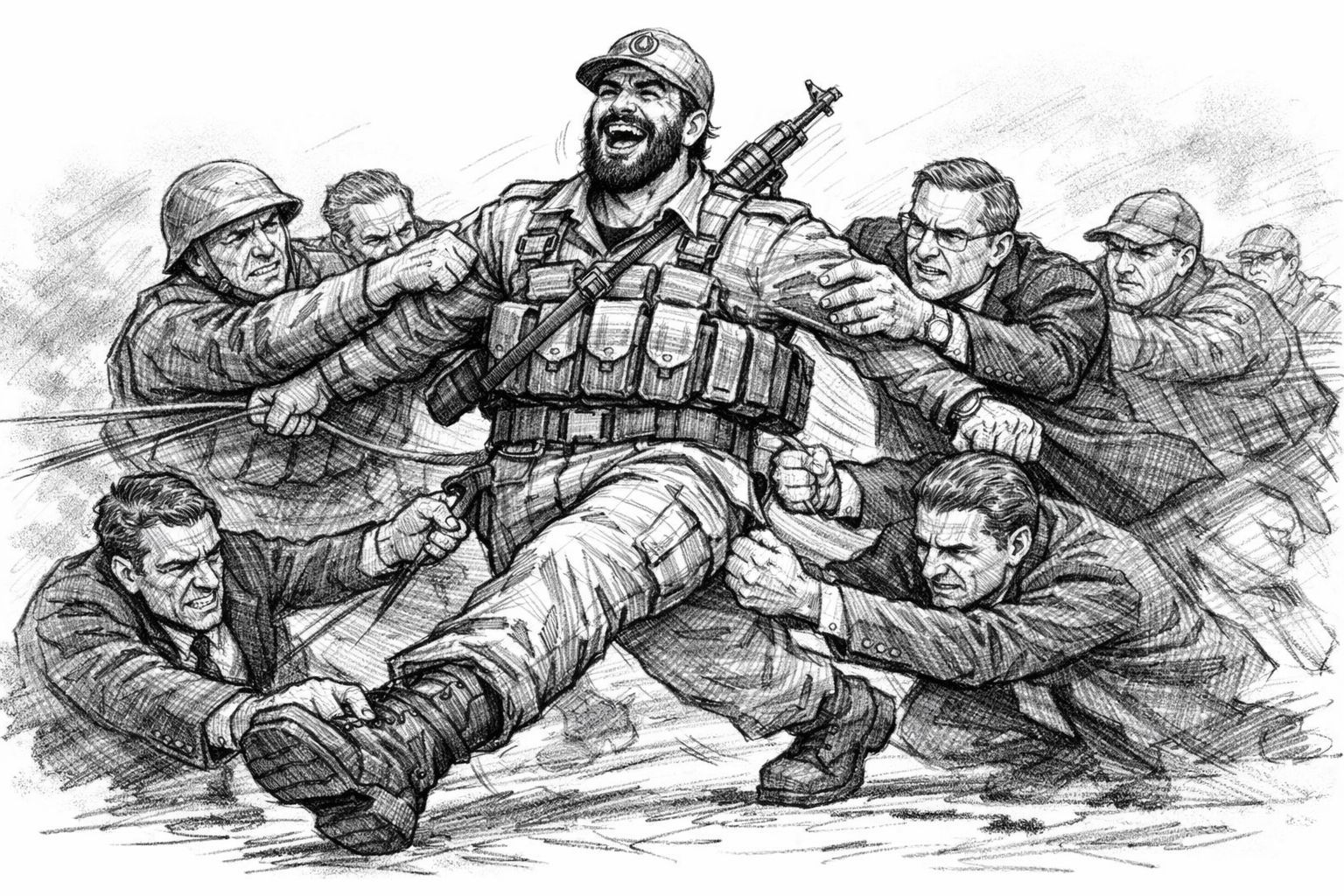
Trump’s fantasies about blockading Iran
By RN Bhaskar and Sakeena Bari Sayyed
Images: Copilot
Trump has begun the attempt to blockade Iran. No oil is ostensibly being allowed to go out. At the same time, little food is reportedly being allowed to come into Iran. The US thought that Iran would buckle. Not really (https://www.aa.com.tr/en/us-israel-iran-war/iran-says-ending-war-lifting-blockade-and-sanctions-minimum-requirements-for-peace/3935455). It remains defiant as ever. Trump has begun to feel helpless (Free subscription — https://open.substack.com/pub/bhaskarr/p/trump-trapped?r=ni0hb&utm_campaign=post&utm_medium=web&showWelcomeOnShare=true). He wants to end the war with Iran. But he runs the risk of losing if he stops the war. Similarly, if he continues the war, it could lose even more.
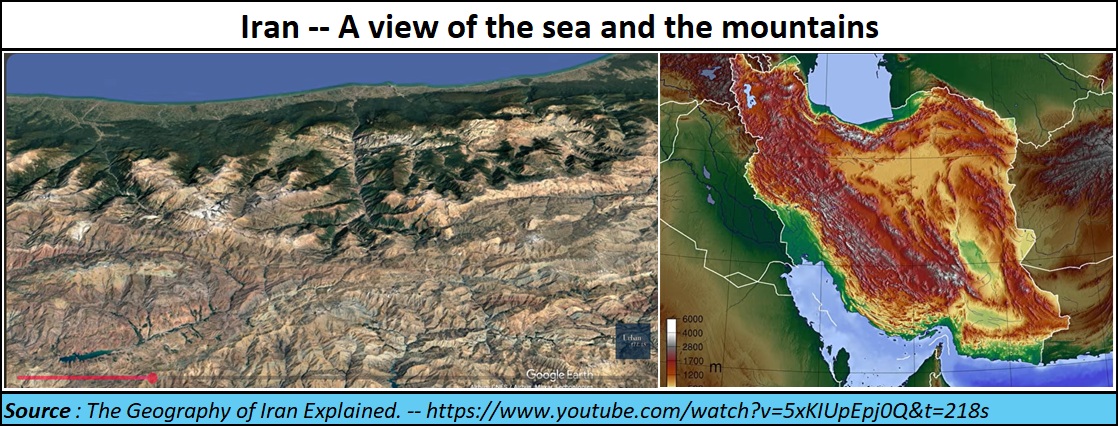 For people who believe that Iran is bleeding, it is important to remind them of three things.
- Iran has withstood sanctions for almost 50 years. It is used to strife. It can withstand a lot of pain, which few countries can.
- Second, Iran has been preparing for war for 20 years, and has an underground economy (literally) which is thriving. Above the ground, it has a funding support of at least $400 billion from China.
- Geography is Iran’s best friend. That makes all the difference.
Iran and India – major contrasts
Take all these factors together, and the difference between India and Iran becomes stark. Listen to Douglas McGregor, retired US colonel, former government official, author, consultant, and political commentator. He explains the difference between India and Iran (timeline 14:52 to 15:04 — https://www.youtube.com/watch?v=FEX5fFODi68): “Initially Russia, China viewed India as a potential strategic partner. But India has been unable to solve its own problems. It’s been unable to remove obstacles on its way. Iran is quite different.” It has tenacity, vision, and a determination to get its own way, notwithstanding even two nuclear powers attacking it. As a result, Russia, Iran, and China have become the new RIC.
India lacks the planning. It couldn’t plan even for its strategic oil reserves. As against a norm of three months, India had reserves of just 9.5 days (https://thecsrjournal.in/indias-strategic-crude-oil-reserves-sufficient-for-just-9-5-days/). Moreover, the quality of its infrastructure is suspect (https://bhaskarr.substack.com/p/a-bridge-too-far?utm_source=publication-search). It has not nurtured the social harmony which leads to a unified vision and a prosperous nation. And it has a geography which favours people leaving the country if conditions do not suit them.
Effectively, India has been displaced in the world rankings. Even in BRICS, it won’t be long before the “I” in the acronym won’t stand for India. It could stand for Iran.
India continues to woo the West. Ironically, even while India’s PM advocates austerity, India’s penchant for the West (even though the countries there are declining powers) and New Zealand will further bleed India. Almost all of India’s trade policies are aimed at allowing this country to import their goods. Its export policies are erratic. It has just banned sugar exports.
Instead, India should be wooing those countries which have growing populations and economies (https://bhaskarr.substack.com/p/india-trade-perspective-missing?utm_source=publication-search). India lacks focus on education – Iran focusses on this sector. Consequently, India has hurt its ability to create jobs. It has lost its ancient calling of generating wealth (https://www.youtube.com/watch?v=ibJJXeGyZxA).
Unlike Iran, India has been suspicious of all its neighbours. It hasn’t built infrastructure connecting its neighbours to facilitate more trade. Till today, the most important infrastructure project that industry wants has been deferred (since 2006) (https://bhaskarr.substack.com/p/indias-two-dfcs-politics-trounces?utm_source=publication-search). Today, India cannot boast of any neighbour being his friend. “China is now the world’s wealth engine, workshop of the world, the production centre for the world,” adds McGregor.
In sharp contrast, Iran’s trade, despite the blockade, continues to be robust enough to feed its people and to defend the nation. Around 76 Iranian ships have skirted the blockage surreptitiously. Wikipedia has a well-written note on this (https://en.wikipedia.org/wiki/2026_United_States_naval_blockade_of_Iran?utm_source=copilot.com). Instead, Iran has successfully blocked the ships of all its enemies – notably, Israel and the US (https://www.aljazeera.com/news/2026/4/18/iran-closes-strait-of-hormuz-again-over-us-blockade-of-its-ports).
The most popular method to evade the US blockade is by ensuring that its own ships hug the coast between Pakistan’s Gwadar port and Iran’s Chabahar port. So long as they remain within the 12 nautical mile territorial war, the US does not dare attack them, lest Iran begins its retaliation by bombing Middle East and Israeli installations once again. US attempts to escort Iranian ships ended in two of the three US warships being hit forcing all three to scurry away to relative safety.
But the long-term reason why Iran cannot be blockaded is because it has focussed on strategic infrastructure development. But financing infrastructure requires funds. This is where Iran has cultivated those sources that bring money in – quite unlike India.
Funding sources:
The first is China. As reported by the official Iranian Foreign Investment Organization, Iran has received several funding commitments. Among them are
China – China has committed around US $805 million for 30 projects.
It has also announced an outlay of $ 400 bn as part of its 25-year Comprehensive Strategic Partnership). It has a broad investment outlay plan of $280 bn to be spent on Energy. This includes upstream oil & gas, petrochem complexes, pipelines, storage, refineries. This will also go a long way in helping China meet its own energy needs. The remaining $120 bn is to be spent on infrastructure and industry (transport including rail roads, ports and airports, manufacturing, telecom, and digital infrastructure).
 Then, there was a US $5.4 billion funding commitment from the UAE for 35 projects (https://www.presstv.ir/Detail/2025/02/24/743428/Iran-foreign-investment-attraction-figures). But that was before the war began on 28 February. UAE was one of the key targets for Iran. But when the war began, UAE chose to allow the US to use its land for staging attacks. And it got close to Israel as well. Today, in the UAE this commitment may not mean much.
Again, Iran has its diaspora investors. They have collectively committed $763 million for around 97 projects. This has become one of the fastest growing sources of capital inflow. Iranians, enthused as the way Iran has managed to defend itself, are now willing to invest more. Everybody loves a winner. Nobody likes to be associated with a loser. Just study the way FDI has slowed into India, and how capital is rapidly fleeing to other countries.
Then there are other countries which include Turkey, Tajikistan, South Korea, Pakistan, Iraq, Czech Republic, and Oman, among others. They have collectively committed to invest $459 million, mostly in sectors like manufacturing, mining, and services.
Then there are other countries which include Turkey, Tajikistan, South Korea, Pakistan, Iraq, Czech Republic, and Oman, among others. They have collectively committed to invest $459 million, mostly in sectors like manufacturing, mining, and services.
An additional commitment of around $128 million has been reserved for sectors related to agriculture and mining.
Thus, the total foreign investment approved since August 2024 is upwards of $8.2 billion since August 2024. Broad-segment-wise investments are as follows:
- $5.5 Bn — Petroleum & energy
- $2 Bn+ — Manufacturing
- $128 Mn – Agriculture & mining
- $459 Mn – Other sectors
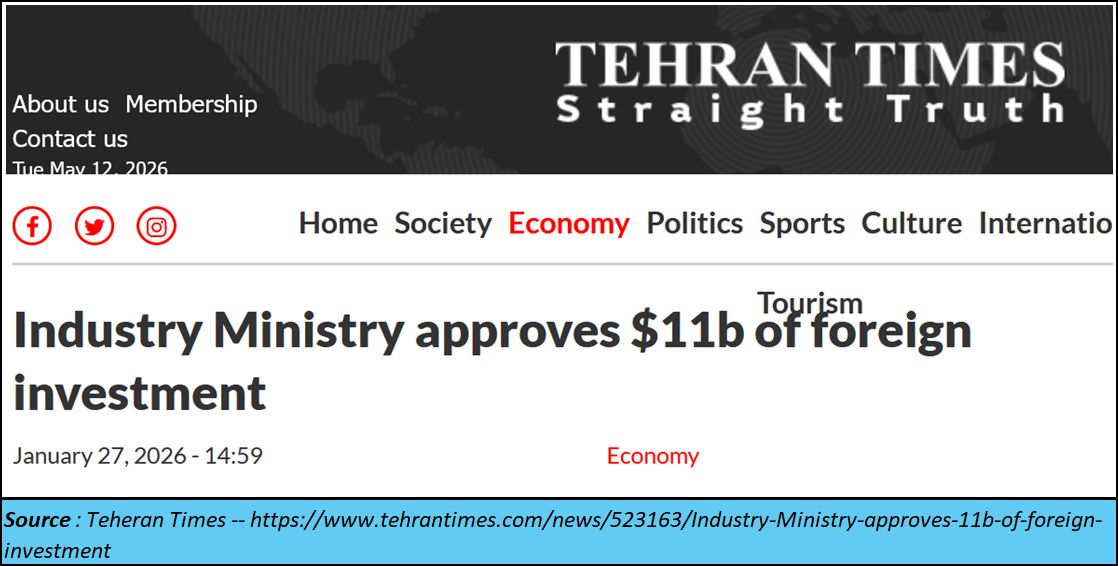
As Iranian sources point out, this $8.2B is actual approved investment, not long-term pledges. Teheran Times, however, puts this figure at a higher #11 bn (https://www.tehrantimes.com/news/523163/Industry-Ministry-approves-11b-of-foreign-investment).
 Transport corridors
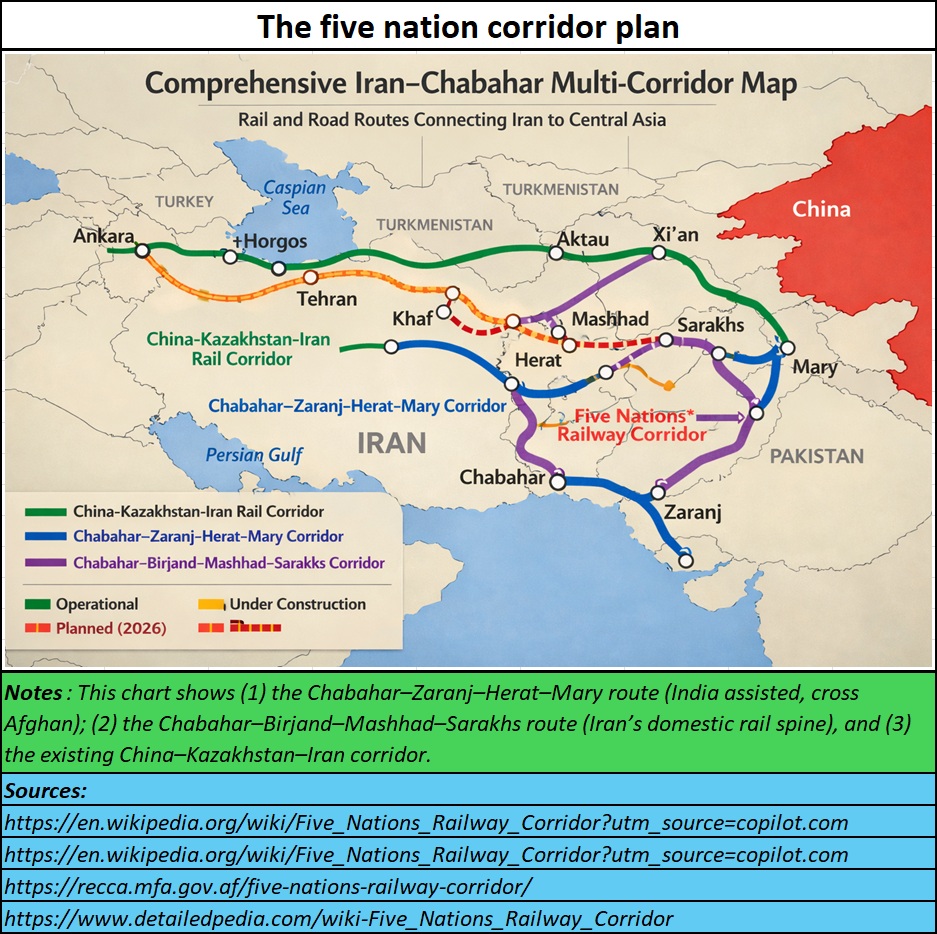
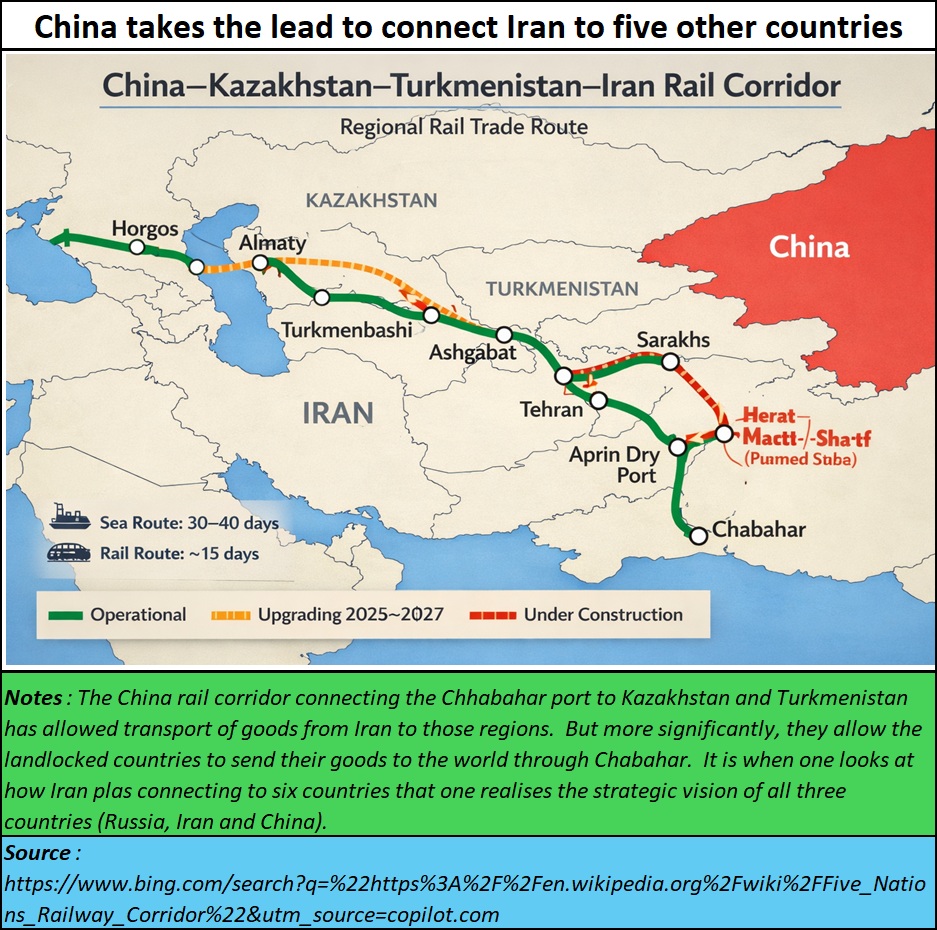
Unlike India, Teheran has focussed on building transport corridors – not only confined to Iran, but connecting five other countries (https://research.hktdc.com/en/article/MjE5NjMwNzc5Mw). What it has done is to look at existing trade routes and has expanded them to become rail links as well. It has also made existing routes sturdier and wider.
On 21 November 2025, representatives of six countries (Iran, China, Kazakhstan, Türkiye, Turkmenistan, and Uzbekistan) met in Istanbul and signed an agreement which makes Iran a gateway for the rail cargo transit from China to Europe. Iran’s strategic location makes it important for Russia, Pakistan, and China for easy access to the Central Asian and European countries.
 It is these linkages that permit Iran to trade with other countries even if the US or anyone tries to block trade routes.
More importantly, Iran’s infrastructure linkages render near redundant the IMEC (India-Middle East-Europe Economic Corridor) corridor https://www.imec.international/). This is the corridor that India was gung-ho about. So were the UAE and Israel. The biggest losers will thus be India, UAE, and Israel. Moreover, freight transit duration from the Middle East to China can also get reduced from 3-6 months to just a week or 10 days. US also loses because it won’t be able to block ocean traffic that is China bound. It thought it could do so at the Malacca Strait bottlenecks, in much the same way that it blockaded Japan during the Second World War. The new networks extinguish such possibilities. Suddenly, the US clout to impose sanctions also gets diminished.
 Iran and Pakistan
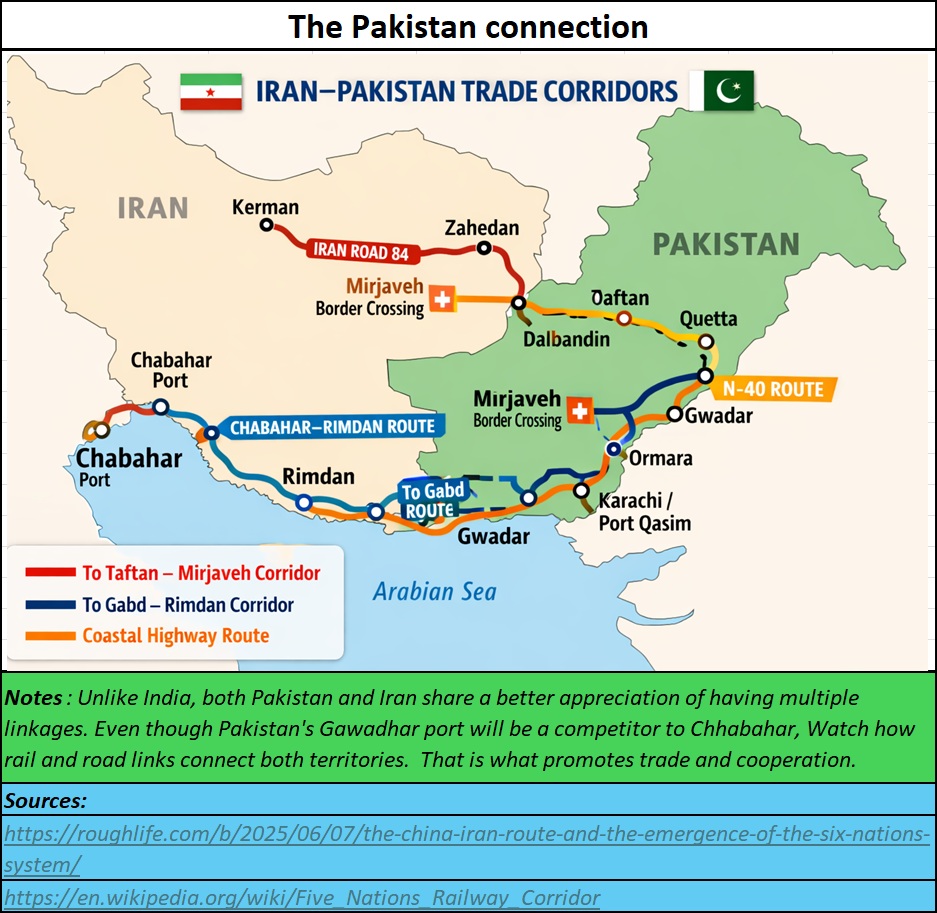
Iran enjoys a unique positioning in Asia. Any trading route would normally have to pass through Iran. Pakistan knows this quite well. That could be one reason why it has chosen to connect a competitor port at Chabahar in Iran with its own Gwadar port which too is being developed by China.
The strategic location of Iran persuaded Pakistan to open routes for Iran (https://timesofislamabad.com/27-04-2026/pakistan-opens-six-routes-for-iran-transit-trade-amid-crisis/). That could reshape regional logistics. Effectively, Pakistan has unlocked its territory as a corridor for goods headed to Iran. Traditional sea paths have begun to face severe disruption. “With 3,000 containers stuck in Pakistan, Iran explores more land routes,” says Al Jazeera (https://www.aljazeera.com/news/2026/4/24/with-3000-containers-stuck-in-pakistan-iran-explores-more-land-routes).
While Gwadar remains the major operational port today, there is every likelihood that Chabahar will become the key operational port within a decade. That explains the road and rail links between Chabahar and Gwadar, in addition to the existing waterways links.
It may also be remembered that Gwadar has a direct link to China through the CPEC (China-Pakistan-Economic Corridor).
Using the port connectivity links between Chabahar and Gwadar, Iran too will enjoy seamless access to China.
 The Russia connection
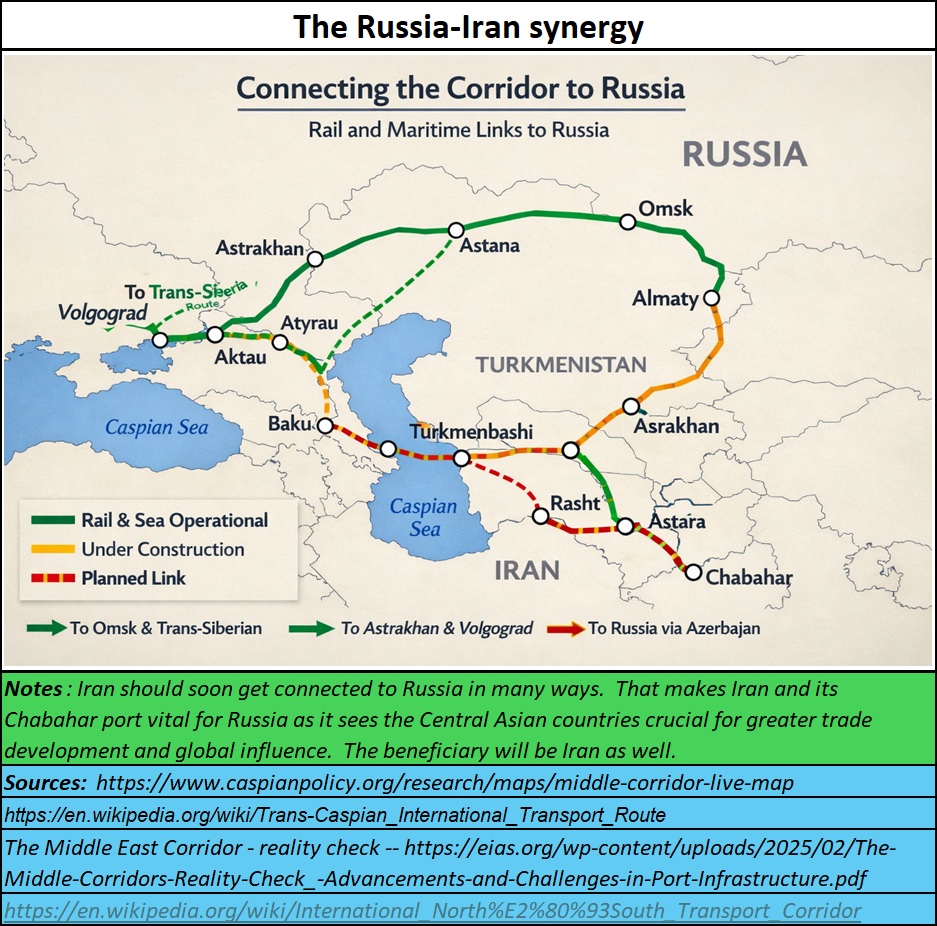
The next important route is the one connecting Iran to Russia, thus giving it greater access to Europe via the Caspian Sea.
Not surprisingly, while Russia will be using the road and rail links to Gwadar initially, it is expected to switch over to terminate cargo movement to the Chabahar port once work on this port is over and the linkages are functioning.
Effectively, Russia will have greater access to China in more than one way. It already has pipelines going to China (the Sakhalin1 and Sakhalin 2 oil pipelines, even while Sakhalin III is being planned) – (https://asiaconverge.com/2024/05/china-could-rebound-faster-than-many-imagine/). It will now be able to use the road and rail networks to move cargo to all the other connected by this network of railways and roadways.
US sanctions won’t apply any more for these countries.
 China’s role
China has already constructed the CPEC arterial connectivity between Gwadar in Pakistan to the Xinjiang region in China.
The CPEC accounts for a 3,000 km roadway (to be supplemented by a rail link as well). It will remain a crucial roadway for connecting to the Middle East, just in case the route via Malacca Straits is blocked. It derisks both China but also allows Iran access to the waters on China’s eastern shore. Effectively, if required, it can also supply oil and gas to Japan and its neighbours using the CPEC. Such a route helps reduce the oil import route from 12,000 km (by sea) to just 2,395 km. This corridor allows for both road and rail connectivity.
 Beyond railways
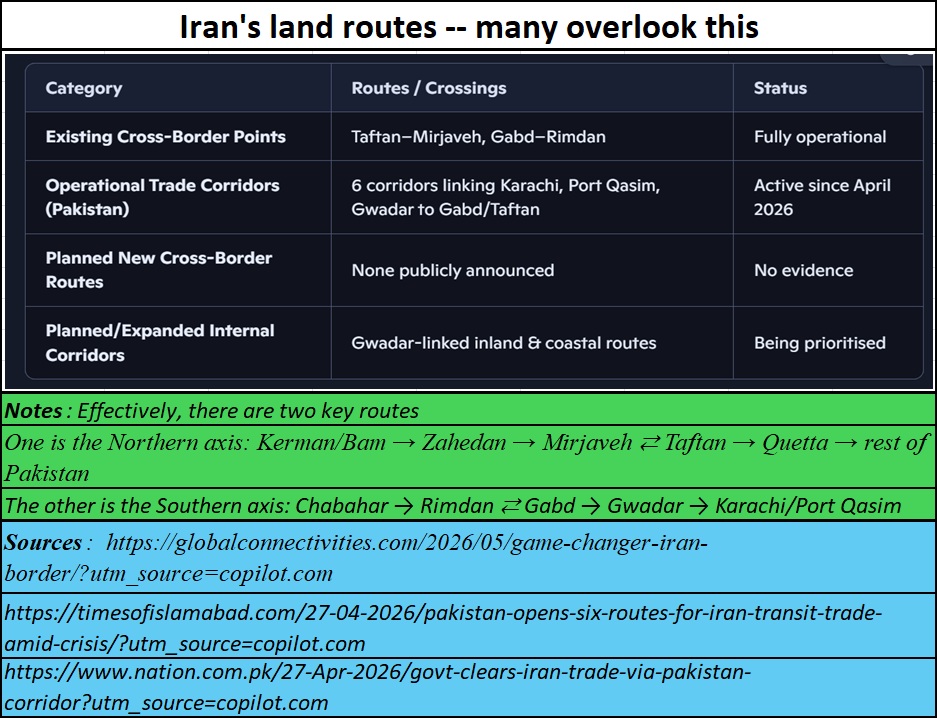
Iran already enjoys good connectivity with Pakistan. The Taftan-Ramdan route is already operational.
The six corridors linking Karachi, port Qasim, Gwadar, to Gabd/Taftan went operational in April 2026 (https://www.wionews.com/world/pakistan-notifies-6-transit-routes-for-iran-goods-amid-strait-of-hormuz-standoff-1777280774067).
And the best part is that even when Israel tried to bomb the railway and road network in Iran – barely a month ago – China jumped in to restore the damage done. The network – both rail and roadways – was revived and restored to full connectivity within just five days of the attack.
Contrast this with the damage Iran did to Israel in retaliation. It left the latter limping — even today. Israel does not have the technology or the ability to restore damaged road-and-rail linkages the way China and Iran have.
It may be mentioned here that the existing Taftan (Pakistan) – Mirjaveh (Iran) route is one of the oldest land routes between the two countries (https://timesofislamabad.com/27-04-2026/pakistan-opens-six-routes-for-iran-transit-trade-amid-crisis/). It is used for passenger movement, for pilgrimages to the holy sites in Iran, and for cargo movement as well. Traditionally, this route was used by camels for transporting goods and even people. Today, vehicles can ply comfortably on this route. It is also connected to Pakistan’s inland network via Khuzdar → Dalbandin → Nokundi → Taftan. All the six newly notified Pakistani trade corridors can ultimately feed into this crossing.
The Gwadar–Gabd corridor is the shortest and fastest route to Iran, reducing travel time to 2–3 hours.
 Huge benefits
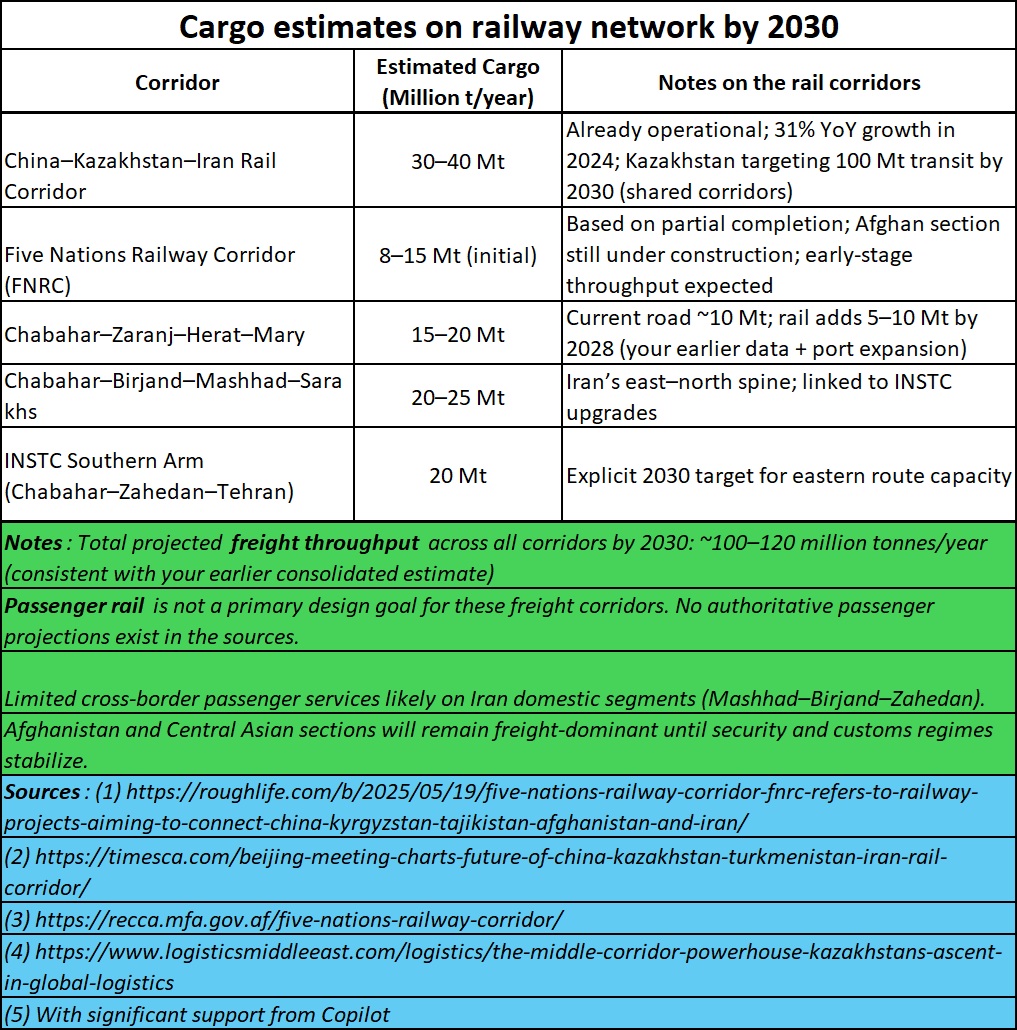
The networks which are being financed largely by China could transform trade routes and logistics. When completed in a couple of years, these roads and rail networks are to carry 100 to 120 million tonnes of freight each year. In fact, all the land locked countries to the north of Iran will now have better access to markets, benefitting all the countries in this region.
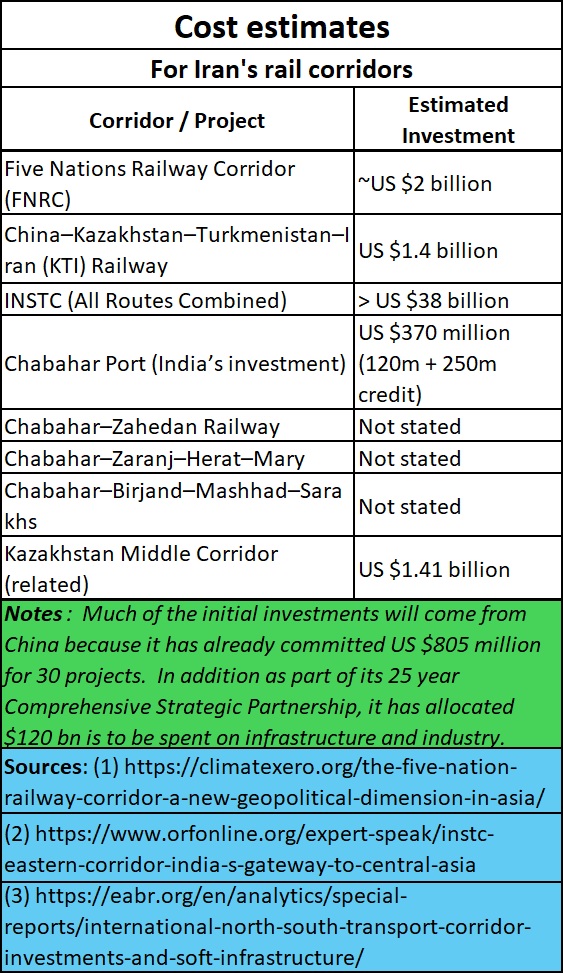 Much of the tab will be picked up by China. What it has spent so far is less than a billion dollars. It has budgets for $120 billion to be spent in Iran on infrastructure over the next 25 years.
Thus, while China also upgrades the petrochemical facilities in Iran, the improved transportation linkages will allow for the additional oil and gas to reach China faster – the transportation route gets shortened from 12,000 km to just 2,395 km. In terms of days, it could reduce the transportation time from six months to just a week (freight movement by sea can be painfully slow).
That is why blockading Iran is likely to remain a fanciful dream (https://www.firstpost.com/world/pakistan-opens-6-land-routes-for-iran-trade-as-hormuz-blockade-chokes-shipping-14005953.html).
Iran is formidable because it plans for contingencies. India has a lot to learn from Iran.
======================
Our latest podcast is on how Trump has become desperate because he is trapped. You can find it at https://youtu.be/nu-HVOgCPBM
======================
Also do watch the video on Republic TV which telecast my views on the recent Trump X Jinping meeting. This was telecast on 12 May before the meeting too place. You can find it at https://youtu.be/84AIcSVROqA?si=pWa2AOW7Icjx9j8M. Do expect a sequel to this video next week.
Our weekly “Breaking News features
- – Cooking oil becomes expensive
- – Trump Xi meeting
- – Oil crisis in India
- – Fuel implications, Rupee fall and export import
You can find it at https://www.youtube.com/watch?v=V7FxsiHSP5k
===================








COMMENTS