





















A new innings for gobar gas plants
By RN Bhaskar
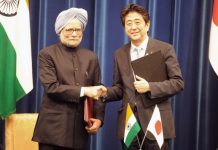
On Thursday, July 2, prime Minister Narendra Modi announced (https://www.pmindia.gov.in/en/news_updates/pms-press-statement-during-the-joint-press-statement-with-the-prime-minister-of-japan/) an India-Japan biogas initiative through which 1000 biogas (or gobar gas) and organic fertiliser plants will be set up in India. As Modi put it, “Through the India-Japan Biogas Initiative, we will get help in setting up 1000 biogas and organic fertilizer plants in India. This will further strengthen our GOBAR-Dhan initiative.”
The Gobar Dhan concept was mooted by Modi as early as in 2001, but the iea of promoting gobar gas got its initial push under the late Dr. Verghese Kurien the founer-chairman of NDDB and creator of the white revolution. He was the person who talked about a value chain from milk to cattle and to gobar, not just biogas. Kurien promoted biogas (gobar gas) for small and medium dairy farms, especially through NDDB’s rural energy and technology initiatives in the 1970-1990 period. Most people, who were contemporaries of Kurien, recall his advocacy for biogas as part of the cooperative dairy ecosystem. One of the authors of this article also had several meting with Kurien where he talked about such initiatives.
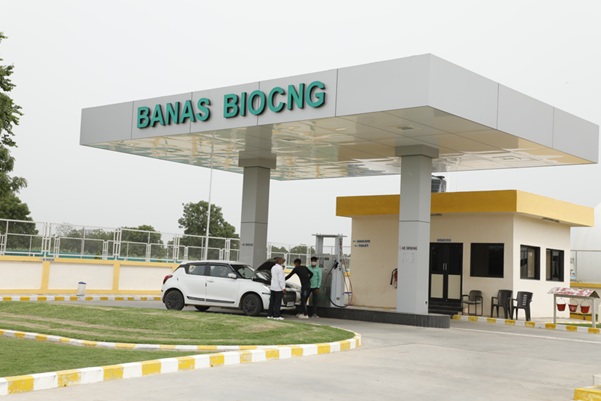 This vision continued to be pursued by NDDB, the organisation he set up with the whole hearted consent of the then prime minister of India, Lal Bahadur Shastri. NDDB continued encouraging dairy farms and cooperatives to set up biogas plants, initially for using the energy to generate electricity, and then for generating CNG for vehicles.
Janan enters the picture
But the going has been slow, because it takes quite some time to scale up operations, as well as to get the funds required for setting up such plants.
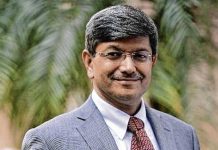
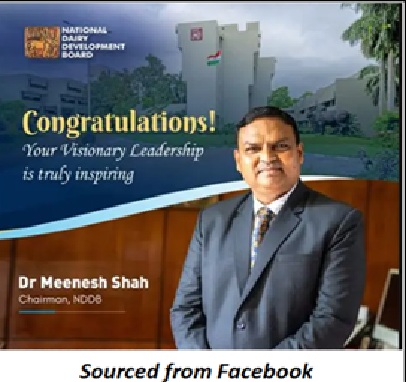 This is where the entry of Japan will give a shot in the arm to NDDB and its chairman Dr, Meenesh Shah. He explains how NDDB has “developed various models. For example, the decentralized model with a small biogas plant at the farmer’s backyard — not new — and then making clusters of those biogas plants, saturating villages wherever you have animal-holding households, and then collecting the bio-slurry after the biogas is utilized at home. . . . . . Then, a women’s cooperative will convert that bio-slurry into organic fertilizers, and the bio-fertilizers are sold. The revenue is ploughed back to farmers.”
Meenesh Shah continues this effort by NDDB by adding “Then we thought that decentralized small biogas plants had issues related to maintenance at the farmer’s level. Though they got subsidies, whenever there was a small problem, they discontinued the biogas plant. That was a major challenge. So, we introduced a flexi-biogas-plant, which is very easy to manage and operate, and that’s how it picked up. We have now about 80,000 such biogas plants already.”
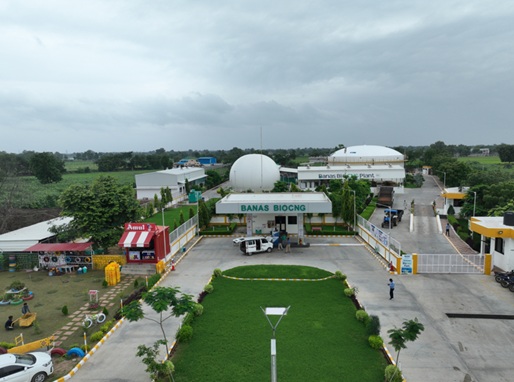
Some of the most impressive plants can be found at places like Banas, Kalol , Godbach and Hingonia among many others.
 Scaling up the business
The work began from Gujarat, around Anand, which was the epicentre of all the plans the Kurien formulated. Explains Meenesh Shah, “We started from Gujarat, of course. Near Anand there is a village called Zakariyapura, which we completely saturated — 370 households, every household with an animal. We provided a plant. Even today, after six, seven years, they are all functioning. So, the major challenge of abandonment due to small issues was mitigated. The farmers are happy. We have one person from the village who is trained, so minor repair and maintenance issues are taken care of locally.”
It was then that NDDB realised that small biogas plants were not the best solution for almost 8 crore families which were involved in dairy and animal husbandry. “So, we ventured into centralized biogas plants where you collect dung at one location. We set up a 100 metric ton plant at Varanasi, inaugurated by the Prime Minister.”
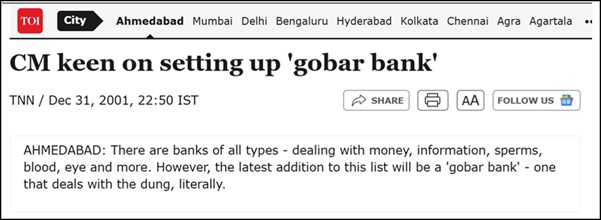
Prime minister Modi too tried to centralise such plantgs by pushing for Gobar Banks when he was chief minister og Gujarat (https://timesofindia.indiatimes.com/city/ahmedabad/cm-keen-on-setting-up-gobar-bank/articleshow/1430853600.cms). However, the lack of a good response, prevented a robust collection system for gobar to materialise. The project was forgotten. That is where NDDB’s tenacity paid off.
 Gobar-Dhan Yojana?
After assuming the role of prime minister, a new slogan was coined – GOBAR. It is an acronym for Galvanizing Organic Bio Agro Resources. The aim of this scheme is to ensure cleanliness in villages and generate wealth and energy by converting cattle dung and solid agricultural waste into compost and Biogas. Under the Swachch Bharat Mission (Rural), the Central government strives to use animal dung and other bio-waste to produce energy — like some European countries and China do. This is hugely helpful for the country as India is home to the largest cattle population in the world, close to 300 million in number, with a daily output of 3 million tonnes of dung. Modi articulated his scheme in February 2018. (https://www.financialexpress.com/india-news/what-is-gobar-dhan-yojana-take-a-look-at-narendra-modi-governments-waste-to-energy-conversion-scheme/1078643/)
NDDB and Japan
That is where the entry of Japn makes things better for NDDB and even the country. Meenesh Shah explains the need for NDDB to push the value chain a bit more aggressively in order to focus on CNG generation. It would help India reduce its import bill and also deal with pollution to a great extent.
He explains, “We are going ahead with the CBG model. Thanks to the recent India–Japan cooperation agreement, scaling up is now possible. Japan is already into this area and provides technical inputs, Once funding happens between the two countries, the India–Japan cooperative biogas initiative signed in the presence of both Prime Ministers will become a significant step for clean energy and will establish a circular economy in the dairy sector . . . . . Discussions are between the two governments; the agreement was signed between MITI (Japan’s Ministry of Economy, Trade and Industry) and the Ministry of Cooperation and Ministry of Animal Husbandry and Dairying, Government of India. NDDB is designated as the implementing agency.”
As things stand now, the agreement is signed; discussions are underway on funding. The target of 1,000 biogas plants is divided into two phases of 500 units in each phase.
Each plant will have capacity of 100 metric tonnes of dung per day. NDDB has demonstrated the technology: three plants set up by NDDB in Banaskantha are already working. Another six or seven plants are being set up with Suzuki R&D using CSR funds in Gujarat. Technology and viability are proven.
NDDB’s target is modest — to set up 20-30 such units in the very first year (2027–28). NDDB prefers it this way because there will be a lot of learning involved. As information and expertise are absorbed, the numbers will increase. As of now three plants are working and another six or seven are being established — roughly 10 such plants initiated outside this agreement.
This project could be extremely important in many ways.
First, it would cater to the waste to energy opportunity that this author has always championed (https://asiaconverge.com/2014/11/waste-management-big-shitbig-money/).
Second, it is a better alternative than ethanol through sugarcane or grain because they are technologies that poach on a food source (sugarcane is also a water guzzler, which is bad for a water stressed country like India). They will be needed, because India’s requirementsare far too large. But the returns from Gobar to CNG could be significant.
Third, at least in states where the cattle slaughter ban is being pursued vigorously, old animals straying on the road could be dealt with mor effectively. They will lack the synergy with the beef and leather industries, and they ould deny the farmer of the money he got from the sale of old cattle. But gobar to CNG is certainly less painful than cattle roading the streets (https://bhaskarr.substack.com/p/dairy-ruminations-that-make-little).
Fourth, it is only a matter of time before all types of waste – agricultural, human and animal waste – are also used in the waste to energy strategy.
Lastly, it iks certain that this time the Japanese will have a better relationship with India thanks to the work that NDDB has already done. Currently, Japan is miffed about the way its Dedicated Freight Corridor, the DMIC and the Shinkansen projects have been handled by India (https://asiaconverge.com/2026/07/japan-grumbles-about-indias-project-management/). NDDB has a reputation of not giving up on any project it has embarked on. That will be excellent for India’s image.
A lot will also depend on India’s ability to ensure that politics does not get into the way of project implementation. But, so far, NDDB has shown that it has a steady hand on the wheel.
The gobar-to-energy story is likely to become very exciting.
Synopsis: The India-Japan gobar gas agreement could usher in a new chapter for the cattle and waste-to-energy industry. NDDB is the nodal agency for building 1,000 gobar to gas plants in India in collaboration with Japan.










COMMENTS