

























9 November 2026
India and a hollowed-out Viksit Bharat
By RN Bhaskar & Sakeena Bari Sayyed
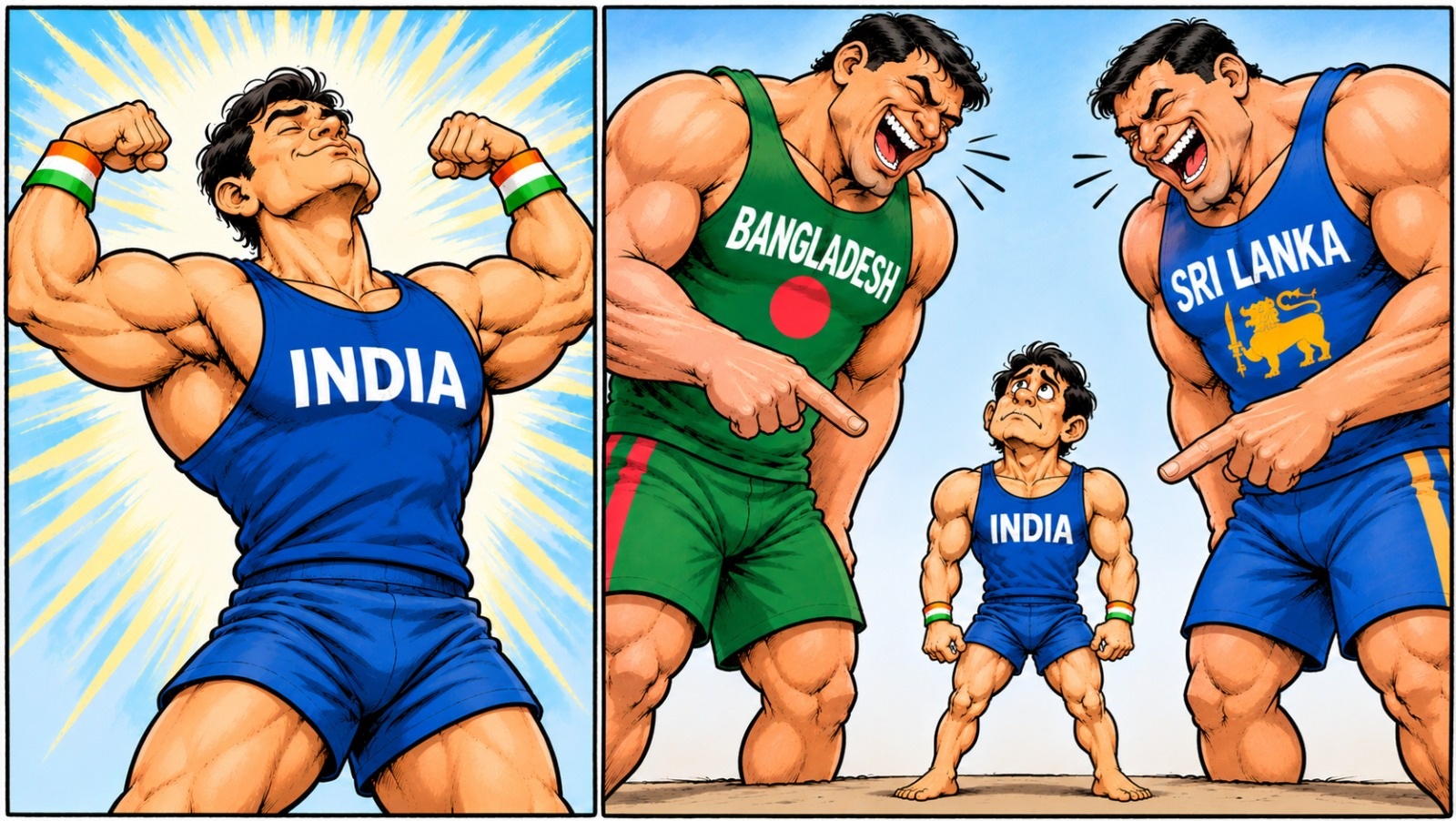
Image:Chatgpt
Even while India was touting its achievement in reducing poverty, there was a stunning report which pointed to the opposite (https://foreignpolicy.com/2020/10/20/india-falls-behind-bangladesh-gdp/). Even growth prospects for India are expected to decline according to the World Bank (https://www.imf.org/en/publications/weo/issues/2026/10/13/world-economic-outlook-october-2026).
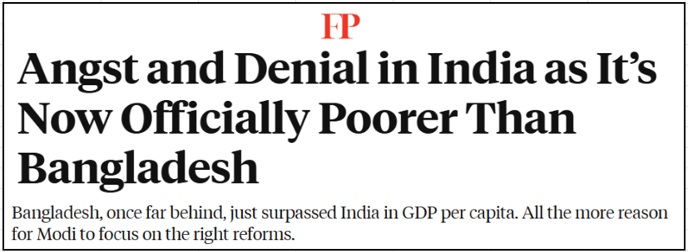 This was also taken up by other media sources, notably Deshbhakt (https://www.youtube.com/watch?v=WZtwLdHqBdg). The story about reducing poverty in the face of a higher per capita income by Bangladesh does not wash. Bangladesh is a poor country. Yet if it can boast of a higher per capita income than India, it means poverty is more acute in India.
So, what is the truth?
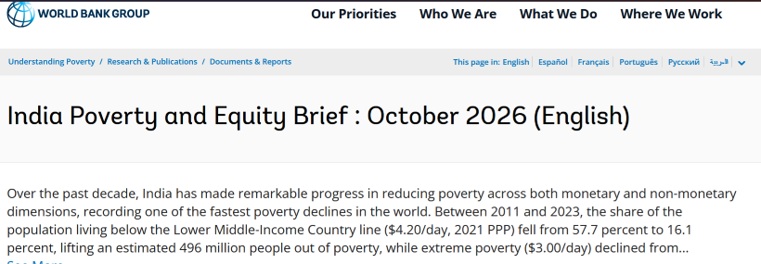
Let’s look at what the World Bank said (https://documents.worldbank.org/en/publication/documents-reports/documentdetail/099722104222534584), “Over the past decade, India has made remarkable progress in reducing poverty across both monetary and non-monetary dimensions, recording one of the fastest poverty declines in the world. Between 2011 and 2023, the share of the population living below the Lower Middle-Income Country line ($4.20/day, 2021 PPP) fell from 57.7 percent to 16.1 percent, lifting an estimated 496 million people out of poverty, while extreme poverty ($3.00/day) declined from 27.1 percent to 2.6 percent.”
So, did India actually reduce poverty? The problem lies in the definitions. The World Bank statement is based on data submitted by India that poverty defined as Multi-Dimensional Index (MDI) on the one hand, and PPP (price purchase parity) showed that India’s poverty did decline.
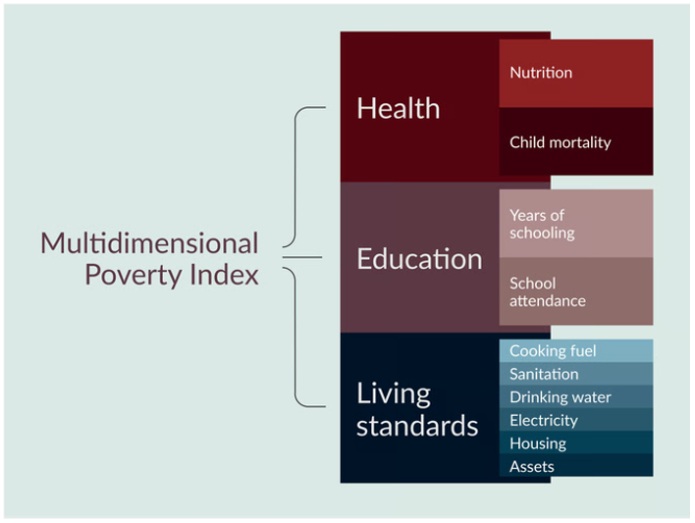
As the chart above shows, MDI is based on three inputs – health, education and living standards. Each of these three have equal weightage.
As everyone knows, the state of India’s health services is terrible (https://asiaconverge.com/2018/08/ayushman-bharat-great-concept-doctors-overlooked/). Medical education is also in dire straits (https://bhaskarr.substack.com/p/medical-education-in-india-is-growing?utm_source=publication-search).
So is education (https://bhaskarr.substack.com/p/poor-education-will-eventually-damn?utm_source=publication-search).
If these two parameters are terrible, it is difficult to see how the third – living standards – could have done well enough to counter the terrible state of the other two. Moreover, all data on employment also points to growing unemployment (https://bhaskarr.substack.com/p/the-cjp-terrifies-the-government). It would appear, therefore, that the government has converted two of its vaulted claims – (1) that it feeds 80 crore (or 800 million people a day with free food); (2) that it provides drinking water to each household. The first could be true, because all the surplus grains India grows, and which are considered sub-standard, often finds its way to the government schemes of free food (https://asiaconverge.com/2021/09/need-sensible-laws-to-stop-farmer-exploitation/). As for water availability, you still see photographs of village women trekking for miles to get water in many places. So, clearly, the data provided by the government to the World Bank may not reflect realities on the ground.
Moreover, the poverty estimates are not made on dollars earned per capita. They are based on PPP or price purchase parity, where the scope for interpreting figures is immense.
GDP worries
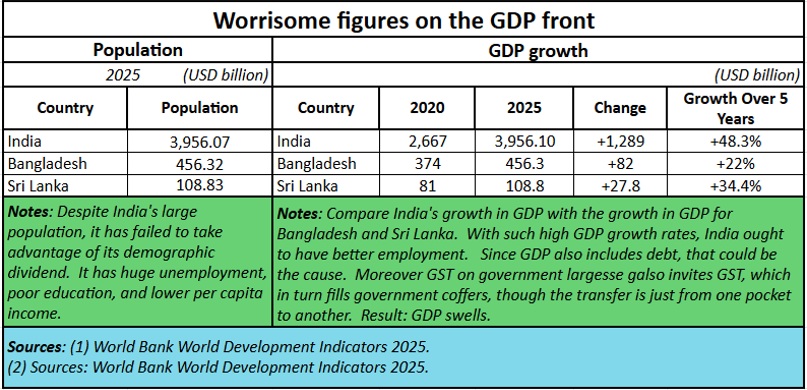
Look at the GDP growth numbers of India and compare them with the GDP growth numbers for two of India’s neighbours.
India’s GDP growth numbers appear far too high compared with those of Sri Lanka and Bangladesh. One reason could be that India borrowed lots of money to build infrastructure – much of which was substandard (https://bhaskarr.substack.com/p/a-bridge-too-far).
Moreover, there is also the issue of GST (https://bhaskarr.substack.com/p/indias-gst-and-gdp-gas-balloons?utm_source=publication-search). The government’s huge spending on projects which are not necessarily economically relevant has always caused India’s GST numbers to surge. This is because every rupee given away by way of largesse invariably gets spent on items that invite GST of around 12% or more. Thus, the more extravagant the government becomes, the more its GST grows. These, in turn, could have helped push up India’s GDP faster than that of the other two countries.
Per capita issues
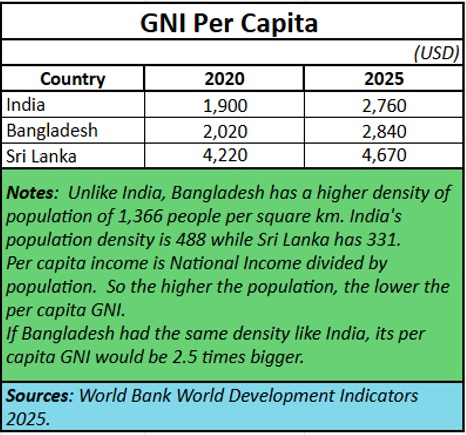
Bangladesh’s per capita income is extremely impressive because it has managed to get a per capita GNI that is higher than India.
By itself, a higher per capita GNI is good news. But for Bangladesh it is even more impressive because it has a higher density of population of 1,366 people per square km (https://www.worldometers.info/world-population/bangladesh-population/).
India’s population density is considerably lower at 488 (https://data.worldbank.org/indicator/EN.POP.DNST?locations=IN). In the case of Sri Lanka, it is lower than that of India at 331 (https://www.worldometers.info/world-population/sri-lanka-population/).
It must be noted that Per capita income is Gross National Income (GNI) divided by population. So, the higher the population, the lower should the per capita GNI. Thus, Bangladesh’s per capita income should have been 2.5 times lower than India’s if they were at the same stage of development.
What this also means is that if Bangladesh had enjoyed the same level of population density that India has, its per capita GNI would have been 2.5 times higher than it currently is.
India has to study the causes that made that country grow faster than India (https://asiaconverge.com/2022/05/bangladesh-trounces-india/).
In fact, as we have observed in the past, more Indians want to work in Bangladesh than the other way around. My conversations with a cab driver in Dubai revealed that Bangladesh offers drivers a higher salary than even Dubai and that many were going back to their country.
Thus, the political slogan about infiltrators and ‘Ghuspetiyas’ may not give the true picture. They may refer to Bangladesh immigrants that came to India when they were poorer. Currently, there would be greater reluctance on their part to come to India.
What should India do?
First, India should begin focussing on social harmony rather than communal disaffection. Hatred slows down economic development. It even destroys nations, as the experience of Myanmar and Israel will show.
Second, it should focus on education – especially science and maths – with greater vigour rather than trying to appoint teachers based on religion, caste, or language. Stop polarising schools (https://bhaskarr.substack.com/p/ideology-hobbles-gujarat-and-maharashtra). Being selective about history and language only makes school administrators get distracted by issues that are not core to education. Get back into participating at the PISA scores.
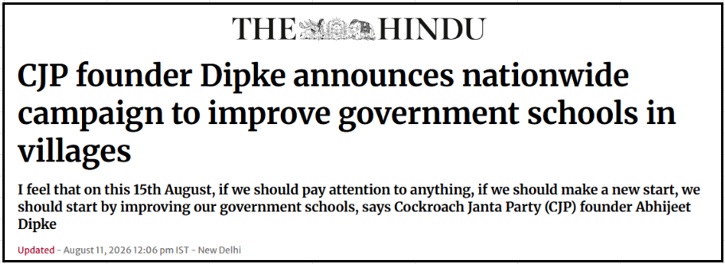
Pay heed to the CJP cries about good schools (https://www.thehindu.com/news/national/cjp-founder-dipke-announces-nationwide-campaign-to-improve-government-schools-in-villages/article71330976.ece). If school education is not improved, the rot will spread to higher education as well, and will severely impact the quality of employment (unless the government wants the youth to end up as delivery agents for quick-service companies. The government must learn not to meddle with higher education.
The government should also be working full-time on improving girl education. They should be encouraged to join the mainstream for jobs. But with the dismal record of states like Uttar Pradesh and Bihar on gender justice (https://asiaconverge.com/2021/07/hindi-belt-ii-crimes-against-children-and-against-humanity/), it is unlikely that the country will even be able to protect its women and children – never mind the statements by politicians on this subject.
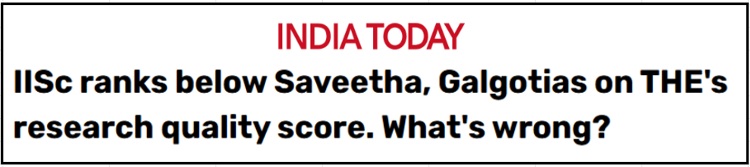 The latest results on the ranking of the Indian Institute of Science is a good example of how rapidly India has been falling. (https://www.indiatoday.in/education-today/featurephilia/story/the-rankings-2027-why-saveetha-lpu-graphic-era-beat-iisc-on-research-quality-3008161-2026-10-02)
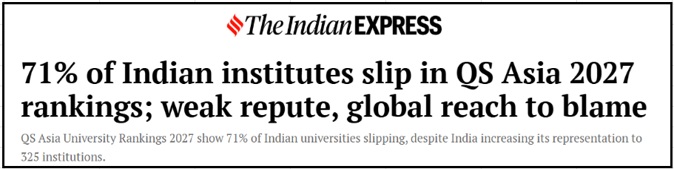 In fact, the decline in education is almost secular, starting from schools and now afflicting all institutes of higher education (https://indianexpress.com/article/education/qs-asia-university-rankings-2027-indian-universities-rank-drop-iit-delhi-iisc-71-percent-universities-slip-ranks-10947471/). At a time when AI is devouring routine jobs, the need to revamp quality education is crucial. This includes upgrading teachers’ salaries so that better talent finds education attractive, depoliticising educational institutes, stricter evaluation without the scourge of “paper leaks”.
The government should have its hands full to be working on these fronts on a war footing. Expending energy, time and money on touting suspect poverty alleviation numbers is the last thing it should be working on.
Unfortunately, many governments don’t learn. And the casualty is invariably the common man.
================
Do watch our latest podcast. It is on Elon Musk’s attempts to offer Starlink services in India. He probably hoped that Trump’s push would make India open its doors to Starlink. But now Trump is a lame duck president. And security concerns hobble Starlink. The going may be tough. You can watch it at https://youtu.be/3v7gT6O3ApQ
———————
Finally, do not forget our News behind the News
- US elections: Changing fortunes
- Diverging turbulence in markets; in USA and India
- Gold loans delinquencies contradict poverty elimination claims
You can find it at https://www.youtube.com/live/51yfhTw1bvs?si=2Jc4pIk3iRTBEahX
============================









COMMENTS