






















2026-09-28
FDA Maharashtra and Mundhe may not be the knights in shining armour
By RN Bhaskar and Sakeena Bari Sayyed
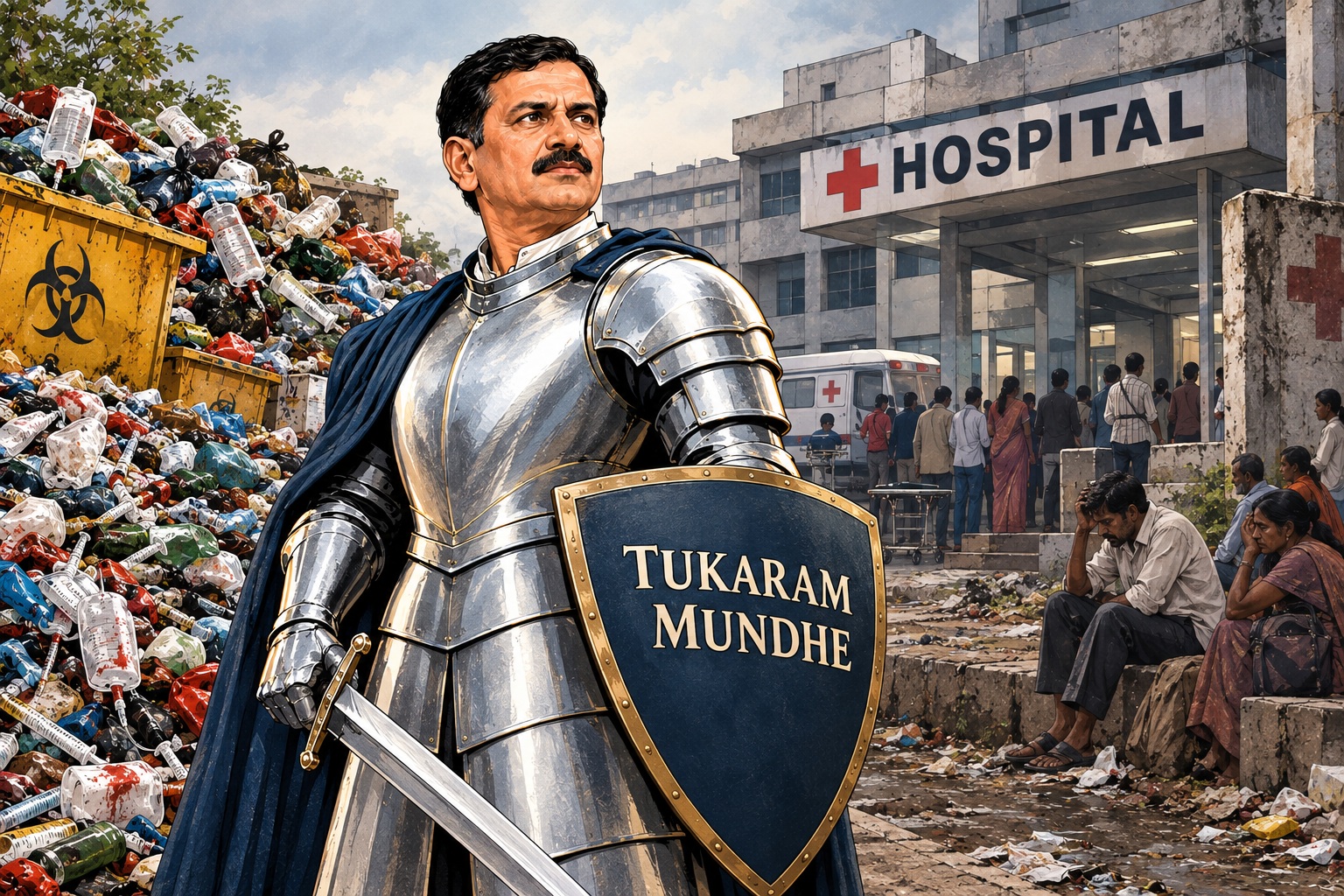
Image: Chatgpt
Tukaram Mundhe became the Commissioner of the Maharashtra Food and Drug Administration (FDA) on May 25, 2026. He has already built a reputation of being a no-nonsense officer intent on improving the standards of health and hygiene in the state of Maharashtra.
During the first 100 days of his office, a Facebook notation (https://www.facebook.com/TVIOfficial/posts/tukaram-mundhe-has-completed-100-days-as-commissioner-of-the-maharashtra-fda-wit/1066868366056588/) records that he has led 904 raids, resulting in 457 arrests and the sealing of 322 food establishments. The FDA also seized fake, adulterated and prohibited products worth ₹34.7 crore. His drives have also resulted in 12,083 notices being issued for food-safety violations. He has also ensured that notices have been sent to several Bollywood celebrities for participating in advertisements suspected of indirectly promoting restricted or banned products. As a result, he has gained near celebrity status (https://www.bbc.com/news/articles/c1wx3v11de7o).
That is good news for a society that hears of rampant corruption all around, with authorities turning a blind eye to infractions. So, is Maharashtra’s FDA turning a new leaf?
 The other side
Not really. Just look up the BBC report itself (https://www.bbc.com/news/articles/c1wx3v11de7o). It quotes Niranjan Laxman Shetty, legal chairman of hospitality association Indian Hotel and Restaurant Association, who says, “While compliance is non-negotiable, high-handed approaches – like public naming-and-shaming, instant suspensions over minor procedural or rectifiable issues and treating administrative oversights with harsh penal measures – create panic rather than reform,”
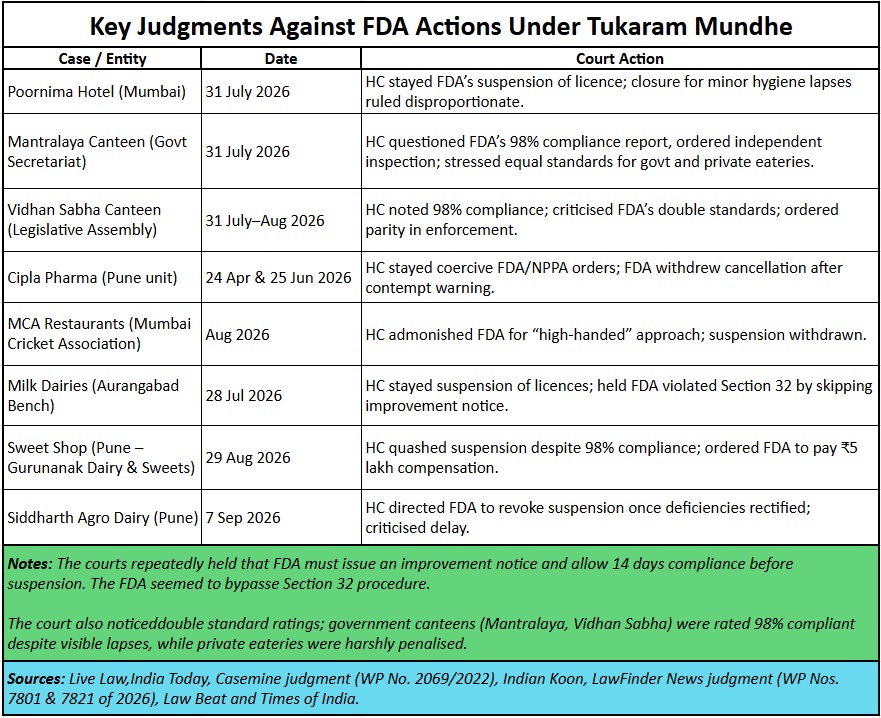
In fact, the FDA Maharashtra has been hauled up by the courts time and again for violating the law, and even picking targets selectively. Some of the key court cases are listed in the box alongside.
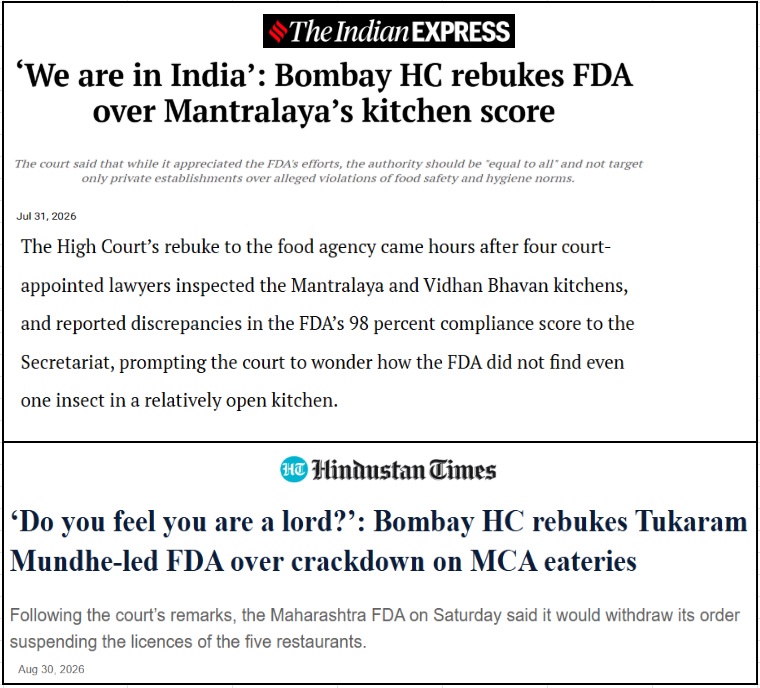 For instance, the courts have overturned licence suspensions in some cases. In other instances, it has ordered compensation for affected businesses. In most court cases, the FDA has been rapped for its approach towards business establishments.
Moreover, at times it has been sharply rebuked for its actions against a popular eating establishment called “Poornima”, even while the FDA gave the Mantralaya canteen a high rating of 98%.
Some critics believe that the strict drive is to force establishments to increase the amount of (graft) money that they pay regularly to a variety of government inspectors – ranging from those dealing with shops and establishments (https://asiaconverge.com/2016/12/want-to-uproot-corruption/) to the FDA itself. This is also true of its associate organisation the FSSAI (The Food Safety and Standards Authority of India). While the FSSAI creates the rules from the top, the State FDA does the ground-level policing to keep food safe.
Since the FSSAI creates the rules, the FDA has not commented on the absurdity of the rules (https://youtu.be/ghnkyQEdp64?si=prQ2vulftAi7rYza). Eventually, it was the Supreme Court itself that has to haul up the FSSAI for delaying mandatory front-of-pack warning labels on packaged foods high in sugar, salt, and saturated fat (https://www.thehindu.com/news/national/supreme-court-slams-fssai-for-not-introducing-front-of-pack-warning-labels-on-packaged-food-products/article71342214.ece). This column has often argued that the FSSAI ought to have been hauled up for manslaughter for introducing measures that would have killed more children, and for promoting sugar consumption in a country already burdened by the incidence of diabetes. The story about cough syrup deaths is another incident that should make the FDA ashamed (https://asiaconverge.com/2025/10/cough-syrup-deaths-indias-drug-authorities-abet-murder/).
In fact, FSSAI too had another brush with law when it sought to ban Nestle’s Maggi noodles on rather specious grounds (https://asiaconverge.com/2015/10/food-drugs-ban-leads-to-caprice-and-corruption/). Even then, it appeared that FSSAI wanted to coerce Nestle into making some kind of compensation. Finally, the court stepped in, and FSSAI sheathed its claws.
Even right now, FSSAI has gone on to ban other organistions (https://www.hindustantimes.com/india-news/fssai-cracks-down-on-e-commerce-over-food-violations-amazon-swiggy-instamart-bigbasket-flipkart-zepto-under-scanner-101790173217694.html) . It said it had initiated penal action against five e-commerce platforms over various non-compliances. Among those facing action are Amazon, Swiggy Instamart, BigBasket, Flipkart India and Zepto. The non-compliances include misleading claims and sale of prohibited products.
As one looks at the FDA’s raids and acts of naming and shaming, one begins to realise that this is actually a good way to divert attention from the FDA’s own actions. Instead, like politicians today, it seeks to blame others.
Just two incidents are adequate to point to the sad levels to which corruption and extortion by the FDA have reached.
The SMS Envoclean case
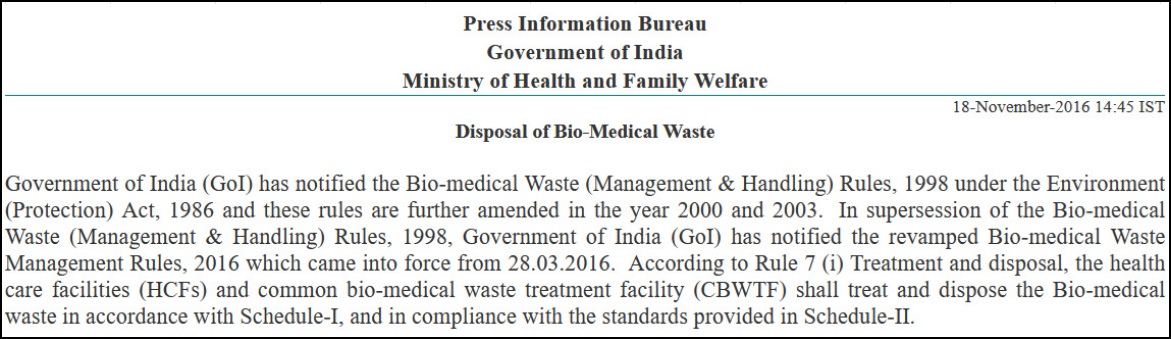
In 2005 the FDA discovered a new way of making money under the garb of public safety and hygiene. It came on the heels of the introduction of the government of India notifying the Bio-medical Waste (Management & Handling) Rules. After being modified a couple of times, the central government brought in a new law in 2016 — Bio-medical Waste Management Rules, 2016. This rule superseded other rules and came into force in March 2016 (https://www.pib.gov.in/newsite/PrintRelease.aspx?relid=153792®=48&lang=2). According to Rule 7 (i) Treatment and disposal, the health care facilities (HCFs) and common bio-medical waste treatment facility (CBWTF) shall treat and dispose the Bio-medical waste in accordance with Schedule-I, and in compliance with the standards provided in Schedule-II.
 In Maharashtra, the 1998 rules were implemented almost immediately.
By 2005, a company called SMS Envoclean was set up as a private company. Its authorized share capital was Rs. 4.25 crore and its paid-up capital was Rs. 4.22 crore (https://www.zaubacorp.com/SMS-ENVOCLEAN-PRIVATE-LIMITED-U52100MH2005PTC156774). Its last balance sheet was filed with the Ministry of Corporate Affairs (MCA) in March 2023. Effectively, it has not filed its returns for three years. According to the NIC code, it is involved in non-specialized retail trade in stores. Its registered office is at 20 IT Park, Gayatri Nagar, Parsodi, Nagpur, Maharashtra, India – 440022.
Interestingly, the FDA and the Maharashtra Medical Council mandated this company to collect biomedical waste from all doctors, clinics, pathology labs and hospitals in the state. It is not known if there are other companies also authorised to collect biomedical waste, but to our best knowledge and belief, it is a monopoly. We have not seen any tenders inviting people to participate in the collection of biomedical waste.
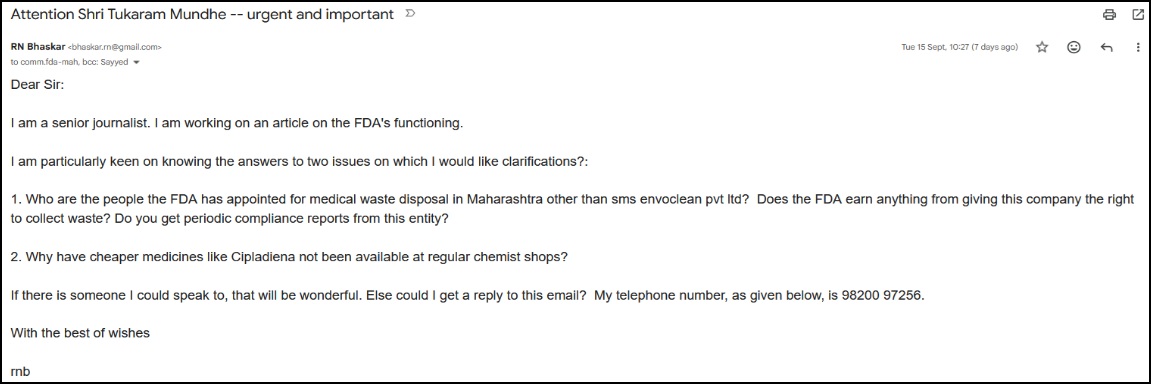 Unfortunately, neither the FDA nor the company responded to our emails. The FDA email was also followed up with a tweet to ensure that it was publicly available, just in case the email was not seen (https://x.com/rnbhaskar1/status/2099724811241197692). But the FDA chose not to respond to our queries.
Curiouser and curiouser
The SMS Envoclean case arouses curiosity because of the following reasons:
- It enjoys a mandate (possibly sole mandate) to collect biomedical waste from all establishments in Maharashtra.
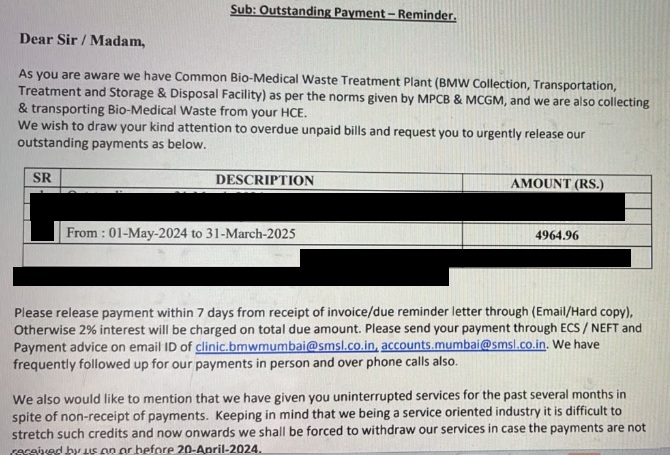
2. The minimum charge for doctors – even those who produce no medical waste – is Rs.4,965 per annum. Doctors pay up, instead of facing notices and court summons. Moreover, non-disposal of biomedical waste in the proper way can invite serious penalties.
3. The waste is supposed to be collected within 48 hours (https://hspcb.org.in/uploads/laws/BMW_Rules.pdf). But SMS Envoclean does not collect such waste for days, even months. Effectively, money is collected for a service, but the work is left incomplete. Collateral damage of spreading infection is something that the FDA is not worried about. It is only concerned with the collection of money.
 How much money?
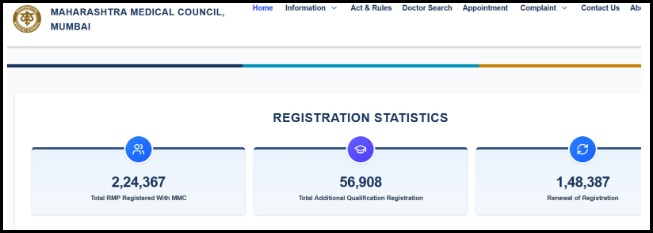
Frankly, we do not know. All we know is that the Maharashtra Medical Council has this number (https://maharashtramedicalcouncil.org.in/). It has 224,367 doctors. This number keeps increasing by around 30,000 each year (https://drive.google.com/file/d/19XmWg4Y0jnoCPKDWqK0wnU98Zs9aD0u9/view). A simple multiplication of 224,367 by Rs. 4,965 gives you a sum of Rs.111 crore. But that is only for starters.
SMS Envoclean has a rate card depending on the volume of waste generated. So, a pathology lab would generate a lot more waste than a single doctor. Many doctors don’t generate waste at all but still pay up. Hospitals generate multiple times the waste that pathology labs do.
Our reckoning is that the total collection of cash could easily exceed Rs.1,000 crore each year. But, as we mentioned earlier, no audit trail of the collections is available.
We would like to emphasise that there is nothing wrong with collecting money. The problem is two isues. First, encouraging a monopoly, without due process being adopted. Second, collecting money and not offering the service for which the money was taken. The first priority is that biomedical waste, which is highly hazardous, should be collected every day, or at least once in 48 hours. Why has the FDA not ensured this? Biomedical waste is more dangerous than all the infractions that the FDA has identified in eating joints. Effectively, all the charges against hospitals smacks of hypocrisy.
What is the use of penalising small food establishments for unhygienic conditions when the very centres that are meant to take care of health end up spreading diseases? Has the FDA Commissioner considered that? Or is blame only meant for others?
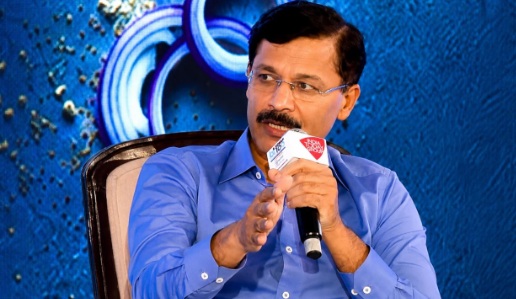
It is such examples of double-standards that make one suspect that FDA Commissioner’s highly publicised blitz-krieg is nothing more than a PR stunt, which is meant to conceal the deficiencies and the avariciousness of the FDA itself. Moreover, as suggested by some critics, it could be to frighten industry into paying larger amounts of ‘protection’ money. The last is a charge that one hears of. But nobody is willing to come on record. For instance, charges are made out against a manufacturer, then mysteriously dropped. A recent case involved a mosquito repellent incense stick manufacturer. The product is still available, albeit discreetly.
However, the non-collection of biomedical waste is clearly visible in hospitals and outside clinics. Similarly, it is possible to collect evidence of money collections from every establishment each year.
 Cheaper medicare
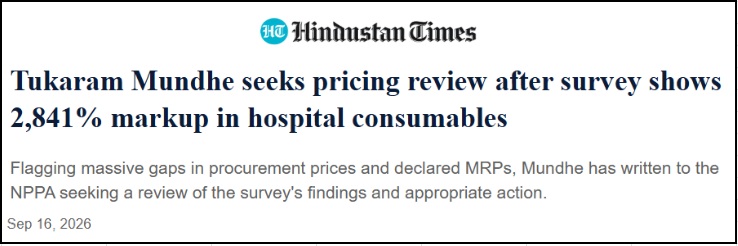
Maharashtra Food and Drug Administration (FDA) Commissioner Tukaram Mundhe has officially urged central regulatory bodies to crack down on predatory pricing, uncovering markups as high as 2,841% on essential hospital consumables and medical devices. Following a comprehensive survey across private hospitals in regions like Mumbai, Pune, and Sambhaji Nagar, the state regulator exposed severe price discrepancies between what hospitals pay to procure items and the Maximum Retail Price (MRP) billed to patients (https://www.hindustantimes.com/india-news/tukaram-mundhe-seeks-pricing-review-after-survey-shows-2841-percent-markup-in-hospital-consumables-101789552553014.html).
He gives examples of where the pricing quoted by hospitals is out of sync with actual prices (https://www.youtube.com/watch?v=dOgUs_fptuU&t=3s):
- IV Infusion Sets: Procured by hospitals at a trade price of ₹11.05, but sold to patients at an MRP of ₹325 (a 2,841% markup).
- Syringes: Procured at ₹6.75, carrying an MRP of ₹57.20.
- Catheters: Procured at ₹29.41, carrying an MRP of ₹310.
- Nebulizers & Oxygen Masks: Procured between ₹40 and ₹45, carrying MRPs ranging from ₹650 to ₹715.
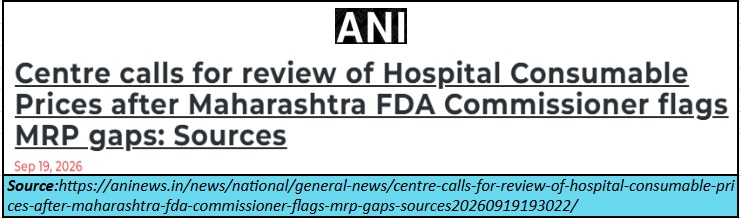 The citing of such price distortions has in turn turned the heat on the government. The central government has now called for a review of hospital consumable prices.
That in turn has caused the Central government to review procedures and pricing for all hospitals across the country. (https://aninews.in/news/national/general-news/centre-calls-for-review-of-hospital-consumable-prices-after-maharashtra-fda-commissioner-flags-mrp-gaps-sources20260919193022/).
This is a good development. But could that also be because the FDA has been kept out of the decision-making about which item hospitals should purchase and from whom. The FDA has also been kept away from deciding the prices at which such items should be sold to patients?
Moreover, what is not stated is that if the hospitals have been overpricing the medicines, so have the medical and pharma stores. The FDA approves the medicines sold through such outlets. The FDA has not talked about the high prices shops charge. Could it be because it is upset that hospitals source their medicines from vendors that meet the price points they like, and not the FDA’s favoured suppliers?
Check the price of almost every medicine sold through chemists’ shops. There is a glaring difference between the price at which these drugs are made available to common consumers and the price at which they are supplied to hospitals. The prices displayed in shops are decided by the FDA in consultation with the pharma company.
Plus, there are good reasons to believe that the FDA plays the game of favourites when deciding which medicine should be made available to the general public.
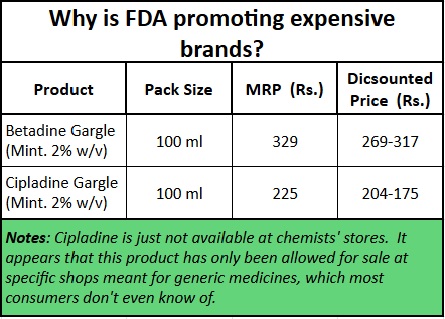 Take the case of Betadine gargle. This brand is the undisputed market leader when it comes to germicide ointments, lotions and gargle solutions. But Cipla entered the market a few years ago. It was priced lower than Betadine. Suddenly, within a month of being available, it was shown to be out of stock by most pharma websites like 1mg or Pharmeasy. Ditto with Chemists’ stores. When queried, many chemists say that the company has stopped supplying this item. When you persist with queries you are told that this product can only be available at stores that deal with generic medicines. It is then that you learn that such generic medicines too are not allowed for sale at pharma shops. Effectively, the FDA itself wants consumers to purchase higher priced products.
That is when you begin to question the authenticity of the FDA’s claims.
Medicare must be made cheaper. But this must begin with retail markets. If hospitals can source products at significantly lower prices, why can’t chemists’ shops also make them available at these prices? Why is there a discounted price for hospitals, but a different one for consumers? One can understand a 15-20% difference. But when the difference is in multiples, you smell a rat.
Conclusion
Mundhe, FDA commissioner for Maharashtra, is right. There is a lot that is wrong with hygiene standards and with medicine pricing. But the contradictions in his approach to alleged culprits is wrong. There is also extortion that FDA has unleashed – SMS Envoclean is one example. Then there are high prices that the FDA has allowed chemist-shops to charge common consumers. They must be addressed. The cleanup should begin with the FDA itself.
———————
Do watch our latest podcast on how India has broken its promise to Japan time and again. It has spurned organised housing in industrial cities. Thus 24 cities which could created jobs through Japan joint ventures have been completely forgotten. Watch it at https://youtu.be/ydedYH0GRb8
———————
Also watch banking expert Madhav Nair talk about the reasons which have led to the banking strike in India. You can find it at https://youtu.be/Zk9aaN7YlZU
———————
Also watch RN Bhaskar’s views On Republic World, on the US threatening higher tariffs on India if it continues to purchase oil from Russia. You can find it at https://www.youtube.com/watch?v=5YJl-a_ngO4
———————
Also read about our views on Brics on the Republic World website at https://www.republicworld.com/world-news/brics-summit-2026-how-the-grouping-is-reshaping-the-global-economic-order-2026-09-09-136636
———————
Finally, do not forget our News behind the News
- India’s Election system hollowed
- Trump-Xi meet; great optics, little substance
- Insurance commissions jolt the market
- Is Viksit Bharat a mirage?
- Rankings change for India’s wealthy
You will find it at https://www.youtube.com/live/Lba6n8CF1oM?si=dezoZtmIg014KdPH
———————






COMMENTS