

























The dark myths about coal
By RN Bhaskar and Sakeena Bari Sayyed
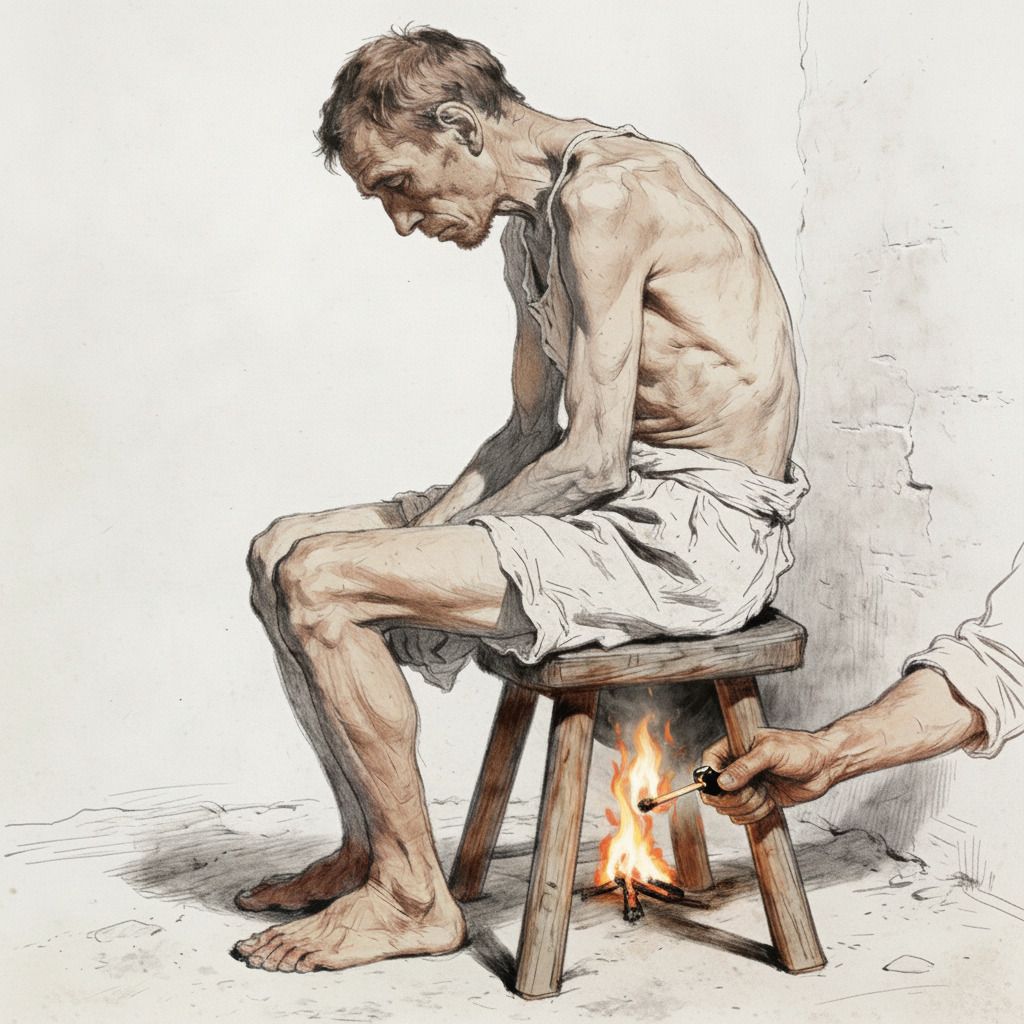
Image created by Perplexity
Someone is keen on setting the entire developing world on fire. And the flames are being fanned by people who have been clamouring against the use of coal. At one end, coal continues to be the poor man’s fuel. At the other end it is the favoured fuel for those who want to produce cheap electricity, steel or cement – all energy guzzlers. Environment activists claim that coal pollutes. Economists say that the pollution can be controlled with dust and soot precipitators and other methods to reduce toxic gas emissions. Trying to ban the use of coal is akin to letting developing economies go up in flames. Moreover, such a ban would leave developed economies laughing all the way to the bank.
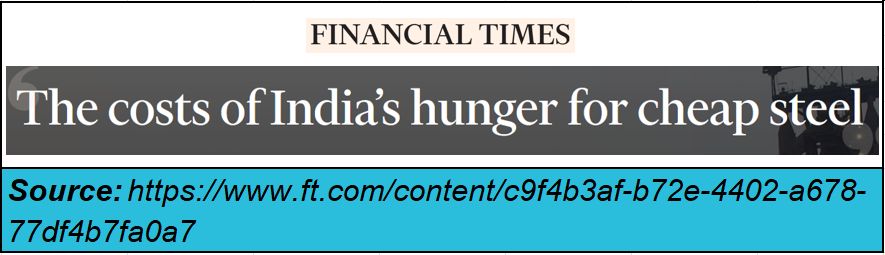
In India, the problem gets more complicated. Coal inevitably gets linked to forests and tribals as well. Activists, therefore, constantly use environment, forest and tribals as the key justifications for their campaigns. In fact, Financial Times recently carried a rather intriguing article on Indian steel producers. It stated that they had a dark secret that was not often talked about, It was the use of coal.
 Terribly expensive alternatives
The FT article pontificates that India was paying a very high cost by permitting the use of coal (the carbon tax that the EU has just activated is based on the same flawed reasoning). The article and the carbon tax levies fail to recognize the fact that developing countries opt for coal as a fuel source because they do not wish to pay a ransom price for oil. Other sources of energy have their own problems.
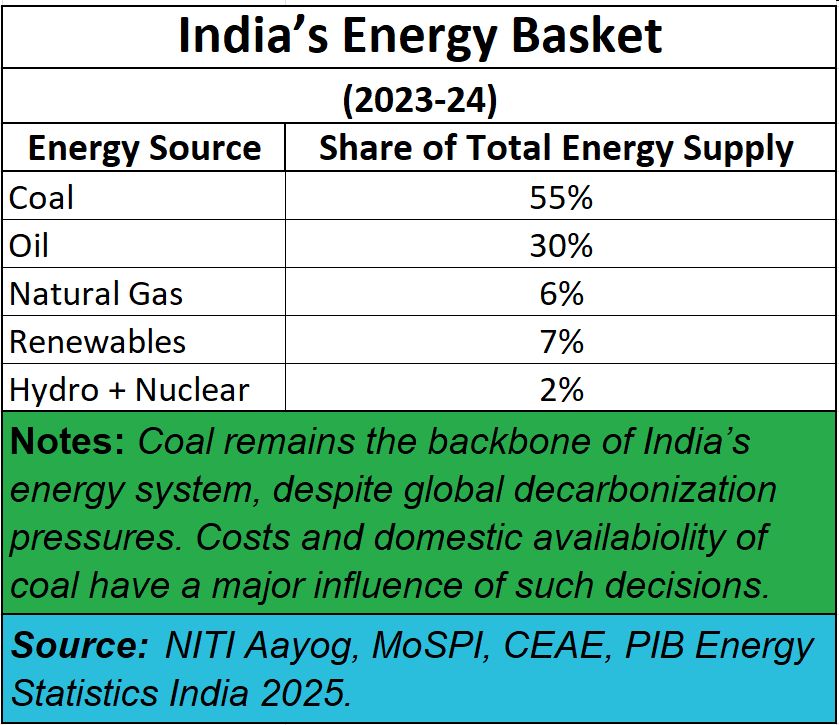 Hydro power is not available for territories where the rivers are not perennial and do not have a flow that is constant throughout the year. They are not desirable in areas that are earthquake prone or already have a huge population staying in the catchment areas. Nuclear power has its own attendant risks. High capex and the unquantified cost involved when decommissioning a nuclearplant. Solar power is good for lighting; but seldom used for high energy needs (railways, aviation, steel making). At the moment, it is King Coal that reigns supreme for electricity, railways and for cement plants in developing economies.
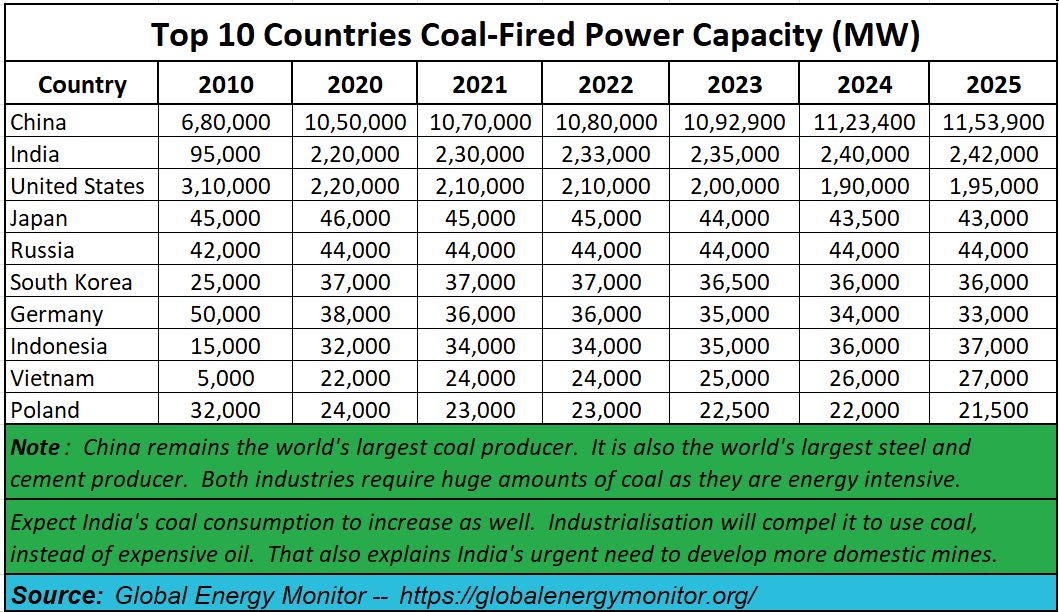 Top coal users
Environment lobbyists claim that India is a culprit for promoting the use of coal. But look at the big users, China is the biggest user of coal. The US, despite being a developed country, still uses coal. Someone appears to have an anti-India bias. Coal is only an excuse.
 Oil is too expensive
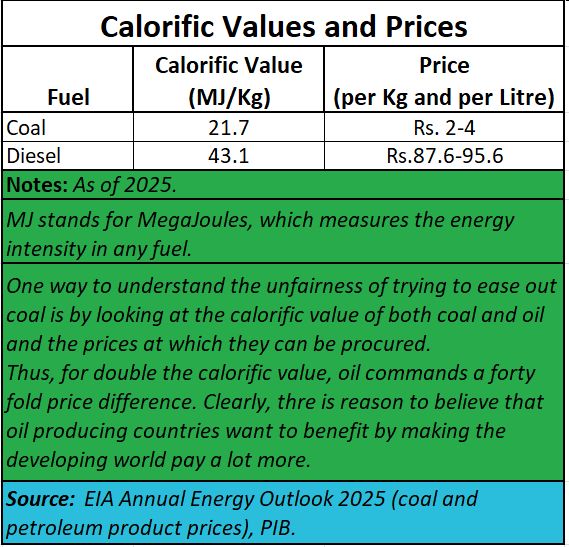
Most developed countries have been insisting that India reduce its coal consumption. They often advocate the use of oil instead. But oil is frightfully expensive. One good way of comparing the price of oil with that of coal is by looking at their respective calorific values.
When you do that, you realize that oil has been priced at least twenty times more than what it ought to be. As the table above shows, oil offers twice the calorific value of coal (for purposes of simplification we have assumed that a litre of oil has approximately the same unit of measurement as a kilo of coal). Yet, for offering twice the calorific value, oil is priced forty times more than the price of coal. That makes oil at least twenty times more expensive in terms of calorific value. That is one of the reasons why developing countries, which do not have the luxury of spendin-power, often prefer to use coal.
 India’s anti mining lobbies
India faces a peculiar problem. Its need for coal is huge but its domestic production has always fallen short of demand.
There were two reasons for this. The first was that almost all of India’s coal reserves lie in areas which also have a dense forest cover. These are also areas inhabited by ‘tribals’.
There was always tensions caused by two principal laws in the country. One was to protect forests and the other was to protect tribal habitation. This in turn has created a bigger tension between the desire to protect forests and tribals and the desire to protect India’s economic growth. Economic growth eventually depends on manufacturing (which requires huge energy) or trade (which requires energy in the form of transportation).
But, where there is need, people will find ways to satisfy the need. If organized mining is not permitted to the extent required by business and commerce and even residential energy needs, someone will step in to fill the gap. Conventionally, the gap is met through imports. But, almost surreptiously, it is illegal mining which helps fill up the gaps.
Imports require foreign exchange to pay for such goods and services. Illegal mining adopts methods which make law enforcement agencies look the other way.
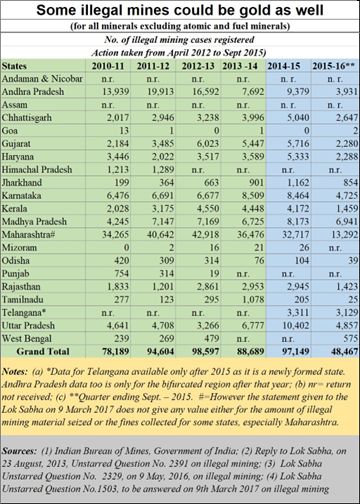 Sadly, India’s policy makers and social activists seldom take strong action against illegal mining. Look at the way it has grown even after the present government came to power in 2014 (https://asiaconverge.com/2019/01/concealing-illegal-mining-in-thenorth-east/_).
What is even more interesting is that there has been no compilation of illegal coal mining. In the parliament, government agencies insist that they have no record of illegal coal mining. This runs counter to other reports that talk about illegal coal mining in the north-east (https://www.newsclick.in/meghalaya-rti-activist-attacked-looking-illegal-coal-mining-condition-critical). Even CBI investigations into the Saradha Chit fund scams reveal how much of the money had been invested in funding illegal mining.(https://www.facebook.com/watch/?v=410575696370246)
The fact is that illegal mining is extremely lucrative. That allows illegal miners to bribe officials to look the other way. It allows illegal miners the ability to pay social media influencers to generate protests against any kind of legal activity in the areas where illegal mining has proliferated. This is to prevent constant surveillance by law enforcement authorities.
Even naxalism has its roots in the funding that illegal mining provides. That is why whether it is an organized railway line or a seaport or even organized farming, social activists raise their voices against such activities. This allows illegal mining to continue undetected and unhindered. Naxalite movements derive much of their funding through such illegal mining (https://asiaconverge.com/2017/04/sukma-killings-naxal-violence-illegal-mining/).
That also explains why activists were vehemently opposed to the construction of the Dhamra port in Orissa, by the Tata and L&T (https://www.business-standard.com/article/economy-policy/greenpeace-to-intensify-drive-against-dhamra-port-108091301051_1.html). Illegal miners probably funded this agitation too because they do not like organized activity in any area which generates huge profits – for entrepreneurs, government officers, even politicians.
The Dhamra port eventually got built. The Ridley turtles did not stop hatching their eggs in that area, and today the port is owned by the Adani group.
Illegal miners invariably use protection of the environment as a good excuse to thwart legal mining and other legal development work.
 Difficult choices
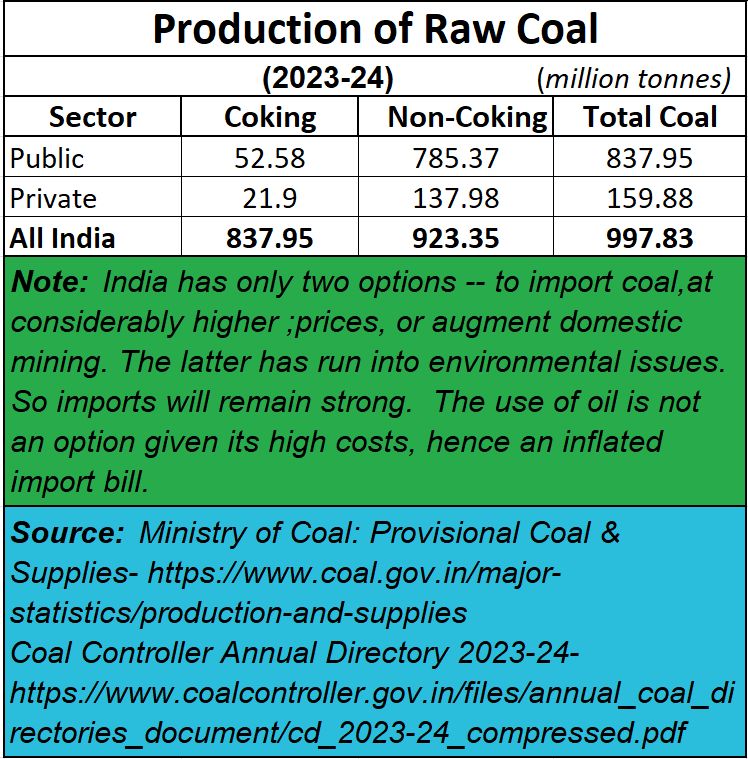
Despite agitations, India has succeeded in increasing its coal production. The coal produced in India is cheaper than the coal imported. That is another reason why any policy maker will want to increase domestic production of coal.
 Country-wise imports
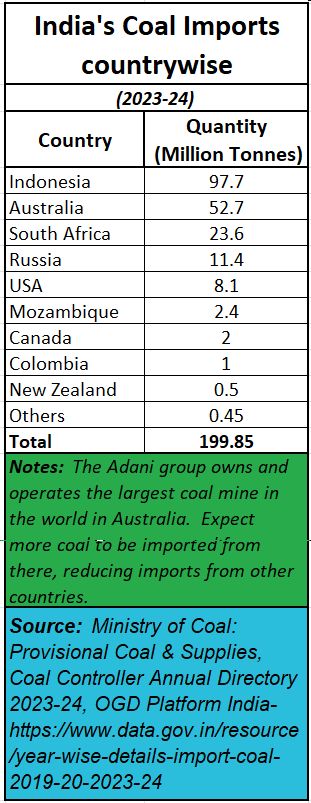
Much of India’s coal imports have traditionally been through Indonesia. In fact many industrialists have begun mining coal both in Indonesia and on the African continent.
However, with Adani acquiring the largest coal mine in the world in Australia (commercial operations began two years ago), it is quite possible that Australia will become the largest coal supplier to India. The FTA that India has signed with Australia (https://www.pib.gov.in/PressReleasePage.aspx?PRID=2088669®=3&lang=2) will possibly help accelerate this process.
Conclusion
India has no choice but to continue exploiting its domestic coal mines.
Moreover, the worsening trade balance will compel India to depend less on import (of coal and oil) and opt for domestic sources instead.
Activists may not like this, but India has no choice. Coal will remain one of the primary sources of energy, especially for steel and cement.
===========
Do view my latest podcast on why India’s FTA with New Zealand will hurt this country and leave NZ smiling. You can find it at https://youtu.be/pddWoWmmpHg
============================
And do watch our weekly “News Behind the News” podcasts, streamed ‘live’ every Saturday morning, at 8:15 am IST. The latest can be found at https://www.youtube.com/live/nx60TRElEhg?si=dPu8JMAFsGeyQh6a
============










COMMENTS