























MARKET PERSPECTIVE
By J Mulraj
Nov 6- 13, 2026
There are several risk factors
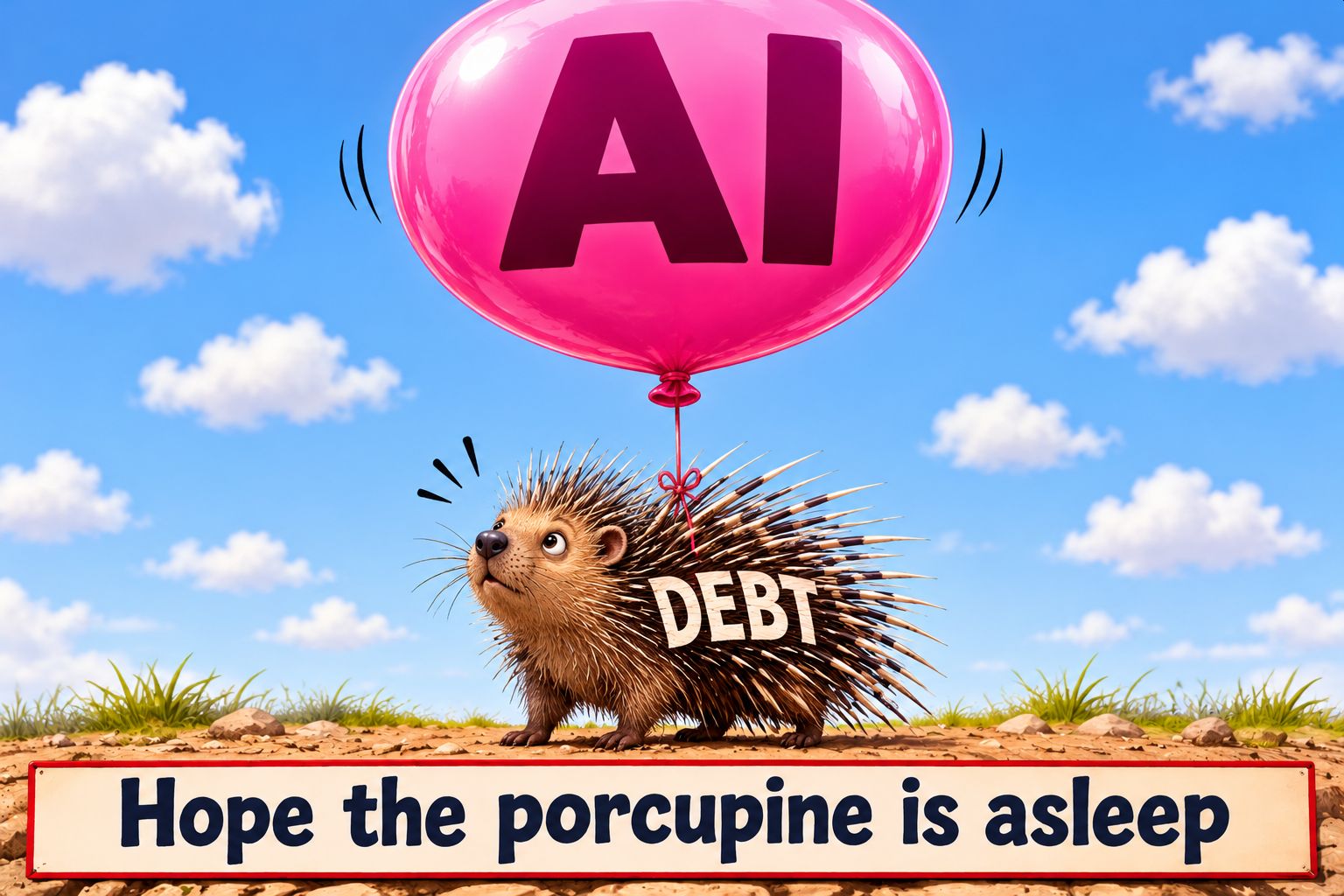
Image created using ChatGPT
Global investors are concerned about the popping of the AI bubble, especially after the Democrats decisively regained control over the US House of Representatives as well as the Senate, in the recently concluded Mid Term Elections.
There are several porcupine pins waiting to pop the AI bubble.
Mid Term Election outcome After the mid terms, the control by Dems over both legislative chambers is one of them. Some towns in Dem controlled States like Ohio (Pataskala and Granville), Illinois, Maine and Kansas have imposed bans on new data centres, the heart of AI. Ten States, including California, New York, Texas, Illinois and others promise to impose g safety frameworks and rules to guard against rogue AI. These would cause delays in receiving planning, environment and electricity approvals, and raise costs.
Trump’s policies were favourable towards AI and AI infrastructure, based on his assertion that whichever country won the AI race, wins.
High Debt Load of AI companies It is estimated that the total debt taken by AI companies, including hyperscalers, data centres, infrastructure, private credit, etc. is $ 1 trillion, half of which is concentrated in 6 companies. More importantly, another $ 1.1 trillion is the off-balance sheet future commitments taken by these companies to lease data centres. A delay or failure by them to meet the lease commitments is a potential porcupine needle. Combined B/S and off B/S debt is 13.4% of total non bank corporate debt. Moreover, interest rates are rising. And there is competition in the debt markets from countries seeking to rollover their debt. For USA, a sixth of its debt of $ 40.5 trillion is due for repayment in 2027. Most countries are over leveraged, simply because voters in a democracy (France, Italy, Germany, UK) don’t Re-elect a candidate that raises taxes; hence elected leaders take loads of debt, instead.
Just as the collapse of Lehman Brothers, which was over leveraged 30:1, triggered the 2008 global financial crisis, the risk of over leveraged countries as well as companies, could do too.
The GFC crisis, caused by bubbles in excessive lending by banks to sub prime borrowers, and over leverage by companies and banks, led to a whopping 57% drop in the DJIA, peak to trough.
The excessive optimism over the new new thing. The Internet was made publicly available end April 1993. There was immense excitement over this New New Thing, as described by author Michael Lewis in his book on the Internet, published in 1999. So absurd did investor optimism become that Internet companies, making large losses, were valued on the basis of eyeballs they attracted! This dotcom bubble burst end March 2000. The NASDAQ Composite dropped 77% from it’s peak.
The proposed IPO of AI leader Anthropic, at a valuation of $ 1.5 trillion or more, seems to be a case of such exuberance. An expected ROE of 15% would need Anthropic to make, within a few years, a PAT of $ 225 b.
The highest profit made by any company was $ 121 b, by Saudi Aramco, in 2022. The highest profit made by an American company was $ 132 b by Alphabet in 2025, followed by Nvidia $120 b. in 2025 and $113 b. in 2025.
The crisis in Nvidia, an AI company, the most valuable company in America: In early October Nvidia was valued at $ 5.78 trillion, making it the most expensive company in the world (and more than India’s GDP). Then its founder and CEO for 33 years, who created the amazing value, discovered Wonderland In Alice, leading to his dismissal as CEO by the Board. It is being alleged that Alice, whom he had an affair with, was a honey trap, a spy for China.
The Nvidia CFO was named as interim CEO, and a hunt has been initiated to find a replacement.
Jensen’s peccadillo was a devastatingly expensive one, disclosing the nature of a key man risk as he was CEO and the one who marketed/allocated Nvidia chip. The market cap dropped 30% to $4 trillion.
Jensen continues to hold a 3.8% stake, valued at over $ 150 b. This video explains the aftermath scenario well. Perhaps the closest comparison of his situation would be when the Board of Apple decided to replace founder Steve Jobs with John Sculley, ex PepsiCo, in 1985. Jobs sold a part of his stake to launch NEXT, which Apple later acquired when it brought Steve Jobs back as CEO in 1997.
Perhaps this may be play book for Jensen. He is very talented, leading Elon Musk to reply, when asked about the possibility of Jensen joining SpaceX, that he would be honoured if he did. Under Jensen, Nvidia’s chips were to be used in AI warfare.
Last week the BSE Sensex closed at 81595, up 564 points over the week.
Investors need to watch out for the porcupine shooting one or more quills to puncture an AI bubble.
—————————————————————-
Comments can be emailed to: jmulraj@asiaconverge.com
——————————————————————












COMMENTS