
























MARKET PERSPECTIVE
By J Mulraj
Jun 13- 19, 2026
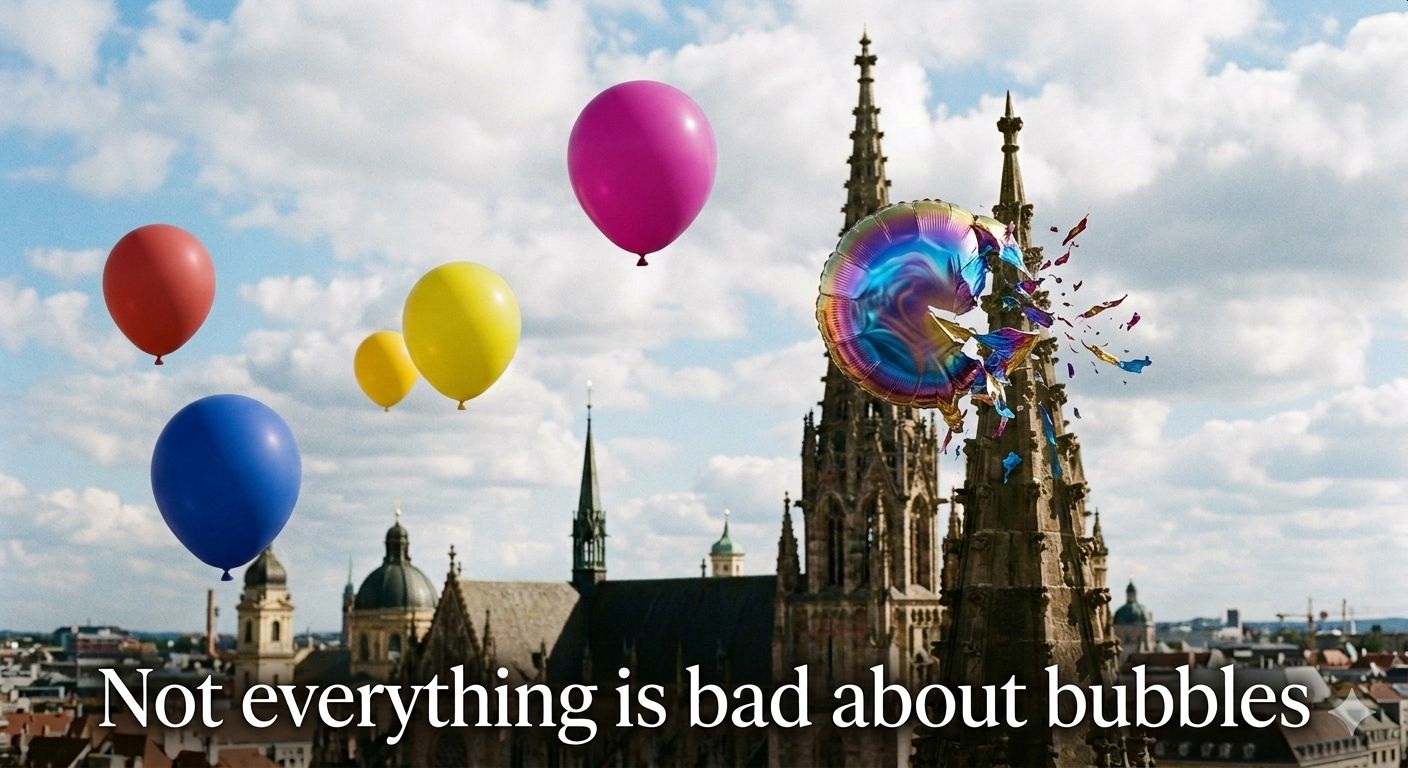
Not everything about bubbles is bad, though
Image created by Nano Banana 2
In Shakespeare’s play Julius Caesar, Marc Antony stated ‘the evil that men do lives on after them, the good is oft interred with their bones’. This is equally true of bubbles. They are excoriated for the losses their bursting causes to investors whose greed overcame their caution, with nary a good word for the good they did.
Some of the well known bubbles in the past were the 17th Century Tulip Mania, in the Netherlands; the South Sea bubble in Britain; the Backbay Reclamation bubble in India and the late 1990s dotcom bubble.
In the 1860s there was a cotton boom in America due to the Civil War. Premchand Roychand, a cotton trader and stock market investor, benefitted from the cotton boom. The boom ended when the American Civil war did, but Roychand had become wealthy. So had other cotton traders, who were longing for investment opportunities other than stocks of British banks, the main alternative, whose stock prices moved at the pace of a tortoise with gout.
To whet this huge demand for investment alternatives, Premchand Roychand, alongwith Cawasjee Jehangir and others, floated a company, ‘The Backbay Reclamation Company’, offering shares to the hungry public. The purpose was to reclaim 1500 acres of land, handing a part of it back for public.
The issue was oversubscribed by enthusiastic investors. Although the bubble soon burst, the reclaimed land upto that point was used to develop residential and commercial housing in Nariman Point and Colaba. The bubble also created Rajbai Tower, a Mumbai landmark building with a clock tower, named after Premchand’s mother, Rajbai. Without the bubble, it is doubtful whether reclamation of land from the sea would have started, and the topography, hence growth, of Mumbai, the financial capital of the country, would have been different.
The dotcom, or Internet bubble, which burst in 2002, helped plough funds to lay the Internet infrastructure. Included in this were two undersea cable companies, like Global Crossing which went bankrupt after laying the undersea cables, and were later auctioned at 10-20 cents to the $. So the bubble provided the funds. Investors, displaying irrational exuberance in funding the bankrupt companies, suffered losses, the price of their greediness. The assets survived. The beneficiaries were companies that bought the assets at distressed price. The Tatas and the Ambanis ultimately bought them. They could then offer Internet services at far lower prices.
Currently, it is believed that AI a companies are getting funded in a bubble. Elon Musk’s SpaceX made an IPO offering shares at $ 135/share, valuing the company, which is loss making, at $ 1.8 trillion, on a Price to Sales ratio of 94! Not Price to Earnings but Price to Sales. It has successfully sold a dream, of colonising Mars, making human civilization a multi planetary one, and of building data centres in Space, to meet the insatiable demand for compute before AI.
Soon to follow are Anthropic and Open AI, each to make IPOs at a valuation close to a trillion dollars.
As per the Kobeissi Letter, a leading commentary on global financial markets, the market cap of the top ten US companies is $ 25.3 trillion, which exceeds the market cap of all global stockmarkets except USA.
The Warren Buffet Indicator says that a market cap/GDP ratio exceeding 200% is a warning signal of overheating. Currently this ratio stands at 233% in USA, 124% in India and 80% in China.
Given these signals it seems that a bubble has formed and is looking for a pin.
Last week the BSE Sensex ended at 76802, for a weekly gain of 1275 points.
In the Iran war, a Memorandum of Understanding (MOU, not to be mistaken for MOUE, which is a grimace to show distaste or annoyance) has been digitally signed by Iran and US representatives. It is a 14 point agreement to cease fire, open the Strait of Hormuz for free shipping, ending the US blockade, lift US sanctions, with Iran declaring it has no intention of making a nuclear weapon. However, problems have already arisen! Iran has threatened to not sign unless Israel stops attacks in Lebanon. The same never ending circle of ‘he hit me first, so I hit back’ that has senselessly propelled conflicts throughout history.
If the MOU continues, over the next 60 days both sides will negotiate a final deal on the future of Iran’s nuclear stockpile and its nuclear programme, as also towards unfreezing Iranian assets.
There is no mention of a regime change, or whether, after the 60 day period, if no agreement is reached, whether the Strait will remain open and remain free.
The MOU has led to a sharp drop in Brent crude from the June high of $ 95/ barrel to $ 77/b.
In interesting developments, India has signed a pact with the Netherlands to build a 60 km dam across the Gulf of Khambhat, between Bhavnagar and Bharuch, an $ 18 b project to keep the salt water of the sea away. Several rivers will fill the dam with fresh water, to be used by the semiconductor industry.
Investors should consider lightening a bit and should definitely hide any pins capable of pricking a bubble.
——————————————————————————————
Comments may be sent to: jmulraj@asiaconverge.com











COMMENTS