


























22 June 2026
Settle the financial absconders’ cases and make India investment friendly
By RN Bhaskar Sakeena Bari Sayyed
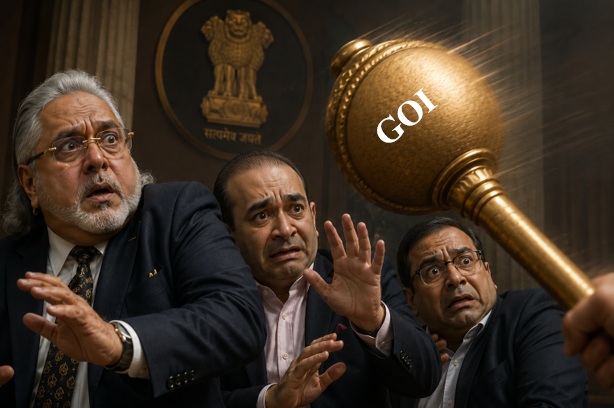
Image: ChatGPT
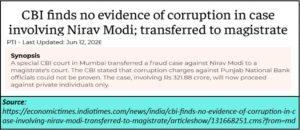 On 11 June 2026, most media channels announced a rather curious development. They said that a special CBI could had absolved bankers of the changes of defrauding Punjab National Bank. The charges related to financial embezzlement by two of the absconders – Nirav Modi and Mehul Choksi. Both had defrauded several banks, particularly PNB, of Rs.6000 crore each, aggregating to Rs.14,000 crore.
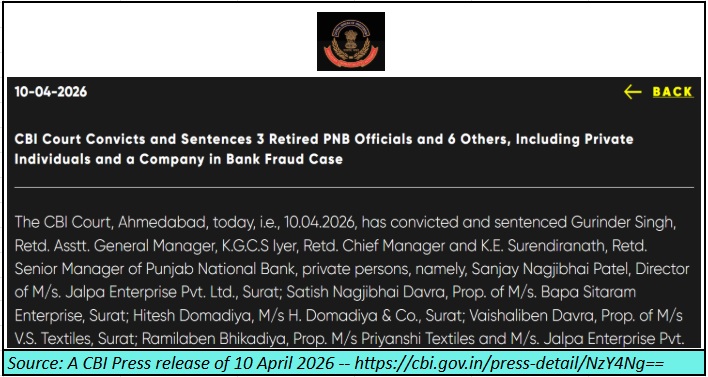 This was baffling because of several reasons.
- Just three months earlier, in April this year, the CBI court had sentenced three retired PNB officials and six others, including private individuals and a company in bank fraud case(s).
- This automatically led to the next question. Were the people sentenced in April and the people exonerated in June 2026 different individuals? Or were the same people (who had been convicted earlier) being freed now? None of the media sources provided this information.
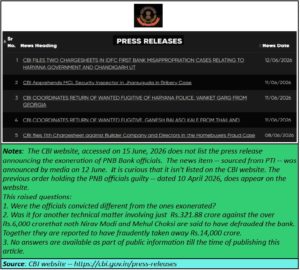
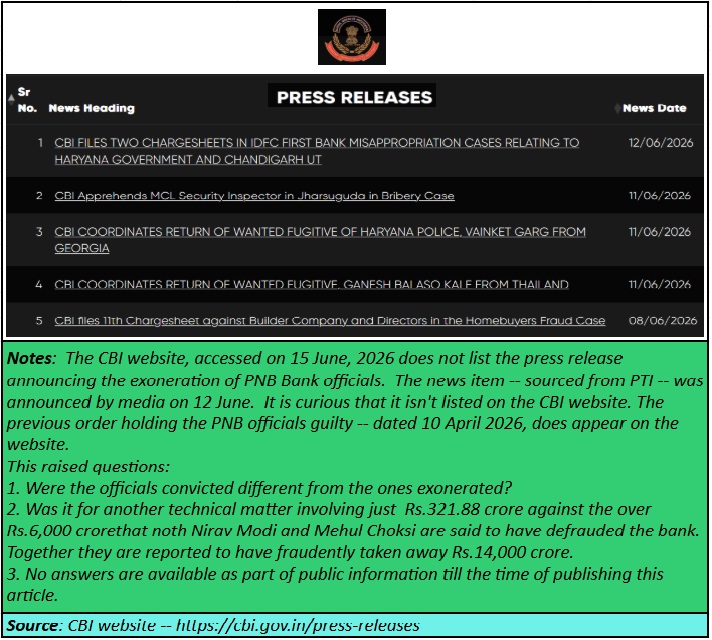
- A look at the CBI website which deals with press releases lists the April conviction, but not the June 11 exoneration. So, was the PTI story — that many media channels quoted – a misleading one? If yes, why did the CBI not issue a clarification? And why are the names missing?
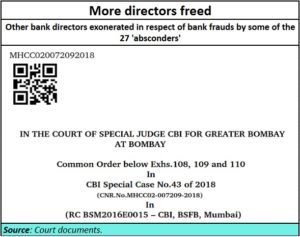
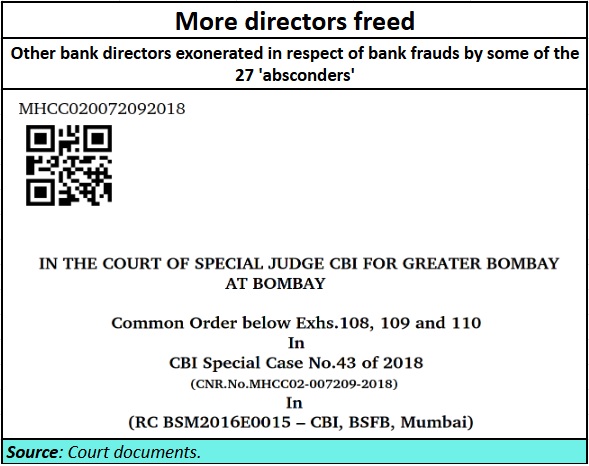
- This is not the first time that the CBI has freed bank officials who were involved with the financial ‘frauds’ of the 27 absconders. One of the instances that comes to mind is the exoneration of several bank employees. All of them were released in respect of “CBI Special Case No.43 of 2018 out of RC BSM2016E0015 – CBI, BSFB, Mumbai from the offences punishable under sections 120B r/w 420, 409 of I.P.C. and section 13(2) r/w 13(1)(d) of the P.C. Act. Applications are disposed of accordingly.”
- The individuals released in the above case are
- Anil Umesh Haldipur
- R. Seshadri
- Manjeshwar Anantharaya Pai
- K. Bansal
- K. Bajaj
- S Partha Sarathy
- S Krishna Kumar
We have no reason to believe that the individuals were indeed “not guilty”. But we believe that there is a very strong case for the CBI to find the real culprits. This is what we hinted at in our article on February 20, 2018 (https://asiaconverge.com/2018/02/pnb-why-did-the-dogs-not-bark/). Even then we had wondered why the RBI dogs did not bark. Why did the central bank maintain a studied silence?
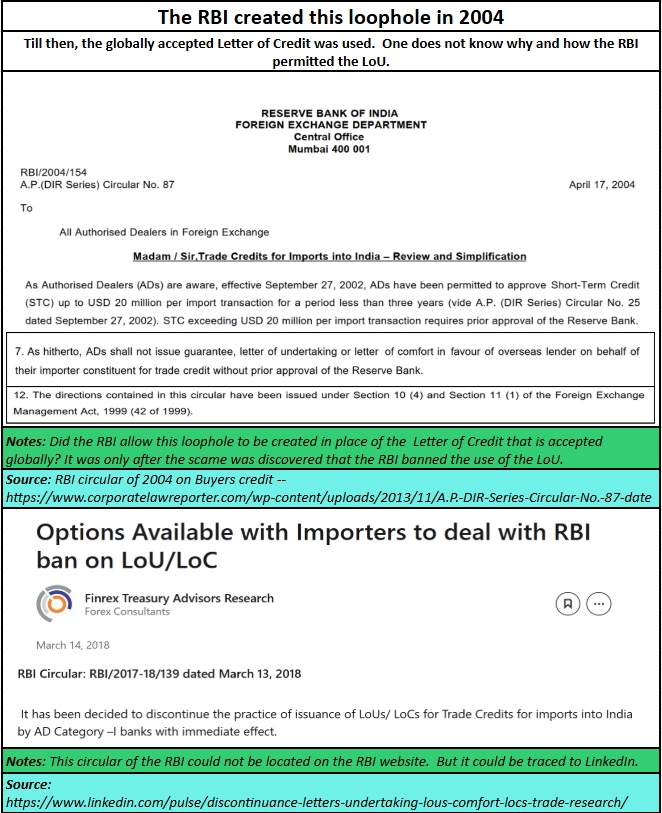 In fact, the RBI created the mechanism that was (mis)used by the culprits. In April 2004, it introduced the concept of letters of comfort known as Letters of Understanding (LOU). Hitherto, all imports required businessmen to use the Letter of Credit (L/C) route to access bank funds. This is a time-tested way which businesses use across the world. Nobody knows what prompted the RBI to introduce a letter of comfort that it called the LoU. It is only after the PNB scam was discovered that RBI decided to make the LoU illegal.
 Pure luck
In fact, it was pure luck that the scam turned out to be just Rs.14,000 crore (https://www.scribd.com/document/892913306/240601040-ThakkarDhruvAmit-RM1#:~:text=largest%20banking%20frauds.-,Involving%20fraudulent,This%20report%20summarizes%20the). It could have been significantly more.
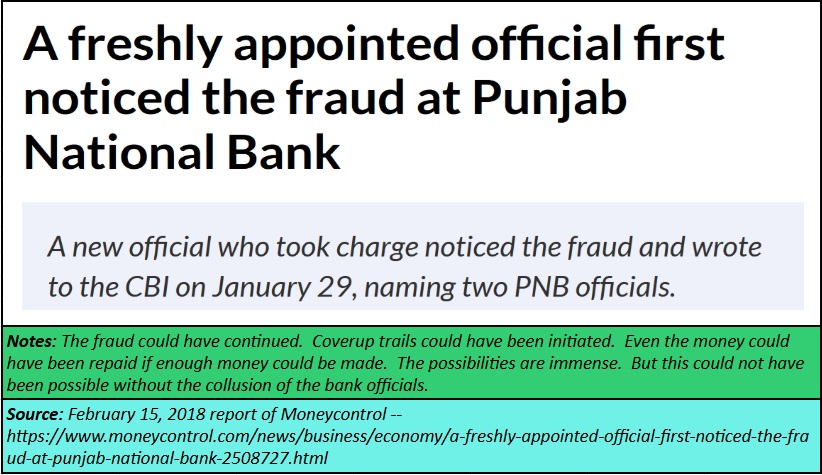
It so happened that one of the officials of the companies that used the LoU route went to the PNB branch to request more funds, and a newly appointed bank manager asked him to furnish an L/C instead. The man protested and said that he had always used the LoU route. That made the new manager suspicious. He began a series of investigations and then blew the whistle and informed the authorities. It was at this point that the RBI stepped in and banned the LoU route.
True, two diamond merchants – nephew Nirav Modi and uncle (Mehul Choksi) used the LoU route to defraud the bank. But to succeed they needed corrupt PNB officials. And they needed senior banking officials and the finance ministry to look the other way. That is why the exoneration of bank officials was inevitable.
Nirav Modi used bank funds that had been borrowed using LoUs through his various companies. Key among them were:
- Diamond R US
- Solar Exports
- Stellar Diamonds
Mehul Chokshi operated through his own companies which were often referred to as the Gitanjali group. Prominent among them are:
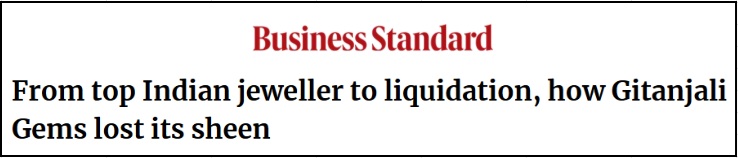
- Gitanjali Gems
- Gili India
- Nakshatra Brands
It appears that corrupt bank employees bypassed PNB’s internal Core Banking Solution (CBS) and used the SWIFT financial messaging network to issue these unauthorized LoUs to overseas branches of other Indian banks. This allowed both Modi and Choksi to secure short-term credit abroad without maintaining any sanctioned credit limits or providing the required collateral.
And this is where questions begin to tumble out.
- Surely, when the bank gives out money, there is an automatic need to show the documents which have been accepted as ‘collateral assets’ against the loan. That goes into the central registry which is not supposed to be bypassed. If it was indeed bypassed, it would reflect badly on the makers of the banking software. Did the CBI investigate the collusion between the software maker and the bank?
- It appears that one corrupt officer had the password to bypass the central registry. But even making a rovision for such a password was unwarranted. That again raises questions about the banking software and of collusion.
- The RBI should have discovered the mismatch between the funds lent out, and the collateral given to the bank. This should have become obvious during annual audits, especially since the amounts were large. That makes people wonder if the RBI also looked the other way. That was the dog that did not bark.
- If so many people looked the other way, does this mean that the government itself was complicit?
 Collusion in scams
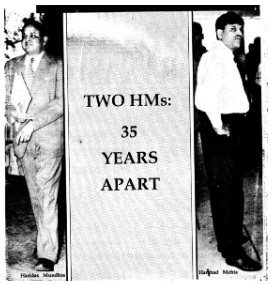
In the 1990s, the Indian Express Group brought out a cover story in one of its publications (Express Investment Week). It was titled “Two HMs 35 years apart”. The first HM was Haridas Mundhra; the second was Harshad Mehta. In both scams, the collusion between the ‘scamster’ and government agencies and key government personnel became obvious.
There are good reasons to believe that no major scam takes place in India without the knowledge of higher-ups in the government. One reason is that governments and political parties need money. This is what happened in the Nagarwala case as well (https://www.youtube.com/watch?v=4CnJWFYU8Hw).
Some governments defraud banks; some play the stockmarkets; some others do deals involving kickbacks. The methods may change, but the need for money is a constant.
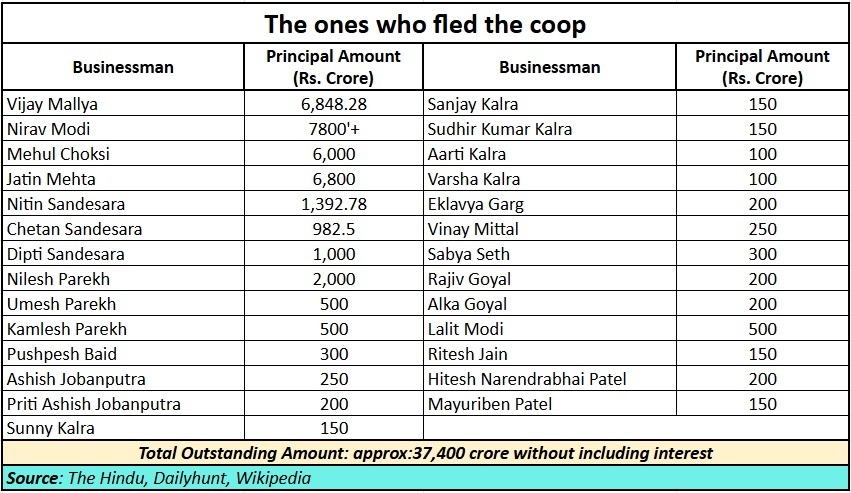 The 27 ‘absconders’
So why were the 27 absconders targeted, if they were in league with government officials? Possibly because of the way the spoils were to be shared. Remember, many of the scams came to light when one government was being eased out, and another was coming in. On other occasions, scamsters get caught because of whistleblowers and public disclosure.
In the case of the 27 absconders, it would therefore appear that many of the scams began under one government; yet continued under another government. It is probable that there were disputes on the way the booty should be shared. It is also quite likely that the ‘scamsters’ were jettisoned by government officials when the unwinding began.
Key and pliant bank managers however are always required for the next scam. That could explain why bank managers and key government officials are invariably exonerated. That is also why policemen and other government officials are seldom dismissed from service. They are merely suspended, and rehabilitated when the time is ripe.
 Bias and rancour
The government should be seen as a fair policymaker. Unfortunately, when it comes to bad loans and defaults – both in respect of corporate loans and even defaults which the government calls frauds – the government has usually tried to favour foreigners at the expense of Indians.
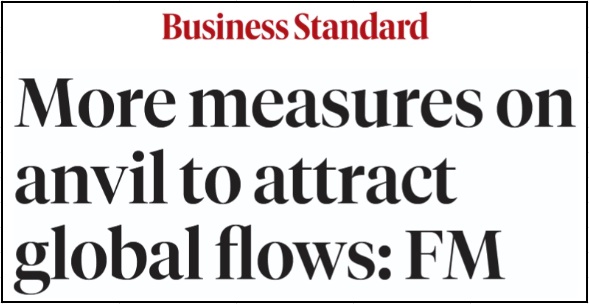 Consider the manner in which even the current government has tried to revive the markets by making things easy for foreign investors (https://www.business-standard.com/markets/news/more-measures-likely-to-attract-foreign-capital-says-fm-sitharaman-126061500382_1.html). Ideally, the government should have tried wooing Indian investors to come back to this country and make investments here.
The government has also been partial towards foreign banks. One favoured bank has been Standard Chartered Bank (Stanchart). Consider two instances.
 Stanchart favoured
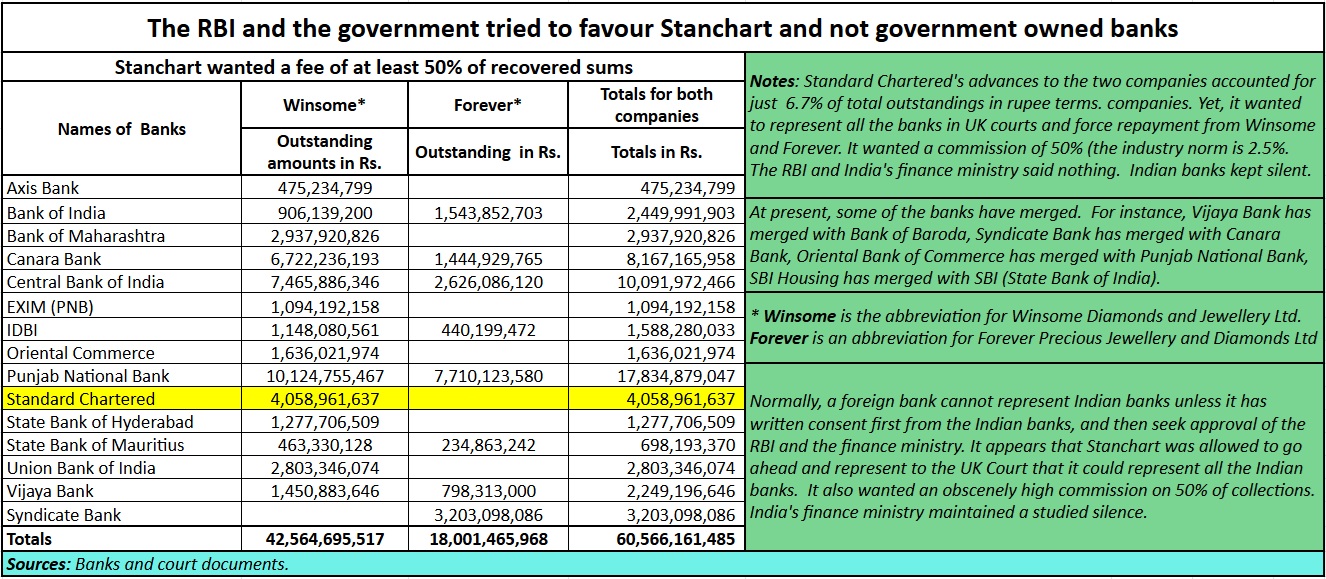
A good example of how the government and the finance ministry (including the RBI) have favoured Stanchart is the way they gave the bank a free hand
(1) to actually short-change Indian banks by taking away as commissions 50% of what they were owed, and
(2) allowing the foreign bank to make claims before foreign courts that it has the powers to represent all the Indian lender-banks.
Consider the above table. With under 7% of a stake in total outstandings of Winsome and Forever, two of the ‘scamster’ companies, Stanchart was allowed to become the tail that could wag the dog (https://asiaconverge.com/2023/02/stanchart-tries-to-break-indian-bankingranks/). Standchart through its associates wanted a 50% commission for getting the outstanding amounts. This was strange. Normally, recovery agents charge a commission of 2.5%. Why was Stanchart allowed to demand a 50% commission? That meant that this commission would come from money owed to Indian banks. This would mean a transfer of funds from Indian (government owned) banks to a foreign bank. In spite of this, Indian lender-banks kept quiet. So did the RBI. Ditto with India’s finance ministry.
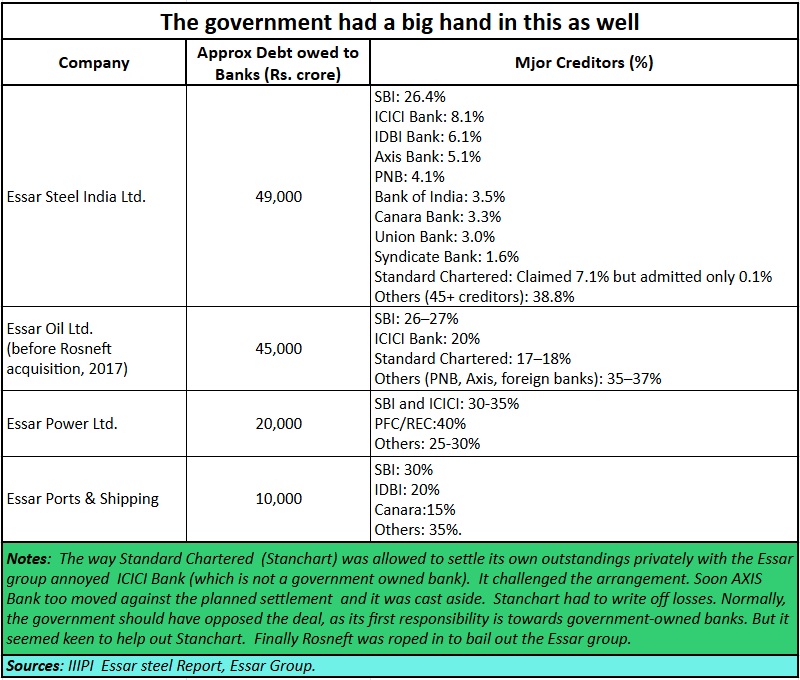 Take another instance. It related to the money India’s Essar group owed to Stanchart. This foreign bank wanted the Indian government to help it recover all its dues.
Ideally, the Indian government should have worked out a deal which would have benefitted all creditors, not Stanchart alone. Instead, the government turned a blind eye and let both the Essar group and Stanchart work out a private deal which excluded Indian lender-banks. Thanks to ICICI, which is not a government-owned bank, the proposed settlement was challenged in the courts (https://asiaconverge.com/2023/01/stanchart-and-indian-banking-laws/). Stanchart had to backtrack, and all the lenders were compelled to take a haircut. Stanchart could not get a sweetheart deal.
It is at such times that the government loses its reputation of being a fair player. This worries investors and even wannabe entrepreneurs. When even the central bank becomes an institution that does not protect Indian lender-banks, is it any surprise that they are easily pressured into aligning with scamsters?
 The way out
The best way out is to have negotiated settlements with the ‘absconders. Remember, they were wealth generators. They created jobs. Mehul Choksi and Nirav Modi both had between themselves, some 4,000 retail outlets. They could have been auctioned with the brands in such a manner that past liabilities would not devolve on the new owners. That requires speed of execution, and a focus on salvaging value. It needs strict laws to prevent ssweetheart deals meant to defraud the system again.
Instead, the government did nothing. It spent even more money on foreign lawyers to try extradite them (even kidnap them), and let the chain of stores to lose their enterprise value.
 Similarly, if Kingfisher Airlines had been sold as a going concern, the government could have recovered all its money. Instead, once again, the government did nothing. It instead spent money hiring foreign law firms to try extradite Mallya and bring him to India. It should have instead let bidders come forward and take over Kingfisher. That way, the firms that had leased aircraft to Kingfisher, the employees, and even the banks could have benefitted.
Currently each one of the stakeholders has lost. The only beneficiaries are lawyers, hotels and airlines that flew executives in and out. Thus, the government lost money. So did the shareholders. And the entire workforce lost its wages. An enterprise that used to generate taxes for the government was also run to the ground.
 Wealth generation and employment
That takes us back to the 27 absconders. Instead of spending money on foreign lawyers, and multiple trips overseas by government officials, the government should do a rethink. It should realise that hounding businessmen only ends in pauperising the country.
It makes people believe that India is no place for investment. Corruption induced by the government invariably results in percolation of similar sentiments for fraud. Soon many people at the bottom also begin to develop sticky fingers.
The focus should instead always be on wealth generation – not just for politicians to make money, but for all entrepreneurs.
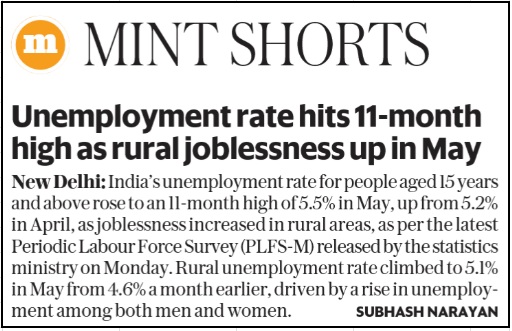
Today, India is almost crippled. Its unemployment rates are swelling (https://www.livemint.com/economy/indias-unemployment-rate-hits-11-month-high-as-rural-joblessness-rises-in-may-11781523721110.html) . Loss of jobs in the Middle East, and layoffs on account of AI will add to the swelling numbers of the unemployed. Poor agricultural policies (https://bhaskarr.substack.com/p/india-seeks-a-rescue-from-the-economic) will add to the depression in consumer demand. Unemployment and poverty will result to huge social instability.
India also needs education and investments. The latter is crucial because money and entrepreneurship alone will help create jobs. But that requires moneymakers. By hounding the ‘absconders’ who were also employers and moneymakers, India loses both talent and money.
 Settlement works
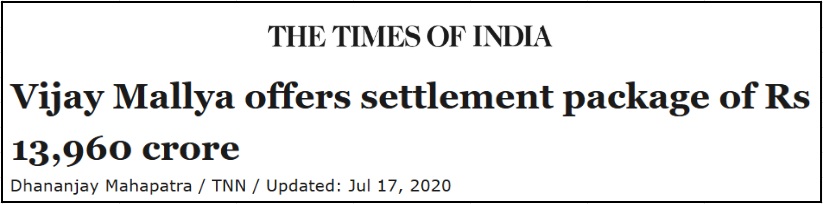
Take the case of Vijay Mallya. As easly as in 2020, he had made an offer to settle all the money he owed banks and the government (https://timesofindia.indiatimes.com/business/india-business/vijay-mallya-offers-to-pay-up-but-govt-is-not-interested/articleshow/77009259.cms). Ideally, India should have accepted this offer. Instead of inviting portfolio investors, it is better to have moneymakers who can generate wealth and even employ people.
At such time, it is better to settle the cases of as many of the 27 ‘absconder’ as possible and get them to bring back both talent and money.
But for that, the government needs to have two prerequisites.
- First, it needs the political sagacity.
- Second, it needs credibility. It will have to sign suitable guarantees that entrepreneurs won’t be persecuted. Some people still recall the unfair treatment meted out to Abu Salem after he was extradited from Portugal (https://www.coe.int/en/web/cpt/-/anti-torture-committee-urges-portugal-to-tackle-police-ill-treatment-and-the-poor-treatment-of-prisoners).
Finally, thanks to the Supreme Court, he won his freedom (https://indianexpress.com/article/explained/abu-salem-extradition-case-background-supreme-court-verdict-explained-8026163/).
Can India become more investor friendly? Can it open the gates to more investment instead of just allowing a trickle to come through? Can India turn India into a nation of wealth generators – the way India did almost 2500 years ago (https://www.youtube.com/watch?v=ibJJXeGyZxA)?
India has the talent. It knows how to generate wealth. But it has been hobbled by policies that have made this wealth go underground or travel overseas. Can the current government revive the great days of Indian entrepreneurship?
=============
Watch our latest podcast on the way politicians corrupt the judiciary. You can find it at https://youtu.be/3SlOWDIcdls
=============
Watch our views on Republic World on the India Oman trade agreements. You can find it at https://www.youtube.com/watch?v=6W4CyRh0i3c
=============
Another interview on Republic World related to the Trump-Iran discussions and the MoU. You can watch it at https://www.youtube.com/watch?v=R6WZl7ellD0
=============
There is another Republic World video which talks about India-US relationships – you can watch it here https://www.youtube.com/watch?v=n2KBqcij2Qw
=============
Finally, do view our News Behind the News:
– Realignments between India and Pakistan?
– Where do India’s health services stand?
– India is not attractive for portfolio investors
You can find it at https://www.youtube.com/live/bv66fbdNoTs?si=yjJhRihhhMv2avc6
=============








COMMENTS