






















9th March 2025
How India’s Judiciary got marginalised
By RN Bhaskar and Sakeena Bari Sayyed
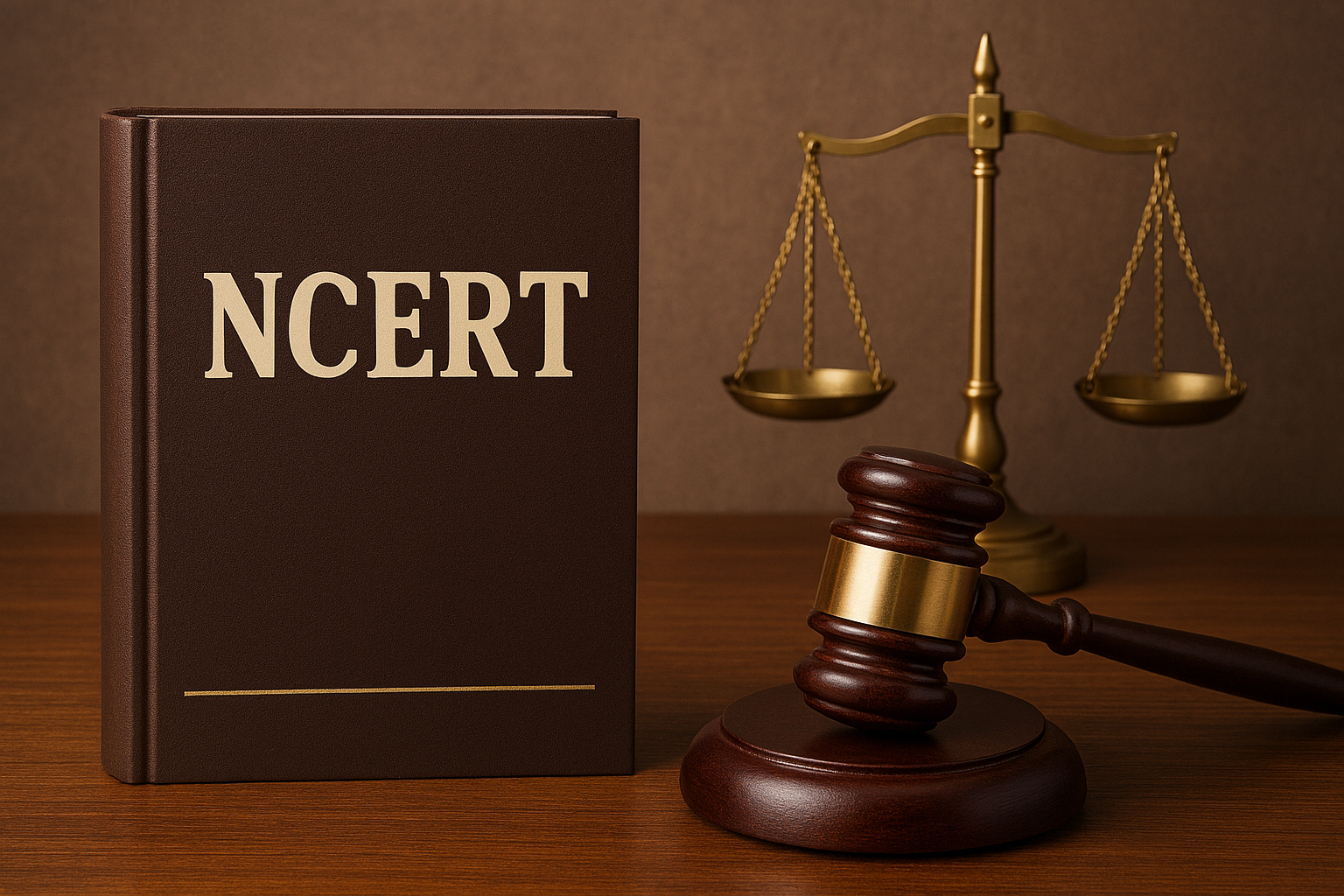
Image: CoPilot
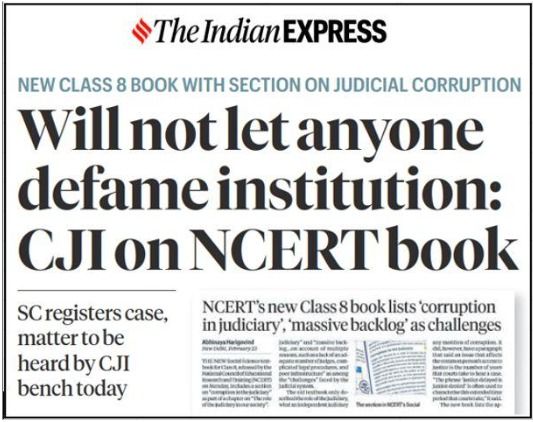
On 23 February 2026, media headlines screamed out that the Supreme Court (SC) had pulled up NCERT for introducing, in the class VIII textbooks, a chapter about corruption in the judiciary. NCERT is an acronym for National Council of Educational Research and Training and is responsible for providing educational content to schools in India. NCERT textbooks are mandatory for Kendriya Vidyalayas (schools run by the central government), desirable for all government schools and recommended for private schools. Hence, the reach and impact of NCERT content can be immense considering India’s school going population of around 250 million.
The immense ire of the apex court can be gauged by the fact that it wanted NCERT officials to:
- Submit an explanation on how this chapter got included.
- Submit to the court minutes and jottings of all the discussions that took place about this chapter being included.
- Details of the people who wrote the chapter and how they were commissioned.
- Immediate recall of all the textbooks already in circulation.
- A total ban on publishing such content in textbooks.
The SC also asked the ministry of education to explain how this was allowed to happen. Never before has India witnessed such levels of disapproval expressed publicly by the country’s highest court. The minister immediately apologized and said that he too would be asking the NCERT to explain. The court has yet to come out with its findings in this matter.
 Did the SC overreact?
Some people believe that the SC has overreacted. Some thought that the best course for the nation’s highest court would have been to allow the chapter and maybe supplement it with another chapter on corruption in other wings of the government.
Banning content is not a good idea. But the SC does have a strong case when the content is designed to selectively tarnish the judiciary. This is what appears to have been the case with this chapter on corruption in the judiciary. It appears to have been an attempt to diminish the stature of the judiciary. It is pertinent to ask the NCERT why it chose to ignore any discussion on corruption in the legislature or the executive and focus only on the judiciary. As the details given below show, much of the corruption in the judiciary is a direct result of the actions of the legislature and the executive.
NCERT’s politics–
The matter looks murkier when one considers the track record of the NCERT especially in recent times. This educational body once enjoyed immense respect for bringing out excellent content during the past decades. All of a sudden, there appears to have been a change in the way NCERT selects or rejects textbook content. Given below are a few examples of omissions, deletions, and inclusions of content on a highly selective basis. Some may even call the selection process capricious. In may cases the justifications provided by the NCERT and the stout defence of such additions, deletions, modifications by the government look specious.
Consider for instance the decision to remove Mughal history from India’s textbooks (https://youtu.be/qvM1Xs7fPwM?si=xU0bUJwoh6GT614A). Little heed was paid to the fact that the Mughals ruled India for almost 400 years. They had blended into the social fabric of India and left behind many monuments and practices that people admire even today. Unlike Ghazni or Nadir Shah, or even the British, the Mughals did not take India’s wealth away from this country.
Instead, the chapter on British history has been retained. Incidentally, the British ruled India for just 150 years. The government talks about the need to shed colonial mentality. Yet it chooses to retain the chapters on British history and dispense with the chapters on Mughal history. Clearly, xenophobia and ethnic discrimination appear to have been at work here.
Ideally, neither chapter – on British and Mughal History – should have been excluded. But NCERT appears to have embraced ideology rather than professionalism. There are many more instances of such questionable decisions by the NCERT. Some of them can be found in the Indian Express report at https://indianexpress.com/article/explained/ncert-book-revision-corruption-in-judiciary-rare-past-changes-10555556/
A summary of that report is given below.
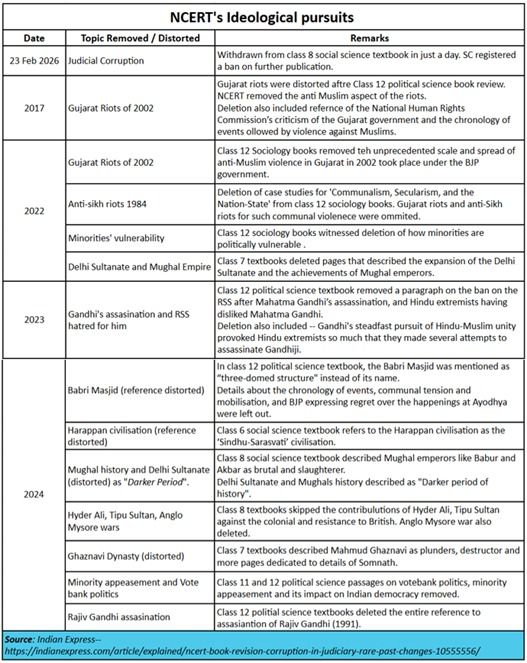 Who degraded the Judiciary?
NCERT failed to appreciate that, if the judiciary has been degraded since the days of independence, it is wrong to blame the judges or the courts. The major culprits appear to be both the elected representatives (legislature) and the executive.
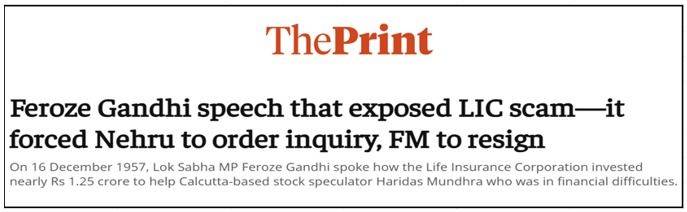 One of the ways to understand the insidious role of both the legislature and the executive branches is by looking at one of the most reported court cases in Indian history, in 1957. That was when the Mundra financial scandal came to light. It was exposed in parliament by Feroze Gandhi and was heard by the SC. The judgement was delivered in February 1962.
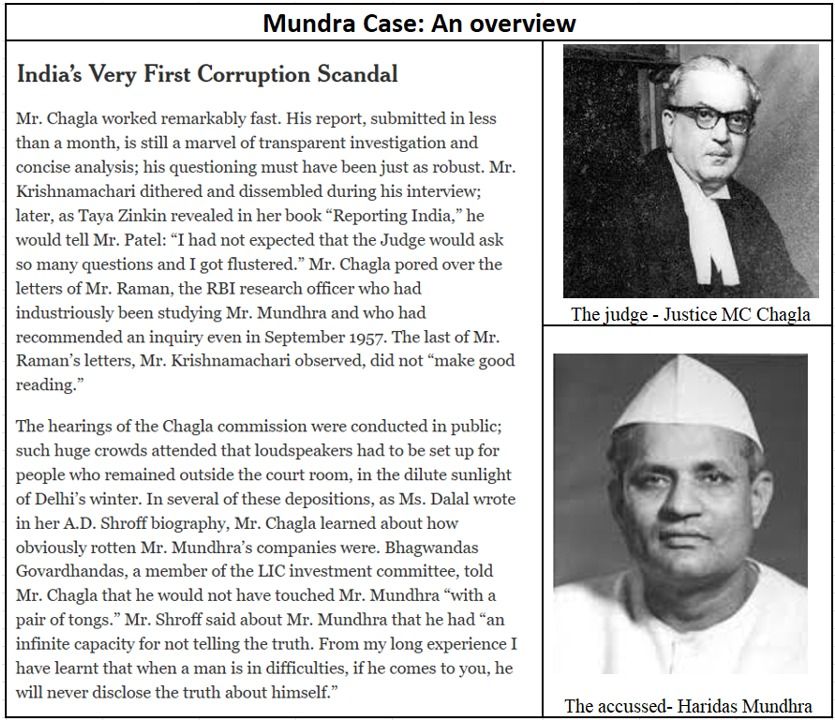 What made this case remarkable were the following factors:
- The case involved the Prime Minister, Finance Minister, the LIC chairman, the Reserve Bank of India (RBI) governor in addition to the scamster Haridas Mundhra (https://archive.nytimes.com/india.blogs.nytimes.com/2012/05/09/long-view-indias-very-first-corruption-scandal/).
- The case was taken up by the SC and the judgement pronounced within a five-year period. That is far less than the time taken by most courts today.
- Except for the Prime Minister of India, all government officials (including the finance minister) were summoned by the court and had to make their depositions and even get cross examined in full public view. When the crowds gathering to hear these public depositions became larger than the space the courtrooms provided, the courts decided to set up loudspeakers so that people could sit in the lawns and follow the proceedings in the court. The argument was that people have a right to know how the officials who were supposed to protect values had failed horribly on this front.
Today, none of the above practices can be followed by the courts. The ministers have armed themselves with new laws which prevent them from deposing in public. The executive, including the bureaucracy has armed itself with clauses that prevent any investigation, even prosecution, without the sanction of their immediate superiors. Thus, when both the accused and the superior officer are collusive in a case of corruption, both end up protecting each other.
Furthermore, the executive and the elected representative have engineered a system where hardly any Chief Justice of India is allowed to stay in office for more than a full term of five years. Many retire within a year of assuming charge of India’s top judicial post. Thus, while legislatures are allowed to remain in office for a full term of five year and bureaucrats for a tenure of around twenty years, judicial posts enjoy shorter terms. How can any remedial action be taken within such short period of time? It would appear that both the legislature and the executive have connived to make the judiciary inept and incapable.
What compounds this problem is that salaries for judges, fixed by the executive, are not good enough. Good lawyers earn more than what judges earn. So do mid-level bank officers. Listen to senior advocate Aspi Chinoy (timeline 1:55:12 to 1:55:31 at https://www.youtube.com/watch?v=sLD_3C3tkK8&t=7293s). Poor salaries mean that the best talent does not come forth to take up judicial positions. You cannot expect a first-rate country with second-rate salaries for judiciary.
Designed shortages
The best way to corrupt people in power is by creating a regime of shortages. This is done in two ways:
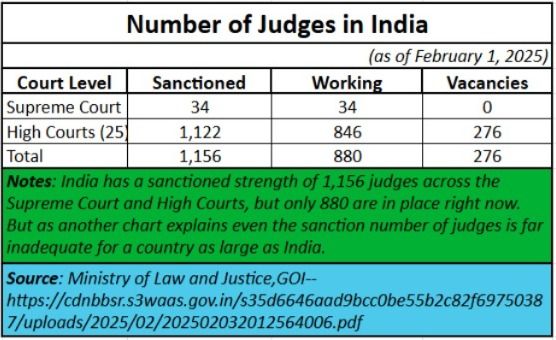
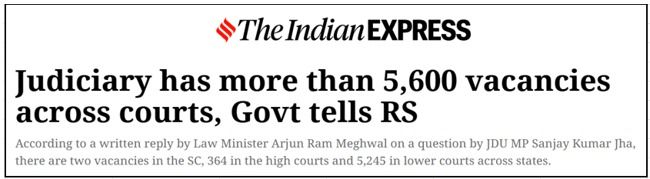
- The executive does not clear the names of judges recommended by SC for filling up existing vacancies. The reduced number of judges, thus dispose of fewer cases than would have otherwise be possible. That makes the backlog of cases grow increasingly larger.
- Refusal to create laws that penalise adjournments. Hence, many cases take more time to reach a final verdict. That reduces the number of cases that any judge can clear and close. Result: a bigger backlog.
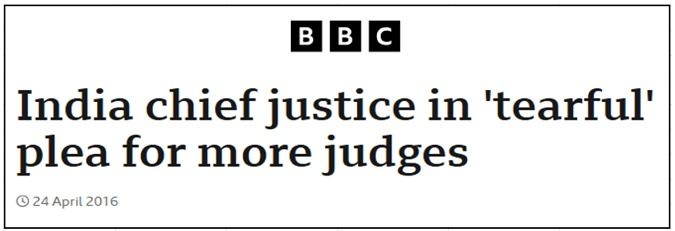
The unfilled vacancies of judicial posts have been so vexatious for the Supreme Court that a former chief justice of India, TS Thakur broke down in tears in public begging the Prime Minister to allow the judiciary to fill up these vacant posts (https://youtu.be/h9asEYHGlHI?si=f6lbQmKEH8fQBXLv).
When India got its independence, it was clear that at least two arms of the government would not have reservations based on gender, caste, or religion. The two arms were the army and the judiciary. The legislative body has repeatedly tried to inject reservation in the armed forces. Fortunately, that hasn’t happened. But saffronisation of the Indian army has already begun. Similarly, there has been talk about reserving seats for special categories in the judicial ranks as well. That would mean politicisation of the judiciary too. This is compounded by the move by some judges to make a public display of their religious beliefs. The job of the judiciary has been further complicated by changing the Indian Penal Code (IPC0 and replacing it by another where even serial numbers of sections in the penal code have been changed. There has been utter disregard for the huge problem this creates for case history.
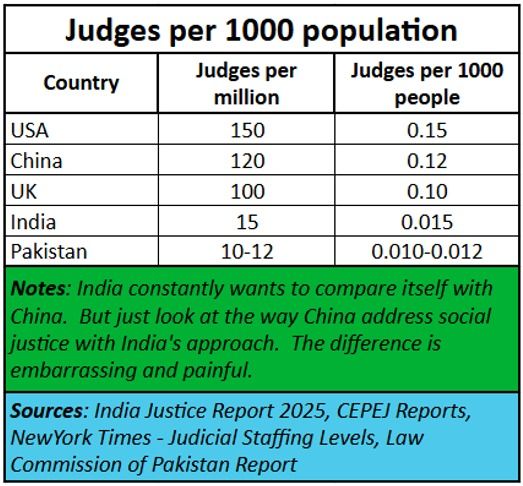
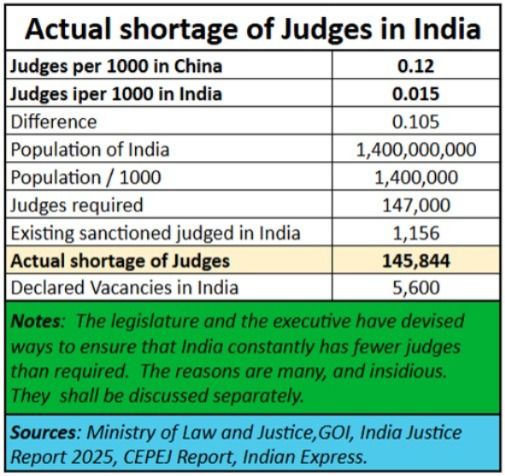 But there is a third, more insidious way to make the judiciary corrupt and ineffective. This is by ensuring that fewer judiciary posts are sanctioned than are required for a country as large as India. Consider for instance, how China, our next-door neighbour has 0.12 judges per 1000 people while India has only 0.015 judges per thousand people. That means the sanctioned number of judges is short by 1,45,844 judicial posts. This creates shortages, which in turn causes the number of pending cases to increase. That, in turn, allows the powerful to delay the hearing of their cases.
The executive also decides on allocation of space for new court buildings, budgets for appointing additional court staff and even higher salaries for judges.
Thus, the legislature and the executive have together connived at engineering a shortage of judicial posts, creating conditions that affects speedy disposal of cases. The government further muddies the waters by encouraging judges to become corrupt. This is done by promising sinecures to the most pliable of judges. Favoured judges are rewarded with government housing, posts of chairpersons of committees, and even prestigious posts of Human Rights Commissions. One was rewarded with a Rajya Sabha seat. In another case, the government has not yet explained how all the investigation reports against a former CJI accused of corruption have not yet led to a conviction. Instead, the accused judge was allowed to become, in 2010, the head of the international Human Rights Commission (IHRC). Such post-retirement sinecures become a bait for judges to pass verdicts that suit the government.
NCERT Bias
It is in the light of what has been explained above that the introduction of a chapter on judicial corruption is both improper and ill-advised. The biggest promoter of corruption has been the government – both the legislature and the executive. Judicial corruption is the inevitable byproduct of the governments’ acts of commission and omission. Clearly, the NCERT has a lot of explaining to do.
Conclusion
But why does the legislature and the executive not want a more efficient judiciary? Surely, they too would be interested in a more vibrant and corruption-free India. That is a very vital issue that needs further elaboration. Watch this column next week.
===========
My latest podcast is on how India has capitulated before the US. You can find it at https://youtu.be/4ff49iMvdlQ
===========
Do view my interview with Republic TV titled “Are Trump’s Actions Against Iran Legal?” RN Bhaskar & Purnima Nath at https://www.youtube.com/watch?v=YpxzXpFm37g
============================
And do watch our weekly “News Behind the News” podcasts, streamed ‘live’ every Saturday morning, at 8:15 am IST. The latest can be found at https://www.youtube.com/live/RVq9dbmvTRI?si=hh7RKIxmcvYrUBFJ
============================









COMMENTS