


























20 July 2026
India has a mixed potential for data centres
By RN Bhaskar and Sakeena Bari Sayyed
Image: Copilot
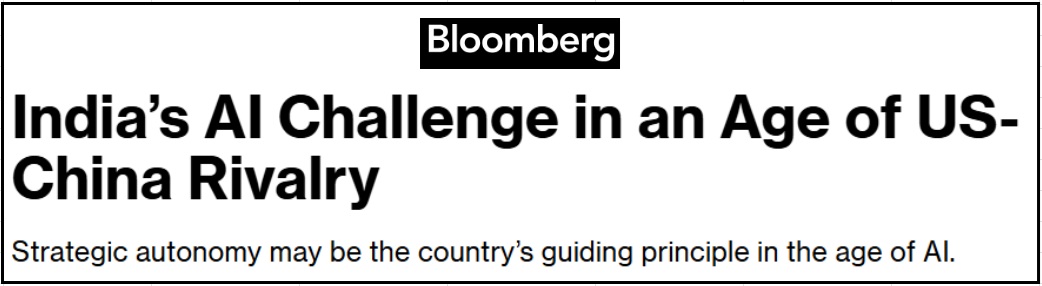
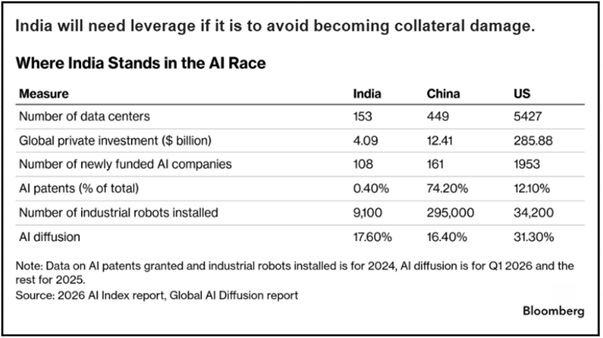 Bloomberg recently had a very interesting newsletter on data centres. It put out a table which shows that India has fewer data centres than either China or the US. India always tries to benchmark itself with these countries, because it fancies itself as a major IT player.
In some ways, that is understandable. India has done amazingly well when it comes to getting outsourced orders. It has done well in terms of call centres. Lately, it has done extremely well in creating GCCs catering to IT services for the entire world. Global Capability Centers (GCCs) help parent companies build specialized capabilities in areas like advanced analytics, AI, R&D, and digital transformation by leveraging skilled talent in cost-effective locations. They centralize operations such as finance, IT, and HR, standardizing processes and driving innovation (https://community.nasscom.in/communities/gcc/understanding-global-capability-center-gcc-service).
 India’s fate
But AI or artificial intelligence threatens to disrupt this model for India. Many of the things Indian IT professionals do could be taken up by AI, reducing the demand of such skills at the GCCs. It is therefore inevitable that India should begin looking to the next big opportunity – namely data centres.
As Bloomberg points out, “The US dominates frontier models, hyperscale cloud infrastructure and compute. China leads the world in AI publications and patent output while investing heavily to reduce dependence on foreign technology. France, Japan, South Korea and Canada have built competitive AI ecosystems. Gulf nations are deploying sovereign wealth to buy compute at scale. Singapore, meanwhile, has emerged as one of the world’s fastest adopters of generative AI.
So where does that leave India? An excellent insight can be got from this Bloomberg discussion (https://www.bloomberg.com/news/videos/2026-07-09/can-india-catch-up-in-the-ai-race-video). It features Menaka Doshi of Bloomberg talking with Srikanth Velamakanni, (co-founder of Fractal Analytics), India’s first publicly listed pure-play AI company, and Ganesh Ramakrishnan, a professor at the Indian Institute of Technology-Bombay, to explore how India hopes to turn its talent, scale and innovation into a competitive edge.
Another bust?
Both the IT experts are brilliant, and right. They point out that despite India’s negligible size in the world of data centres and AI centres, its key strengths are
- low costs compared to the west, and
- its ability to create new applications through its GCCs
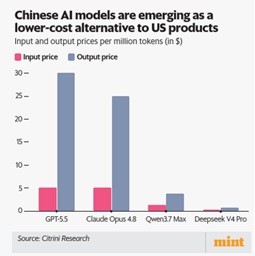 But there are fears that the AI model the world is adopting is reaching extremely risky levels. One reason is that China has lower costs than the West – and even India. As Alastair Crooke, former British Ambassador and a brilliant strategic thinker states- (https://substack.com/@conflictsforum), the entire AI model is making the world jittery. According to a US Treasury report that has not been put out before the public, even bankers are feeling jittery. The report states, according to Crooke, the situation is really bad (timeline 18:18 to 19:12 — https://www.youtube.com/watch?v=GbDdTq4nrrM).
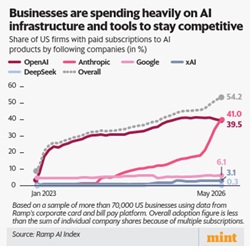 One reason is that too much money has been pushed into the IT sector, making it a bubble that resembles the dot-com bubble. The enticement of the AI boom has been so great, that it has sucked in small investors who are borrowing money from banks to purchase assets that have already been leveraged three times. Unlike the dot-cum bust, this time the AI bubble is embedded far more across the US economy than did the dot-com bubble. The implications for the entire global market will be extremely dangerous.
The education pitfall
The biggest pitfall this industry faces is the poor state of education in this country. Government schools are doing badly (https://youtu.be/WZ4PV_ZXvQE?si=eZ7UiyShxrzHEWZB).
The administration of education related examinations has been disastrous (https://frontline.thehindu.com/the-nation/neet-2026-cancellation-student-crisis/article71001783.ece). And the temptation for fiddling around with educational content – in order to make it politically desirable – is corroding the very vitals of education (https://youtu.be/eL-GAo-abiw?si=mIAXcVnt3hDgF1y3).
Without education, the entire service sector could be at risk. That is where agitations like the one currently being staged by the Cockroach Janata Party have immense relevance for this country (https://www.youtube.com/watch?v=Cud8fP1rJ8k).
India’s policy blind spot
India is correct in looking seriously at the IT sector. One reason is that data from India accounts for 20% of data in the world. But as Bloomberg points out, India does not have its own AI system. Velamakanni and Ramakrishna agree. India needs to get there. But they also point out that India’s strengths in developing applications and its emergence as a key GCC player in the world, make it quite formidable. They believe that India has the potential of making this one of the biggest growth sectors, not only in India, but also the world.
That cannot be disputed. The problem is the government’s ability to drive capital into less productive or promising areas.
Consider, for instance, the government’s penchant for giving subsidies – some projects in Gujarat had a subsidy element equal to 80% of the total project cost. Chip manufacturing is where India will not be able to match players like ASML, TSMC and NVIDIA. India has great strengths in designing chips. Let the manufacturing be done by the giants who have the capital and the global clout. The government channelling funds into sectors which do not have the potential to help India immensely. It has ignored areas where India’s strengths can become a multiplier.
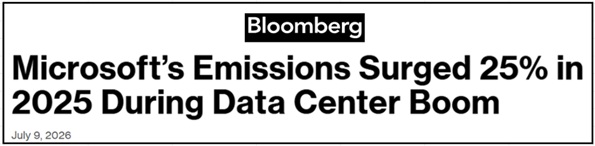 There is also the problem with the environment. India’s lax standards on this front – too many projects get a go-ahead without revival or remedial plans being enforced – means that India will seek to invite investments often for the wrong reasons. The fact is that IT can be a big polluter. Consider how even sober players like Microsoft saw emissions surge by 25%. Expect such emissions to surge even more in countries like India.
Result, companies may be profitable. But the eventually victims will be common residents and even the world. Can India adopt a sensible policy to cope with this?
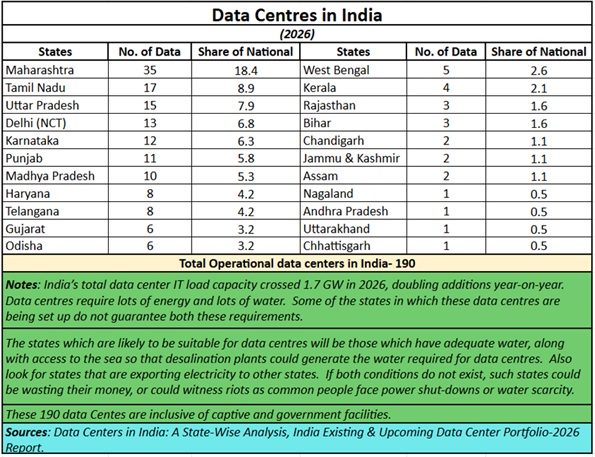 There is another issue. Just take a look at the states in which data centres are being planned. Some of the states either remain electricity generation stressed, or water stressed.
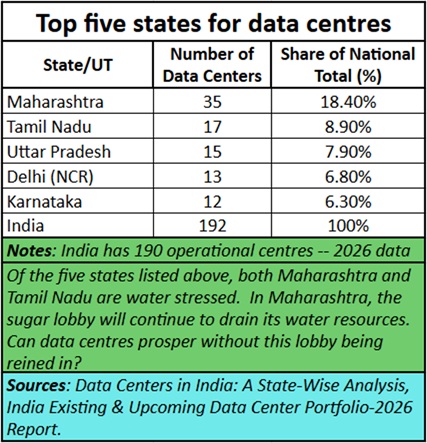 Look at the top five state destinations for data centres. Maharashtra is one state that is surplus in power generation, but is water stressed. Luckily, it has access to the sea and can insist that the data centres should set up desalination plants to meet their water requirements. If the state itself decides to set up desalination plants, it will result in the state’s sugar lobby ‘stealing’ that water to allow its own sugarcane crop to increase production. Controlling that lobby will be difficult.
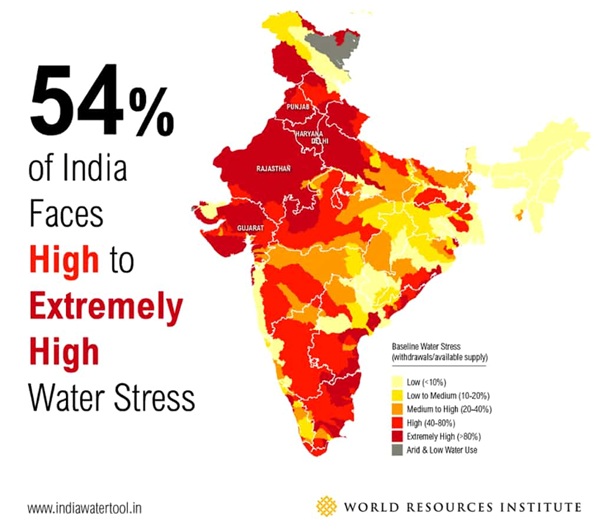 Data centres that are far from the shoreline may actually face immense difficulties.
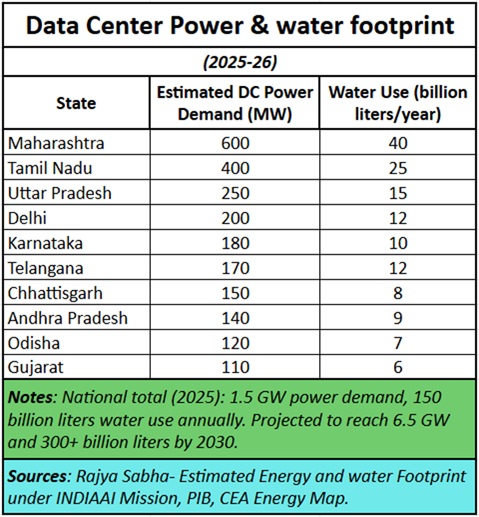 In states like Uttar Pradesh, power generation will always be problematic because of the demand from the agricultural centres. Subsidised power has made the state power generation plants remain stressed for finances.
That is why, data centres will have to be viewed with a great deal of caution.
Conclusion
The IT sector has already become a huge employer and foreign exchange generator. But the government in its enthusiasm has been trying to channel investments into areas where it may distort the industry, and even lose money on its investments. It should instead allow NASSCOM, the industry body, take the decisions about where and how to grow. Letting states decide industrial policy may make political sense. But that could even kill the golden goose.
=============
This week we have a podcast on Tamil Nadu’s petition to the Supreme court seeking a check on the high court trying to expand the scope of the cattle slaughter ban. The SC issued a stay. Tamil Nadu won its plea – albeit temporarily. The ideologues lost. You can find it at https://www.youtube.com/watch?v=YWyIlJmpsj0&t=2s
=============
Also, do watch our podcast on Security options before India by Ltd Col (retd) Sodhi and Parjanya at https://www.youtube.com/watch?v=Ea3DaSjxDuo
=============
View our News Behind the News:
- Thanks to SC, Wangchuk is finally on media frontpages
- India finally realized the benefits of FTA with ASEAN
- China positions itself as global AI leader
- India is still confused about its solar strategy
https://www.youtube.com/watch?v=7ldBNfFOHfo








COMMENTS