
























3 August 2026
CJP spurred by a decade of misgovernance
By RN Bhaskar and Sakeena Bari Sayyed
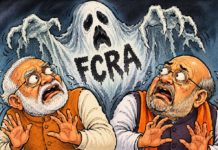
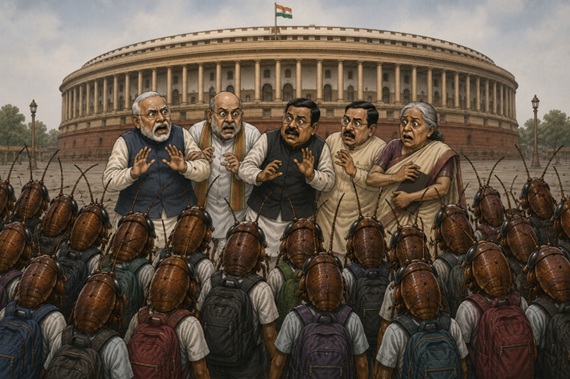
Image: Chatgpt
The CJP (Cockroach Janata Party) upsurge at Jantar Mantar in Delhi is now called off. The fast by Sonam Wangchuk is also over. The outpouring of crowds of youth – often referred to rightly as GenZ) has stopped. The government finally wilted, buckled, and allowed Dhamendra Pradhan (former education minister of India) to submit his resignation. That was a key demand of the protestors.
A new education minister — Prahlad Joshi — has been appointed. Sadly, he appears to have an unsavoury past (https://www.youtube.com/watch?v=OBsLZMsB7sE). Media reports say that he defended the early release of the rapists and murders involved in the Bilkis Bano case. Fortunately, the Supreme called the advice of the Gujarat government illegal. The rapists and murderers went back to jail.
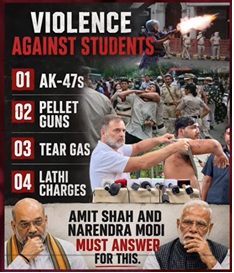
But the CJP movement also raised the issue of unwanted violence against the students — by the government, the police, the paramilitary forces. Teargas was used on non-violent student protestors. So were stun batons and pellet guns. In Bihar, an AK-47 was used. None of this would have happened without the consent or knowledge of the home minister. No culprit was dismissed. The AK-47 culprit was only suspended, not dismissed. Not surprisingly, the call for the resignation of the home minister is now being taken by by the opposition parties – both within Parliament and even on the streets. This call has been gaining momentum.
The storm may appear to be over. But that could be an illusion.
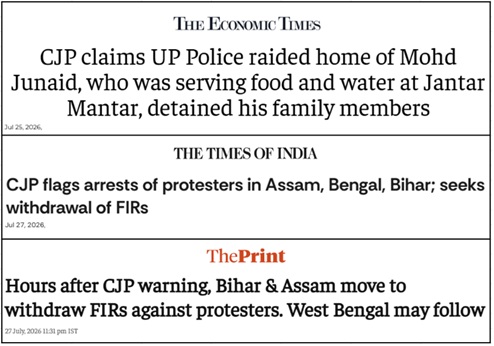 Given the DNA of the government at the centre, a vicious retaliation is now taking place. True, the government agreed that there will be no targeting or victimisation of the protestors. But immediately after an agreement (between Wangchuk and the CJP leaders on the one side and the Indian government) had been concluded, the investigation agencies were out on the streets. Students are being pulled out of their houses and taken away by security personnel without name tags, in vehicles without licence plates! Do view this video — https://www.youtube.com/watch?v=F94fyDHD3RY .
Post-agitation moves
The first targets were the vendors of food and water. The courier boys too were caught to find out who ordered the food and water for the students. Some key vendors of food and water were picked up for questioning. As of now one does not know if they have been chargesheeted. But the focus on the suppliers has put everyone on the edge. This raises a very disturbing question – can those who provide food and water be harassed? Is denial of water and food not a crime against humanity, even a war crime?
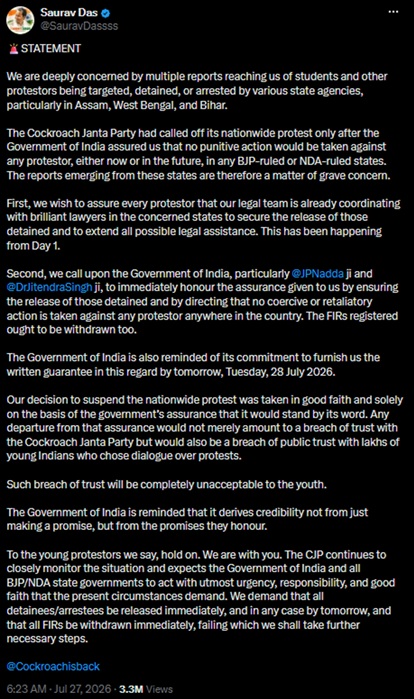
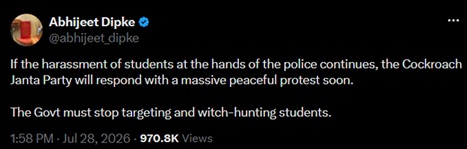 Will the CJP now call another demonstration? Will the legal community come together and launch a legal challenge to the government in the courts (this is already happening)? Will the courts be compelled to genuflect to the ruling party?
Will the CJP now call another demonstration? Will the legal community come together and launch a legal challenge to the government in the courts (this is already happening)? Will the courts be compelled to genuflect to the ruling party?
Will the new education minister, despite his unsavoury past (https://www.pratidintime.com/national/pralhad-joshi-bilkis-bano-education-ministry-12199984), be able to clean the Augean stables of education? Remember how paper leakages have been there in the past as well, with culprits not booked. Remember the Vyapam scam? For more details, please visit https://www.theguardian.com/world/2015/dec/17/the-mystery-of-indias-deadly-exam-scam). But under this government’s tenure there have been over 150 leakage incidents (https://www.telegraphindia.com/india/152-paper-leaks-in-10-years-7-5-crore-students-affected-zero-conviction-says-rahul-gandhi-prnt/cid/2171311) . Joshi is known to be close to the RSS, the prime minister and is one of the longest surviving ministers in his cabinet (https://www.aljazeera.com/news/2026/7/26/who-is-indias-new-education-minister-pralhad-joshi).
The government is now being accured of “bad faith”. That could could lead to a further erosion of the government’s image that it has tried cultivating during the past decade. That could have a devastating effect on the forthcoming elections, first in Uttar Pradesh and then throughout the country. It may make many elected representatives nerous. Many of them switched parties to join the ruling party. They may begin wondering if their decision was right. In politics anything is possible. The CJP agitation could be the trigger.
Choking off funds
Make no mistake. This government is known to plan its moves almost like the military. It appears to have little respect for its own words. Consider how the Prime Minister, the de facto leader of both the party and the state, has repeatedly shifted the timelines for fulfilling his promises (https://www.instagram.com/reels/DUqiD12D_mh/).
The government has a beady focus on which way funds move — like Indira Gandhi the former prime minister of this country. Choking off funds (to the opposition or to industrialists sympathetic to the opposition) is the best way to decapitate an opposition. So, it targets the financiers of people and parties which are close to the opposition. It wants to target the suppliers of food and water too this time. It does not hesitate to use all the powers at its disposal – the police, the paramilitary, the investigation authorities and even the election machinery – to cripple the enemy. The government has also been accused of corrupting the judiciary as well (https://youtu.be/J-6oAVhfYAU?si=3y7X5lbqLEcagla_).
Threats and violence
The other method the government adopts is to frighten people into submission. For the older folk, it uses the enforcement directorate, the income tax and even the police and the paramilitary forces. Threat of investigations and judicial proceedings (that can be a most vexatious quagmire in India) is another way. Then there is the threat of torture and even imprisonment. It has begun using face recognition technology to hone down to people who attend a specific demonstration in violation of privacy laws (https://www.youtube.com/watch?v=F94fyDHD3RY).
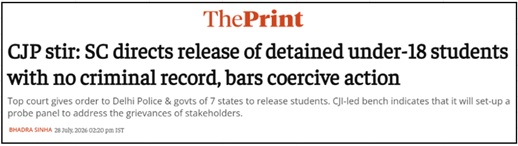 The Supreme Court has called for restraint. One hopes it will halt such intimidation.
Meanwhile, the government is all set to introduce bills for delimitation and Women’s Reservation in a bid to ensure it gets a two-third majority in the Parliament. That would allow it to even tweak the Constitution of India. The CJP protests may have thrown grist into the wheels of government machinery.
That is what many people are agitated about. These arrests and attacks continue even after the government promise (to Wangchuk and the CJP leaders) that all charges against students would be dropped and that they would not be targeted.
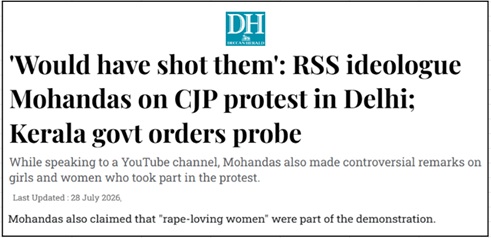 Effectively, the government is rapidly losing its credibility. Ever since Modi came to power in Gujarat in October 2021, he has wooed women and the youth – two key electoral constituencies. Today, these vote-banks are in danger of swinging away. Women are shocked at the seamy part of the government (https://bhaskarr.substack.com/p/india-is-fertile-territory-for-more). Then there is the recent statement from the RSS ideologue T.G. Mohandas who described women protesters as “rape-loving women”. He said he would have preferred all protesters (male and female) to be shot dead(https://www.deccanherald.com/india/kerala/would-have-shot-them-rss-ideologue-mohandas-on-cjp-protest-in-delhi-kerala-govt-orders-probe-4089816). Even during the recent CJP protests, girls complained of molestation and violence at the hands of the police and plain-clothed goons.
On its part, he RSS issued a clarification that T.G. Mohandas remarks were made in his personal capacity. It added that he did not hold any position or power in the organisation. Really? But then, how are his remarks different from those of minister Joshi? Mohandas maligned women; the new education minister reportedly defended the exoneration of rapists and murderers.
Bogus votes
The CJP protest has also raised issues about how the entire voting game is played out. To understand how bogus voters were promoted by this government (not by infiltratorsm as alleged by the government), one needs to look at its strategy. This website has written about each one of these steps in greater details.
- It took the form of issuing Aadhaar cards in such a manner that over nine states had more Aadhaar cards than even the population of these states (https://asiaconverge.com/2020/02/aadhaar-cards-populations-many-ways-rig-numbers-financial-transactions/). This was admitted by the government before the Lok Sabha (https://asiaconverge.com/2023/04/election-peril-aadhaar-and-the-missing-census/). The error wasn’t corrected till 2024 under the pretext that the Aadhaar platform with UIDAI could only add names and numbers, not delete them (https://www.hindustantimes.com/business/aadhaar-deactivation-for-a-deceased-person-soon-report-101679302940813.html). .
- The government then allowed bank accounts to be opened using Aadhaar as the sole Identify proof. No further checks were required (https://asiaconverge.com/2018/02/does-aadhaar-identify-or-merely-authenticate/).
- Mandatory linking of PAN cards to Aadhar and accounts making bogus accounts legal vehicles for cash transfers and small businesses (https://asiaconverge.com/2020/11/aadhaar-pan-combined-through-article-139aa-threaten-banking-financial-integrity/) It then wanted to link Aadhaar cards to the voting card (https://asiaconverge.com/2025/03/linking-aadhaar-and-voter-ids-ushering-in-a-potential-constitutional-crisis/).
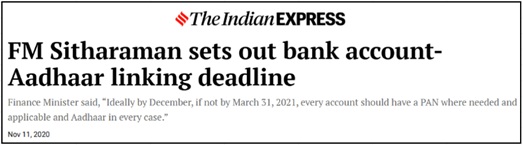 4. Laws were tweaked to allow the production of two or three of the above documents to get election cards. The government itself proposed linking Aadhaar to Voter ID cards to tackle duplication issues (https://newsonair.gov.in/eci-decides-to-link-voter-id-with-aadhaar-to-tackle-duplication-issue/).
5. The Census was delayed. Thus, the weeding out of the “living dead” who had died during Covid or other causes did not take place. Therefore, bogus votes could participate in the crucial 2024 election (https://bhaskarr.substack.com/p/ghosts-at-the-voting-booth). The Election commission failed to call off the elections till the Census had been completed even when activists like EAS Sarma (a former Secretary to the government) wrote to the EC (https://asiaconverge.com/2025/03/eas-sarma-restoring-the-credibility-of-the-election-commission/). The EC did not respond to any of his communications.
6. As the vote percentage share of the ruling party had begun slipping, it was important to create another authority for weeding out the unwanted (not duplicate) voters. That could be the rationale for the SIR (Special Intensive Revision) (https://frontline.thehindu.com/the-nation/karnataka-sir-voter-rolls-voter-exclusion/article71252634.ece and https://youtu.be/9quDCnwDIcI?si=Xn7pGcULVG2qPXRa).
7. The unsavoury effects of the above mechanisms began being felt elsewhere. First, almost all cybercrime proceeds were found to land in benami accounts, created by bogus Aadhaar cards. It is not known if powerful politicians were behind these bogus accounts (https://bhaskarr.substack.com/p/the-government-abets-cybercrime).
8. The government’s focus on grabbing votes made it lose focus on two other key areas
(a) Investments, and hence employment, and
(b) Education which in turn led to increasing unemployability.
Investment
The first major impact over misplaced priorities was investment. The desire to block small funds coming into the country to dry out social media content creators on the one hand, and funding of opposition parties on the other, soured the social and political climate. An imperious government, keen to use enforcement and investigation authorities to go after businessmen and financiers scared investors away (https://youtu.be/lsOMvuoH3JU?si=rWzwyrY8X9rR67GM).
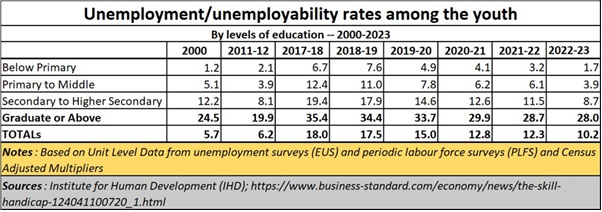
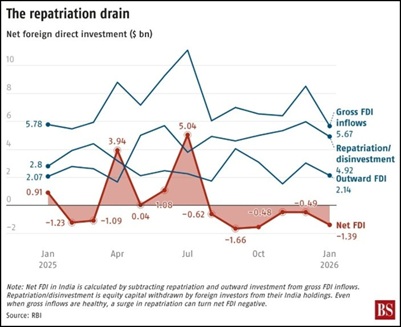 That in turn led to the near absence of new job creation. Result, soaring unemployment numbers, especially among the educated.
Education
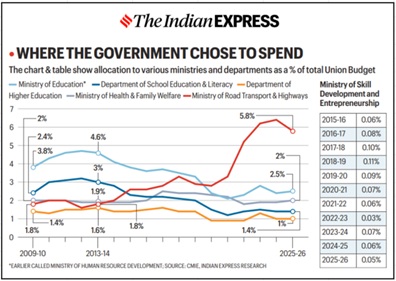
Poor education meant substandard students especially among the lower middle-income classes. The rot in school education became obvious, as admitted by the government in Parliament.
That eventually translated into greater unemployability
On the top of this, was the issue of mismanagement. When examinations cannot be held properly repeatedly, there is an absence of focus. This was possibly because of the focus on votes and on revenues being generated for the party.
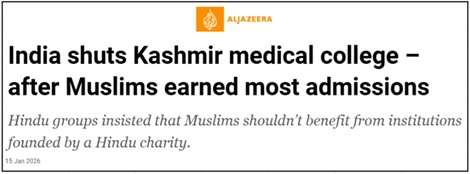
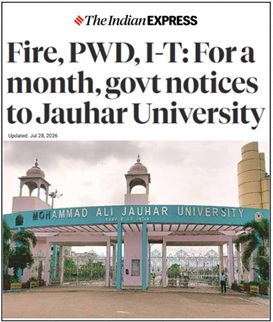 The need to cultivate the Hindu vote bank even made state governments to try close down Muslim schools and universities. Fortunately, the Supreme Court has put a stay on this.
 Inevitable protests
The riots were thus inevitable. Fortunately, it took the form of an extremely peaceful protest – robbing the government of the justification to use force to quell the rioters. In fact, CJP leaders discovered at least one truck with stones for pelting before the riots began. They suspected that they would be misused by elements which wanted to give the CJP a bad name. So, they posted photographs of such incidents even before the riots began.
Obviously, when a government abandons its biggest resource – its youth – without good education or jobs – discontent is inevitable. When a government tries to divide society on religious grounds, it nurtures hatred which find many other ways of expressing itself.
Clearly, the government had not learnt from global examples — that dividing societies on the basis of religion and stoking hatred can be extremely counterproductive. Look at the way Myanmar collapsed. The majority believed that it could marginalise the minorities (mostly Muslims) which accounted for just 10% of the population. The blow back was inevitable. It led to civil war, and the pauperisation of Myanmar.
This is what is happening in Israel as well.
India too could be propelled towards self-destruction.
The country needs to pull back from this suicidal path. More so because India has too many unemployed young people. Poverty is rampant, but disguished on account of freebies – especially food. The whiplash was waiting for a spark. Examination paper leakages proved to be that trigger.
Chori (theft)
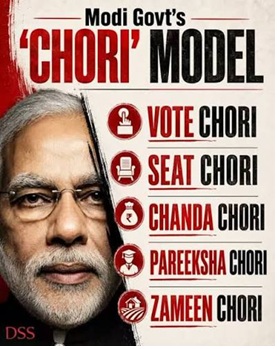
The examination ‘chori’ (Hindi for theft) got merged with other types of chori.
Can the government rise from the ashes? Maybe yes. The BJP has shown an amazing tenacity and ability to overcome odds. But then, can this government, wedded to the RSS ideology, change its stripes? If no, it will marginalise its young voters. Threats, fears, unemployment, and poor education will accelerate the alienation.
The youth have their future staring at them. They don’t want it to be barren. Most of the politicians (who are well beyond their prime) have lived their innings. If they do not pay heed to the call of an aspirational youth, expect these cries to become louder. India could then be on the cusp of violence which could then destroy seven and a half decades of growth.
Give the youth – and the country — a future!
==========
Watch our latest podcast on how India has a flawed po9licy on financial absconders. What the government should be doing is to let them pay back the money owed and allow them to return to India. They will help create new jobs, which has remained on of the biggest failings of this government. You can find it at https://youtu.be/CT-xHrgybL0?si=IbWEdYE7x_x6i61o
=============
Finally, do view our News Behind the News:
- Episode 200
– India uses AI for surveillance and suppression
– Education is a mess in India
– Stock markets yo-yo across the world
– FCI’s procurement and allocation games
You can find it at https://www.youtube.com/live/D5o_QBQH02I?si=pUfl8QUR9a6Zh7Tq
=============








COMMENTS