

























10 August 2026
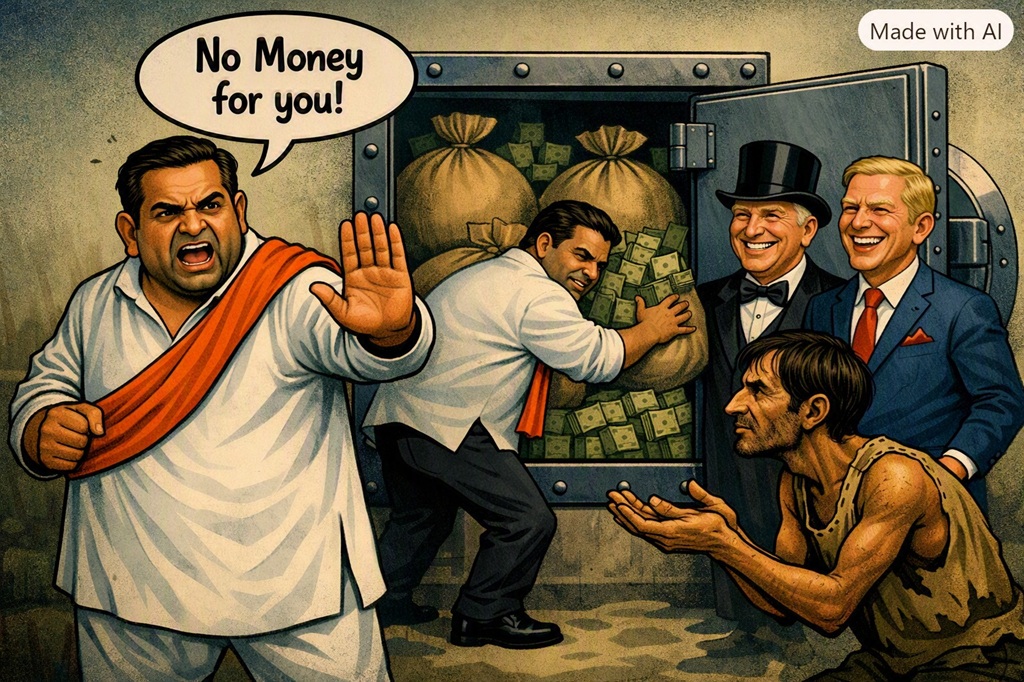
When policy fails, the government allows hawala trading
By RN Bhaskar and Sakeena Bari Sayyed
Image source:
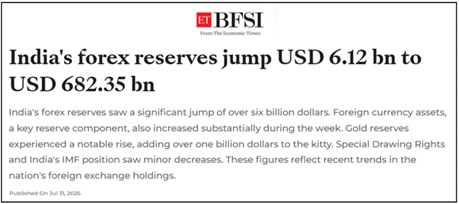 On July 3, 2026, media headlines talked about India’s reserves had jumped by USD 6.12 bn to USD 682.35 bn (https://bfsi.economictimes.indiatimes.com/news/industry/indias-forex-reserves-jump-usd-6-12-bn-to-usd-682-35-bn/132767098. This jump was quite impressive. Much of the reserves were in the form of deposits by NRIs with the government of India. Some called it nothing but a hawala scheme.
‘Hawala’ is normally an informal, trust-based money transfer system operating outside traditional banking channels. Funds move globally through a network of brokers called hawaladars without physical cash or electronic wire transfers crossing borders. This time it was different. It involved banks, but the transactions were not normal. They offered profits of over 20% on investments to selected parties.
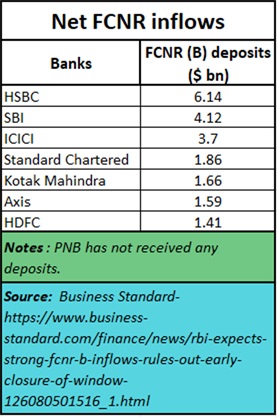 The deposits keep coming in. Banks have mobilised nearly $41 billion under the concessional swap window as of July 31, according to RBI data. Of the total inflows, $36.7 billion came through FCNR (B) deposits, $2.57 billion via overseas foreign currency borrowings (OFCBs) and $1.5 billion in external commercial borrowings (ECBs).
Says RBI governor, Sanjay Malhotra, ““We have got robust flows. We do hope to get healthy flows going forward. But there is no proposal under consideration to close the scheme prematurely,” Malhotra said at the post-monetary policy press conference. He added that the RBI had no mobilisation target under the scheme (https://www.business-standard.com/finance/news/rbi-expects-strong-fcnr-b-inflows-rules-out-early-closure-of-window-126080501516_1.html).
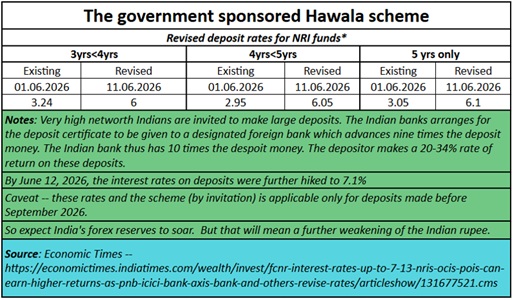
Many of the deposits are believed to be of 3 to 5 years’ tenure. These deposits are believed to have begun swelling since June 2026. It follows the RBI announcement increasing interest rates on deposits from non-resident Indians (NRIs) — including overseas citizenship of India (OCI) certificate holders, and persons of Indian origin (PIOs) (https://economictimes.indiatimes.com/wealth/invest/fcnr-interest-rates-up-to-7-13-nris-ocis-pois-can-earn-higher-returns-as-pnb-icici-bank-axis-bank-and-others-revise-rates/articleshow/131677521.cms). The rates have been increased substantially for deposits of 3-5 years, not for shorter periods. But these enhanced rates are valid only if these deposits are made before September 2026.
 The big Indian hawala scheme
By June 12, these rates were further hiked to 7.13% (https://economictimes.indiatimes.com/wealth/invest/fcnr-interest-rates-up-to-7-13-nris-ocis-pois-can-earn-higher-returns-as-pnb-icici-bank-axis-bank-and-others-revise-rates/articleshow/131677521.cms). That gave many Indians, in collusion with banks, to create a perfect situation for hawala trading.
It was clear that the government was in a state of panic. It wanted to shore up its deposits through the RBI. Hence the change in deposit interest rates. The RBI in turn is believed to have asked some banks – especially ICICI Bank, AXIS Bank and Punjab National Bank to go forth and begin wooing High Net Worth NRIs. Other banks joined in as well. Hawala trading is never too far away when returns are mouth-watering. The reasons?
- Foreign portfolio investors (FPIs) had withdrawn their funds from the Indian markets. Some money has begun trickling in, but the flows are exceedingly small. Investors have become jittery about India.
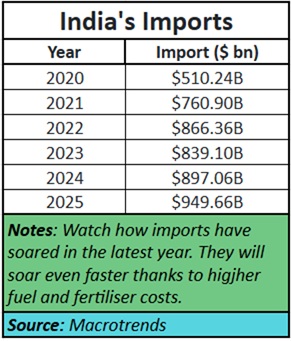
- The inevitability of significantly increased prices for oil, fertiliser and even sulphur (used for making fertiliser and pharma products). That will cause India’s import bill to soar higher than ever before. That will worsen India’s balance of payments., and will create a financial crisis for the country.
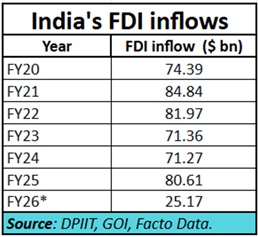
- FDI too had begun dwindling – because India has become extremely investor unfriendly. As a result, India is experiencing for the first time, a negative FDI flow.
 Modus operandi
The desperation is evident even from reports from very high networth individuals. They say that they have been approached by senior bankers, urging them to deposit large sums of money with the Indian government (they say that this offer is exclusively for individuals willing to deposit $10 million or more). The bankers say that they have been identified by the government of India (that may just be a spiel woven by bankers, and may or may not be true). The deposits would fetch the NRI a 7.1 % rate of interest. But for these select individuals, the banks would hugely sweeten the deal.
Once the deposit is made, the banker tells the depositor that he can deposit the deposit receipt with a designated foreign bank (the offer is by invitation, and the bank selected has already been informed about this scheme which appears to have the Indian government’s approval).
The designated foreign bank then advances to the selected depositor nine times the amount deposited. These funds are also deposited with the Indian bank.
The advanced funds attract a rate of around 4%. Thus, the depositor enjoys a 3% spread on this nine-fold advance-turned deposit (4% interest payable for the nine-fold advanced sums, adjusted against 7.1% offered by the Indian bank).
Effectively, the depositor gets a return of well over 20% (7% on the original deposit, and 3% spread x 9 times additional deposits). That gives him a rate of return of 34%. After paying the cost of hedging against the dollar, the depositor gets incredible net returns of 20-25%.
Someone must eventually pay these costs. It is reasonable, therefore, to believe that the cost of funds for incremental deposits would be around 25%. Since the RBI has the power to print notes, it is quite possible that these costs will be disguised and concealed. But the excessive cost of funds is bound to kick in huge inflation and rapid depreciation of the Indian rupee.
This could mean that the government is promoting hawala (https://asiaconverge.com/2020/10/gold-smuggling-i-is-encouraged-by-flawed-government-policies/). Many of the depositors would include relatives and friends of politicians who have access to vast amounts of unaccounted (or black) money. That would be laundered and India would get the funds as NRI deposits.
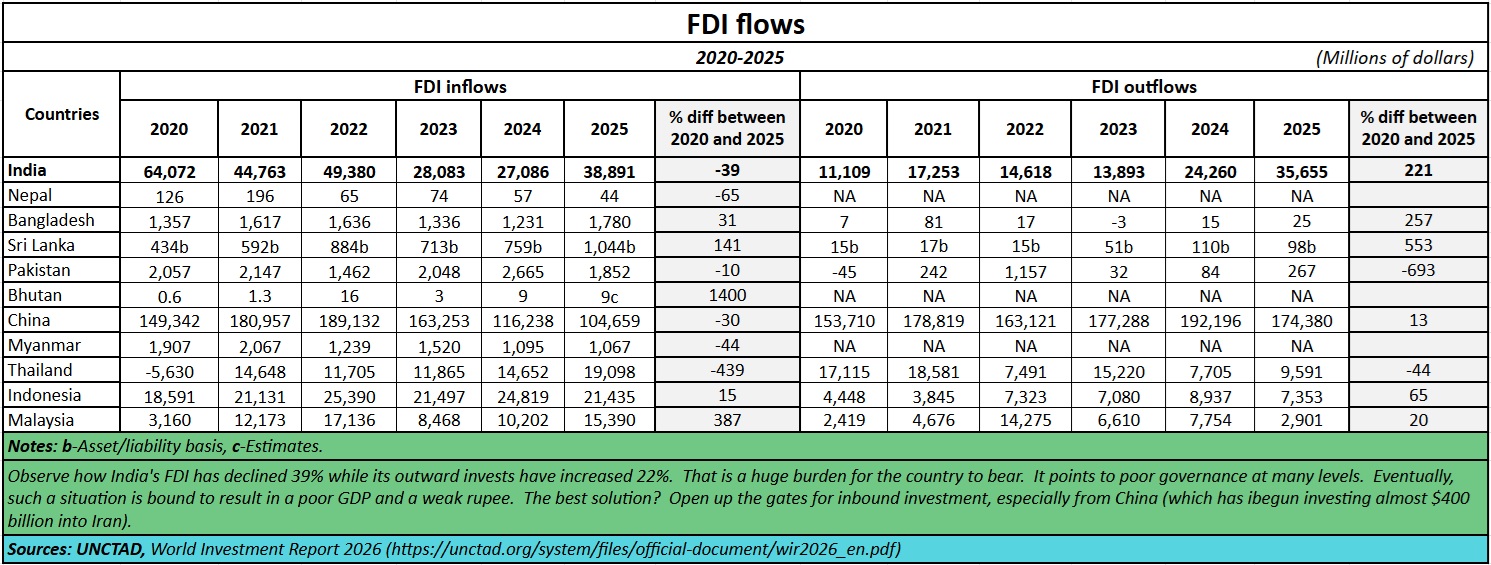 India becomes unattractive
There was a time when India was a go-to destination. Somehow, over the years, the present government has driven investors away. Moreover, unlike China which promotes domestic investors and ensures that they get good returns on their investments, India rewards foreigners. Indians are compelled to pay taxes on investments. Foreigners are exempted very often.
In fact, the more you look at India’s financial policies, it appears that it has invariably promoted hawala. The increase in gold import duty is bound to cause increased smuggling. The government cannot be unaware of this. Yet it suits the policy makers. The FPI and derivatives scheme – through which players like Jane Street made money (legally) also promoted hawala indirectly. Jane Street and similar players got enormous amounts of hot money that they are pushing into Indian derivatives, causing huge losses to small Indian investors.
The government made judicial redressal more difficult for genuine foreign investors by scrapping the Bilateral Investment Treaties or BITs in 1926 (https://asiaconverge.com/2020/01/arbitration-and-investment-protection/). It wanted to discourage investors from going in for arbitration. Even today, the government is thinking of modifying its laws to allow arbitration after a cooling off period of two years. No foreign investor wants to spend two years before crying out for justice. What the government should have done is to appoint more judges and provide more facilities to the judiciary for speedy judicial reform (https://asiaconverge.com/2021/03/the-judiciary-series/).
The heavy hand of the government over businesses, especially over cross border transactions, crippled entrepreneurs. India effectively blunted India’s entrepreneurial skills, which once made it the richest country in the world (https://www.youtube.com/watch?v=ibJJXeGyZxA).
It is possible that the government is spooked by the thought of foreign funds going to India’s political opposition (a thought repugnant to the ruling party, just as it was to Indira Gandhi, former prime minister of India). Today, India does not permit payment to content creators as well through crowd funding. The raids and seizures, bank accounts being frozen, and the terrible climate for investors, has also driven them away.
Even domestic investors began running away.
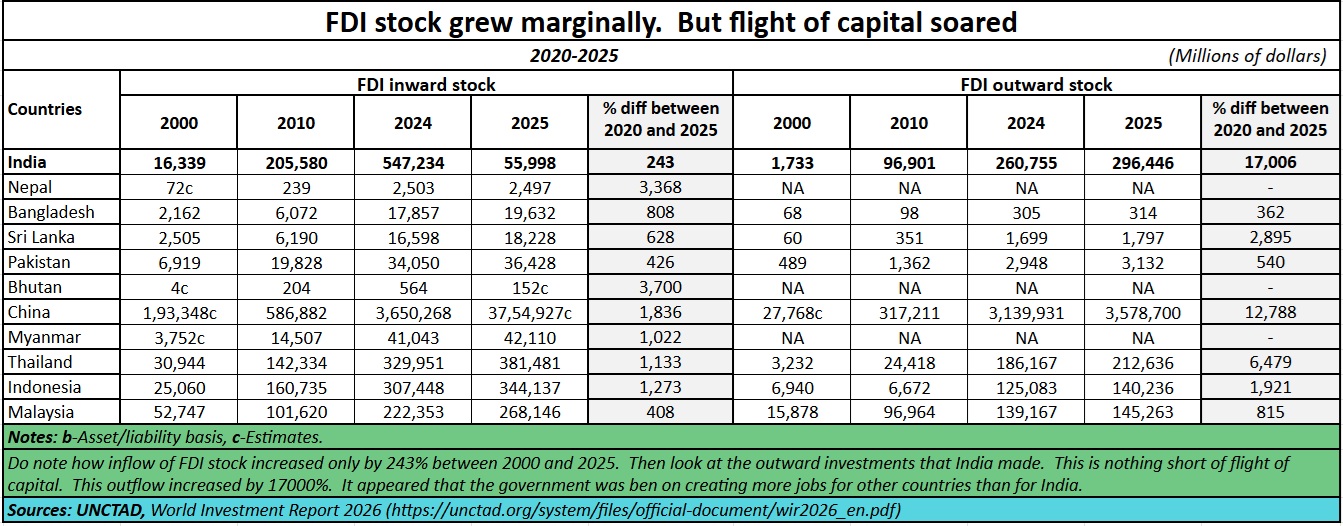 The FDI picture isn’t pretty
Consider how, thanks to the efforts of previous governments, the total stock of FDI in India has kept on growing, but at a modest pace. What is alarming is the way the flight of capital has been encouraged, even at times when FDI inflows were weak. This again points to poor governance. The stock of outward FDI soared by 17,000%. That is truly cause for alarm.
India’s FDI isn’t something great to write home about.
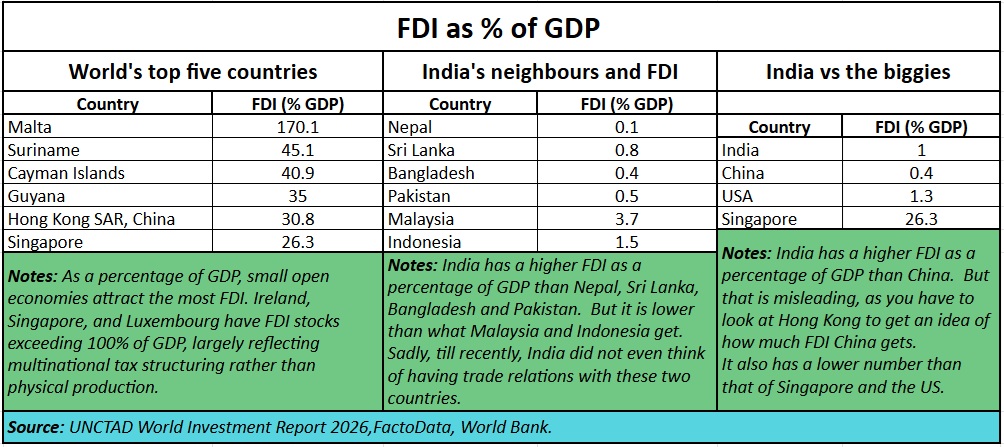 Take a look at FDI as a percentage of GDP. In the three tables given, it is evident that small countries are quite successful in raising money. On the contrary, India’s FDI inflow accounts for just 1% of its GDP. That is definitely poor unless you want to benchmark this country along with Nepal, Sri Lanka, Bangladesh and Pakistan. It should try and benchmark itself with Malaysia and Singapore.
When viewed against the data in the two tables from UNCTAD, India’s pathetic performance stands out in stark contrast.
So why is India desperate?
As mentioned above, one reason clearly is India’s inability to garner foreign direct investments. That is primarily on account of a deteriorating investment climate in the country. Speculators and hawala dealers are given more attitude and manufacturers and producers.
Countries like Malaysia, which the Indian commerce minister Piyush Goyal liked to disdainfully ignore, is a country that ought to have been cultivated. Not only does it have a large booming population, and a large Indian diaspora, it also is an attractive source for seeking out investments.
India definitely needs to become more investment friendly.
Little headway in import substitution
But there is another reason. India has failed to create industries that could reduce its dependence on imports.
Take three examples.
- It could have set up more fertiliser plants. Instead, it preferred to continue importing. Now with the middle east crisis, India is stuck. It has to pay huge prices. India did not even create a decent strategic oil reserve unlike many other countries. It had reserves of just 9.5 days when the Middle East crisis began. Now it wants gas users to pay an additional cess to build the oil and gas reserves (https://www.reuters.com/business/energy/india-may-charge-gas-users-fund-planned-42-billion-fuel-reserves-sources-say-2026-08-05/).
- Take solar power. India has two major problems. First, its solar power capital costs for consumers are double those of what they ought to be. The cause? High imposts and duties. India’s import costs are therefore at least 80% higher than what they ought to be. Given the bribes and other inefficiencies, the costs swell to more than 100% of international costs.
Second, India could have opted for rooftop solar across India (https://www.youtube.com/watch?v=04g7l3RxBVQ). That would have reduced theft, transmission losses and a more productive rural sector. It could also have created around 9 million jobs (https://bhaskarr.substack.com/p/a-new-policy-direction-for-solar and https://asiaconverge.com/2017/12/sabotaging-rooftop-solar-and-employment-generation/).
That would have swelled India’s GDP, provided employment to millions of youths clamouring for jobs, and even reduced its import bills.
It would also have made industry more competitive as its electricity tariffs could then be lowered, as subsidised electricity supplies to the rural sector would not have to be cross-subsidised by industry. Electricity theft and transmission losses could have been reduced. Lower energy costs would have made industry more competitive.
But India chose not to do this, possibly to sate the corruption demands of legislators and power sector employees working in government power stations and distribution companies.
- Take another example. India could have provided incentives to its pharma sector to produce the kind of intermediates that we currently import from China. Such imports remain crucial, because without them, Indian pharma won’t be able to export pharma products. Instead, unwisely, India gave subsidies to the electronics sector, which are both capital intensive and provide very little employment. So, we lose out of foreign exchange. India also reduces its ability to boost its consumption power.
- There are many other examples which show how India has favoured imports rather than letting its own farmers produce more. It wants to import dairy products from New Zealand. It also imports pulses and edible oilseeds forcing farmers to lose and thus produce less. That also pushes up our import bill.
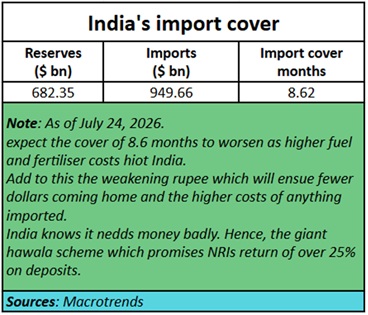
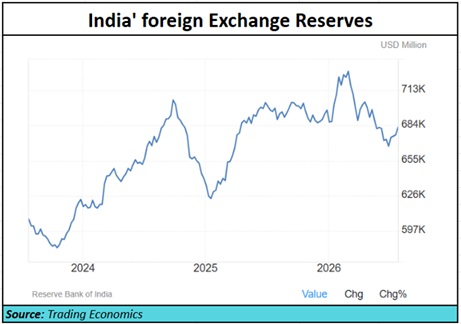
Now combine all these with the way our FDI began declining, and our flagging reserves, and you get a picture that is not at all pretty (data from https://tradingeconomics.com/india/foreign-exchange-reserves and Economic Times).
 Instead of fortifying India with investment policies that could galvanise FDI, or introduce policies that could reduce import dependence, India has opted for the hawala route.
One only hopes that India will not become a highly speculative proposition just as Situational Awareness became (https://www.fastcompany.com/91582560/situational-awareness-leopold-aschenbrenner-hedge-fund-collapse-explained-ai-stock-market-investing-openai ). This was being run by a 24-year-old who overleveraged his investments. When markets tanked, he pulled down others as well. RBI’s leveraged deposits could do the same thing.
What the RBI is doing, is nothing but overleveraging. India deserves a better economic handling of the situation that confronts it. It needs more capable managers than the people at the helm of affairs.
==========
Watch our latest podcast on how the newly formed Cockroach Janata Party shook the very foundations of government in India. It explores how its rise was inevitable, and how India will have to cope with the new situation. Watch the podcast at https://www.youtube.com/watch?v=8EBnOCLjrUU
=============
Finally, do view our News Behind the News:
- Democratic protests; Jharkhand, social media and a missing Home Minister
- Medical education in great danger
- The RBI promotes hawala through deposits leveraging
You can find it at https://www.youtube.com/live/BpP3shFAk34?si=m9efapJ9-_zKrGCR
=============







COMMENTS