


























17 Aug 2026
Cities and the corrosion of democracy
By RN Bhaskar and Sakeena Bari Sayyed
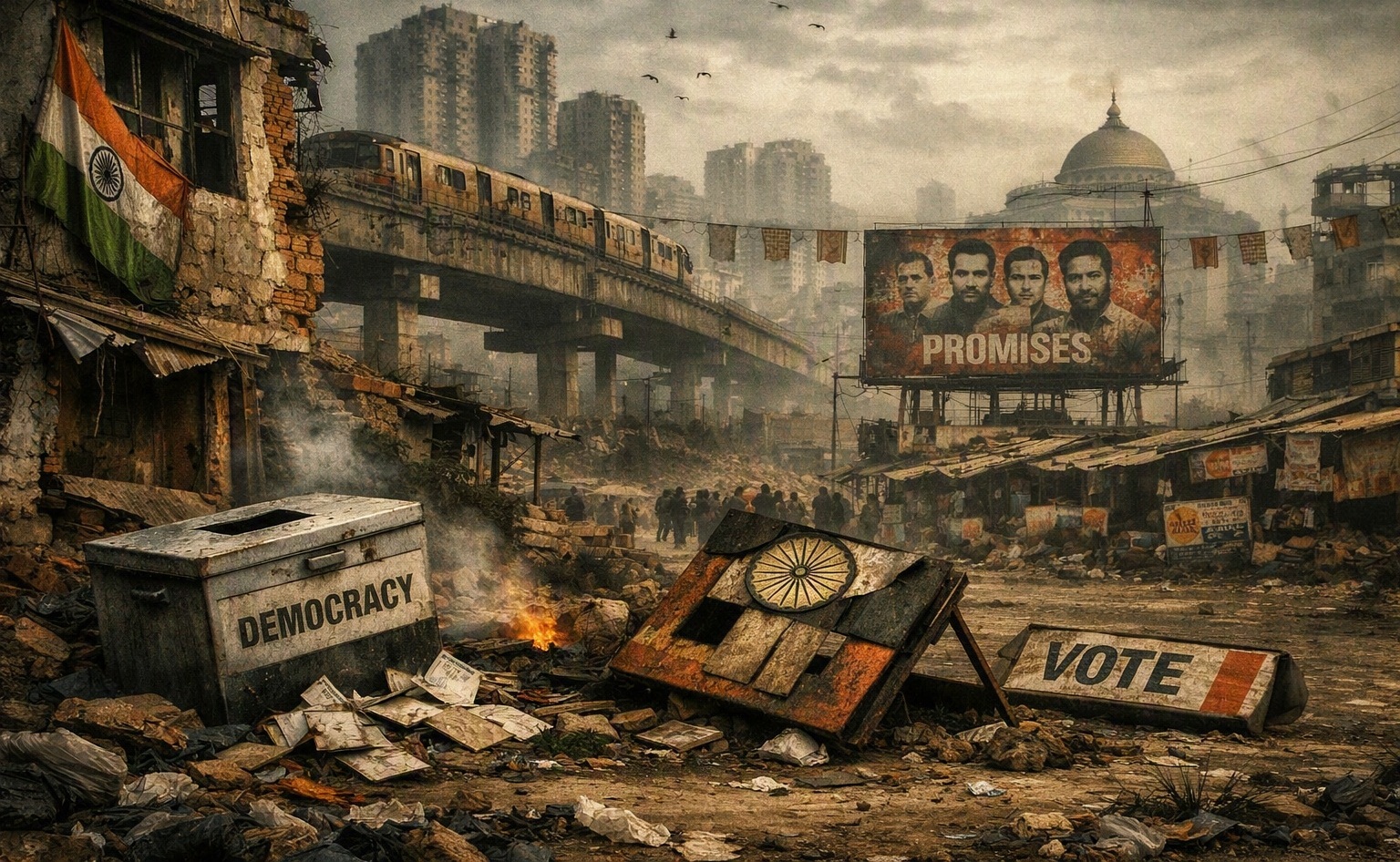
Image: Copilot
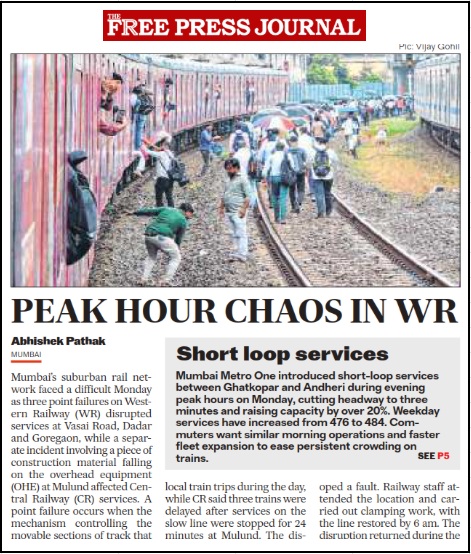 Images like the one above, which appeared on the front pages of Free Press Journal, is likely to become a common sight in all Indian cities. This is because Indian cities are becoming unmanageable.

Three key factors
The reasons why the continued corrosion of cities is likely to gain pace is because of three factors.
First cities are the honey to bees. They generate and use a lot of cash. They offer more opportunities for jobs than smaller towns do across the rest of the country.
Second, real estate provides one of the biggest opportunities for making money. Hence, politicians are bound to create housing cheek-by-jowl so that their respective areas provide more avenues for making money.
Third, and most important, cities allow political parties to grab more money and power through the creation of slums. Mumbai, for instance, has a slum population close to 50% of its population.
It is worth dwelling on each of these factors. But first a perspective.
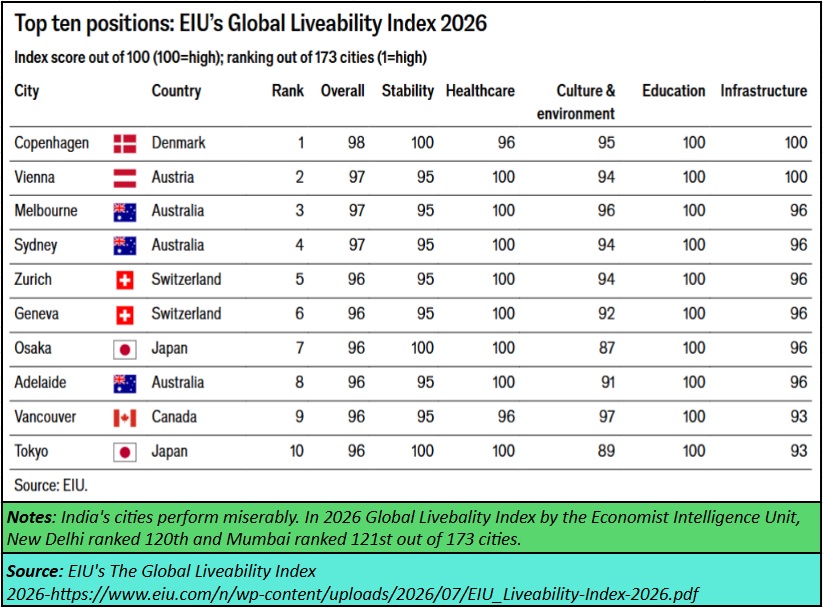 Signs of decay
Consider the “Global Liveability Index” of the EIU (https://www.eiu.com/n/campaigns/global-liveability-index-2025/). A columnist in Indian Express candidly declares that Indian cities evoke disgust. The EIU survey puts “Delhi and Mumbai at 120 and 121, out of 173 cities. We do not need an international index to tell us that our cities are unliveable. All we need to do is walk down a street or go shopping in a bazaar to stumble over rotting garbage, rats and filth. (https://indianexpress.com/article/opinion/columns/tavleen-singh-writes-indian-citis-double-engine-chief-ministers-10782387/).”
The reason for this is simple. Unlike other developed countries, where there is always one key person who is responsible for each city, almost all cities in India have no one person who can say that the buck stops with him/her. The Chief Minister can override the municipal commissioner and the mayor – even the police commissioner.
Eventually, with a weak-spined executive – extremely keen on (a) ensuring that the police and investigative agencies are not set on them by politicians, and (b) a beady eye on post-retirement sinecures, most states and even the centre have politicians calling the shots.
Industrial townships
The framers of the Indian Constitution foresaw this. Hence, they created the provision of Article 243Q of the Constitution of India. That article empowers state governors to exempt heavily industrialised areas from forming standard municipalities. It allowed for the creation of Industrial townships which would have a CEO managing the affairs of that township.
That is how Jamshedpur, one of the first industrial townships to get formed in India, remained a peaceful and well organised city, despite the worst ravages that took place in Bihar. That is why the mayhem in Uttar Pradesh does not affect NOIDA significantly. And that is also the reason why Navi Mumbai is more liveable and slum-free unlike Mumbai ruled by corporators.
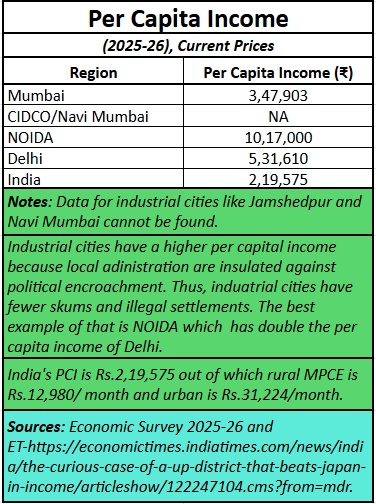 That could also explain why governments – both at the centre and the state levels – remain reluctant to give the per capita incomes of industrial townships. Luckily the data for NOIDA is available. It shows that NOIDA has double the per capita income of Delhi, the seat of power and corruption in India.
Industrial townships do not allow slums to be set up, which keep growing in cities governed by elected representatives and a cowering executive.
That also explains why governments and municipalities do not like industrial townships. They testify to what is possible if raw political power is allowed to have its sway over cities. Such townships almost shame politicians. They have the ability to defy political overlords to stay out of the turf of industrial townships.
That also explains why the government did all it could and successfully managed to erode the independence of SEEPZ in Mumbai, gradually bringing it under the municipal authorities. A similar war is taking place in Mahape and MIDC areas which enjoy some autonomy (though not as industrial townships). So, politicians are now trying to erode the powers of both MIDC (https://asiaconverge.com/2016/07/extortion-land-grab-navi-mumbais-midc-part-i/).
Control over urban areas allows them to tweak land development rules, fiddle with property pricing, and most importantly even change the demography in these areas.
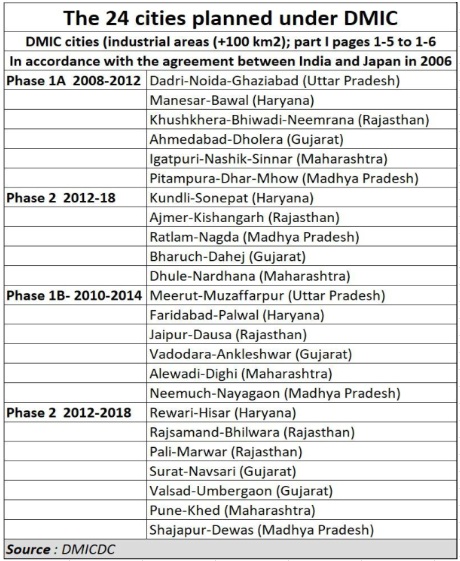 That could be the principal reason why the government does not even want to touch the dedicated freight corridor (DFC) that Japan agreed to finance (https://bhaskarr.substack.com/p/indias-two-dfcs-politics-trounces). This Haryana to JNPT, Mumbai DFC was meant to be inextricably linked to the development of 23 industrial cities. That decision to stop talking about the 24 cities provides ample proof that the country’s policy makers just aren’t interested in making Indian industry competitive, or in creating jobs, or in promoting industrial development.
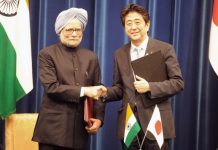
The 24 cities (also known as the DMIC cities) were to be partly funded by Japan’s industries. They wanted organised, liveable cities where Japan’s industries could finance joint ventures, and set up houses, schools and hospitals for the employees and their families who would settle there. Those 24 cities would have transformed India. But the politicians wanted to have cities which would allow them to make money. They were not really keen on the development and growth of the country. The DMIC cities and the Western DFC were conceived of in 2006, and the deal signed by the then prime ministers of both India and Japan (Man Mohan Singh and Shinzo Abe).
The Western DFC and the DMIC cities together do the very things that Ashok Lahiri, vice chairman of Niti Aayog, has recommended (https://www.business-standard.com/industry/news/niti-urges-industrial-clusters-to-build-india-into-a-manufacturing-hub-126081301890_1.html). He recommends that India should strengthen cluster-based manufacturing and develop integrated industrial parks with shared utilities, infrastructure, and efficient approvals to build scale and lower costs. The DFC would have reduced logistics costs, on the one hand, and the 24 cities would become manufacturing hubs. The present government has lost that vision.
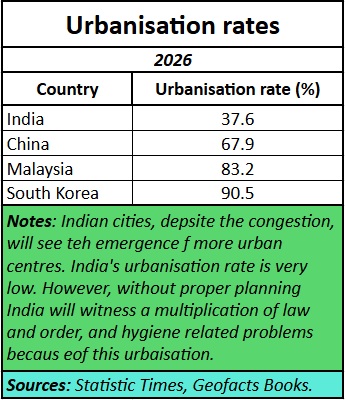 Today, two full decades later, you realise that India is backward (not Viksit Bharat) because of the country’s policymakers. It will continue to slip backward because India is bound to have more unorganised and disorganised cities. India’s rate of urbanisation is lower than that of other developed countries in this region. But, unlike other countries, it will have more slums with few playgrounds, more pockets from where rent-seekers will continue to make money, and more congested roads because dwellings and unlicensed squatters and parking have eaten into the roads.
The first factor
First cities are like honey to political bees. They swarm around them, because cities are the place where enterprise enjoys a multiplier effect.
The density of entrepreneurs allows them to create new businesses, and hence jobs and revenue opportunities.
Where there is money, politicians always find ways to tweak rules to collect graft. Look at a city like Mumbai. Just look around. There is the water tanker mafia (https://asiaconverge.com/2019/06/the-stranglehold-of-the-water-tanker-mafia/). That is why politicians refuse to implement solutions that could eradicate the curse of illegal parking and unlicensed hawkers (https://asiaconverge.com/2017/12/solution-indias-parking-hawker-problem-kills-graft-rewards-investors-unclutters-roads/). Allowing illegal parking allows the authorities to collect a bribe for looking the other way. Ditto with hawkers.
Cities allow for a proliferation of chemists and druggist, which allow for the FDA (Food and Drugs Administration) and the FSSAI to make pots of money by creating and selectively implementing rule (Free subscription — https://open.substack.com/pub/bhaskarr/p/fssai-and-its-new-nutrition-ratings?r=ni0hb&utm_campaign=post&utm_medium=web&showWelcomeOnShare=true).
The second factor
Cities allow the collective force of India’s entrepreneurship to get together and create opportunities for wealth generation and job creation. That in turn brings in real estate developers for creating office and residential spaces. That in turn brings in the municipal officers who create rules and processes that only fatten the employees of the corporation – not the state. That also creates vested interest in not ensuring that municipal incomes come from property taxes – as is the case around the world. There is a vested interest to retain old rateable values, and meagre rents for properties in prime areas primarily because they are occupied by the influential. Many properties in South Mumbai command low taxes and low rental because of archaic laws that should have been abolished decades ago.
But such large numbers of entrepreneurs and employees also result in whetting the greed of government inspectors, who just need an excuse to demand a bribe. Consider the inspectors who represent the Shops & Establishment department. They know that every business establishment needs to register itself under the S&E Act (https://asiaconverge.com/2016/12/want-to-uproot-corruption/).
That makes inspectors point to just a simple failing – why have the offices not been coated with lime, as prescribed? Why was oil paint used instead? Where is the muster (even if attendance is not in electronic records. Pay them a small amount and they will go away, even remain friendly with you. Don’t pay them, and you get a notice from the courts. In many cases the inspectors do not attend the court hearing. So, you have to appear one more time some other day.
Repeated demands for appearance before the courts, make you lose time and money paying for lawyers to represent you. Finally, you realise that even to get the courts to dismiss the case against you is proving to be exorbitantly expensive in time and cash terms. It is better to pay a small bribe and avoid harassment through the courts.
It encourages even renegade policemen to play games (https://asiaconverge.com/2024/08/mumbais-traffic-police-has-huge-gaps-in-its-service-delivery/).
That is where industrial cities allow a single point administrator, who can transfer or even terminate the services of errant staff. Better monitoring and better accountability are possible when industrial cities, which enjoy the protection of Article 243Q of the Constitution of India.
 Factor three
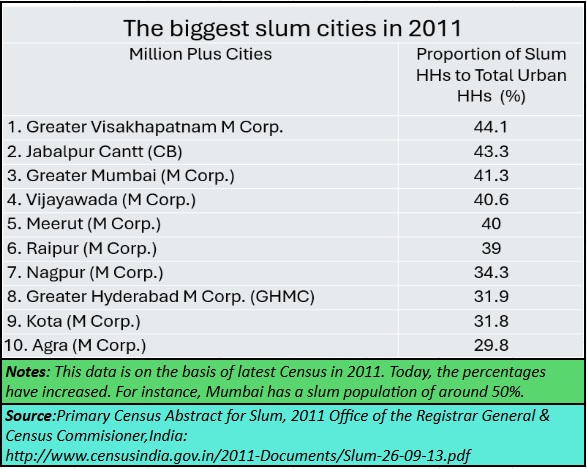
But the most corrosive is the third factor. In India most cities – not governed by a single administrator (union territories and industrial cities) – have corporators and legislators encourage the creation of slums (https://bhaskarr.substack.com/p/property-taxes-land-and-corruption?utm_source=publication-search).
Unfortunately, the data for slums is available only till 2011 – when the last Census was done. Even according to that, the biggest slums are in cities. And the population there has kept on growing because they have been encouraged by our elected representatives. In fact, if the Census were to be held today, Mumbai would have slum dwellers accounting for 50% of its population. Such a surge in numbers would be true of other cities as well.
Why are politicians interested in promoting slums? Three reasons. First, it allows them to change the demographics of specific areas. Assume you live in an area where there are 5,000 residents who like you and vote for you. If a politician wants his candidate to win from your area, all he has to do is to get 10,000 of his people to build slums in this territory. Effectively, your voter base remains at 5,000 while those voting against you swells to 10,000. The politicians win from that constituency without worrying about the ballot box.
Unfortunately, neither the courts, nor the election commission has voted against this practice.
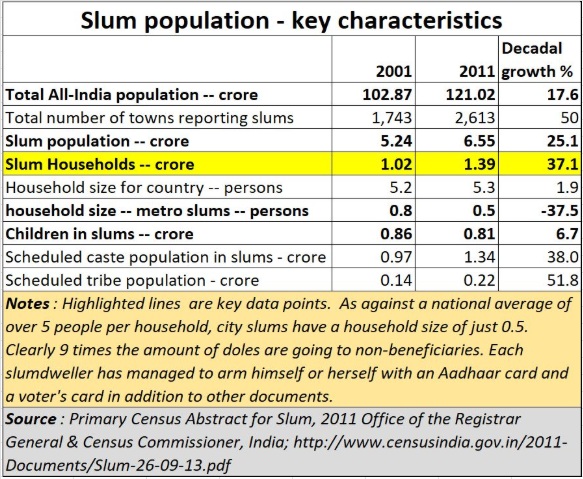 As a result, the population in slums grew faster than in non-slum areas. Moreover, since most benefits that slums get is to households, not individuals, the number of households grew faster in slums than for the country. Finally, while the national family size was 5-6 people per household, slums have a household size of 0.5 persons. That means that each person is shown to belong to two families. Effectively, slums get 10 times more benefits than they ought to get.
So, slums offer an attractive way to generate money. Moreover, redevelopment of slums – in situ, or in the same area – results in the dew demographics remaining intact. Thus, the beneficiaries are slum dwellers who get an attractive piece of real estate at zero cost, the politicians along with other authorities who take the extra money from entitlements that slums get, and the politicians once again who want their own person to win elections from select constituencies.
The losers are the genuine city dwellers who face congestion, overcrowded civic amenities, unlicensed hawkers who crowd pavements and other open spaces, fewer playgrounds (which get filled up with slums quickly), and unliveable cities.
That is why industrial townships don’t have slums, while the other cities do. That is why politicians do not want industrial townships.
Conclusion
If India wants a Viksit Bharat, it must do three things
- Allow for industrial cities to come up. That will reduce the demand and value of real estate in all other cities. It will create more jobs, better schools and hospitals and better governance. You will have liveable cities.
- Remove the protection government officials and politicians get from common citizens prosecuting them.
- Increase the number of courts and facilities an expanded judiciary requires – in keeping with the numbers and averages in developed countries.
- Immediately cancel in situ offers of homes to slum dwellers. Do not give them voting rights until they have legal places of residence. Don’t undermine democracy using slums as a convenient excuse.
- Have a proper property tax system so that cities can finance themselves through property taxes and not additional taxes on common citizens.
Unfortunately, that requires integrity and political will. So, expect India to have unliveable cities for a few decades more.
==========
Watch our latest podcast on How the Cockroach Janata Party (CJP) protests have thrown the spotlight once again on elections. Slogans chanting “exam chori, vote chori and election chori” have gone viral. This is because the government has fiddled with elections more brazenly this time, than ever before in India’s history. You can find it at
Watch the podcast at
=============
Watch our latest podcast on how the election system has been rigged in India – more so during the past decade than ever before. They could end India’s future as a democratic country. Watch the podcast at https://youtu.be/efCF97R3AHU .
=============
Finally, do view our News Behind the News:
– Tata Trust chairman N Chandrasekaran opts to quit
– The darker side of FDA & FSSAI
– Food crisis looms large for the world
You can find it at https://www.youtube.com/live/3ULmWjC-Pqg?si=LXd_efdCqTr3n4bT
================








COMMENTS