

























Sept 7 2026
Policies that have made sugar bitter
By RN Bhaskar and Sakeena Bari Sayyed
Image: Chatgpt
At one level, there is some cause for jubilation. From a higher level, you begin to realise how India’s policy makers are being suicidal. True, there is money to be made. But it is being made recklessly. The sugar industry is exultant. But India should be grieving.
 Cheerful news
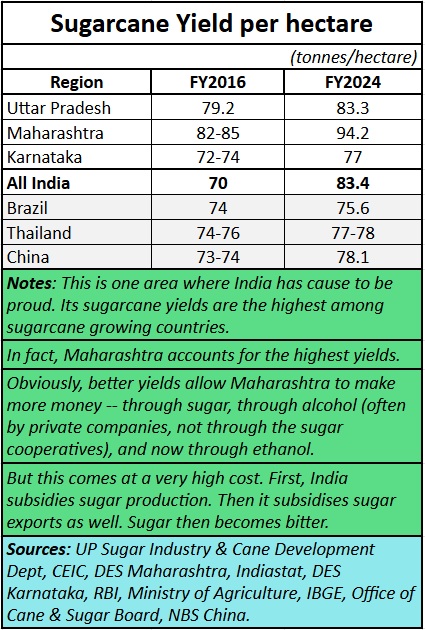
First, the good news. India has among the highest yields in sugarcane production. It beats other countries. And the leader in yields within India is Maharashtra.
Obviously, better yields allow Maharashtra to make more money. First through the production of sugar. Then through the production of alcohol. This activity, interestingly, is not through the sugar cooperatives that produce sugar, but through private companies owned or promoted by the owners of the sugar cooperatives.
The same is the case with production of ethanol, which is then sold for blending with petrol. This too is produced by private companies.
Effectively, it is a very convenient way of privatisation of profits, and socialisation of losses. Do remember that losses claimed by sugar mills in Maharashtra and Karnataka are subsidised by the respective state governments through grants to sugar cooperatives. These sugar cooperatives have also floated cooperative banks, which often register losses and are bailed out by the state. The money which states provide is obviously collected from common citizens by tax imposts.
Uttar Pradesh’s problems
In Uttar Pradesh, which does not have sugar cooperatives, the situation is different. Sugar mills are privately held, though they benefit from the concept of command areas from which they can pick up the cane that is grown. Sugarcane growers cannot sell to anyone outside the command areas to which the farms belong. Sugar mill owners therefore try to squeeze production costs by not paying the farmers as lavishly as is being done in states like Maharashtra and Karnataka.
What is worse is that the state government in Uttar Pradesh, as in other states as well, tries to woo the farm votes by promising them higher wages and higher prices for the sugarcane they produce. Since there is no bailout of subsidies as is given out in Maharashtra and Karnataka, there is always a tug of war between the mill owners and the state machinery, often ending up in acrimony.
That is one reason why sugar mills are reluctant to expand cane production in Uttar Pradesh. They know that the state government’s ability to blackmail them by making lavish promises to farmers is huge. Hence mill owners in that state are likely to drag their feet till the government can work out suitable guarantees. As a result of government caprice, the state remains poor, its potential remains under-exploited, and the farm sector also loses out. A good way would be to work out a wage, and price procurement formula that is acceptable to all. But the politician wants to have the last word. That enhances his ability to make greater demands of mill owners.
The mess in this state is the government’s doing. It is sad that despite being a state run by the ruling party at the centre, there has been no resolution to this problem.
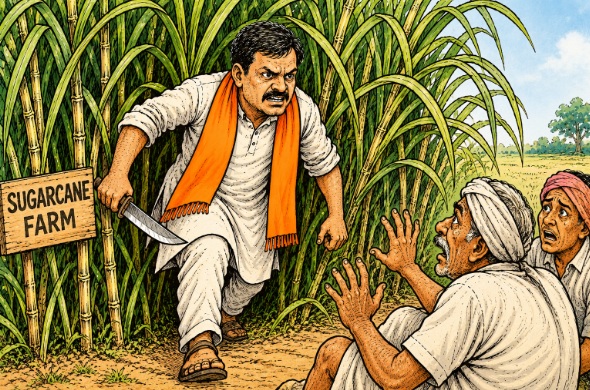
In fact, the areas that grow sugarcane have witnessed the largest number of incidents dealing with brutality rapes and murder. Remember the Lakhimpur incident where the son of the home ministry official run over farmers with deathly intent (https://hrdaindia.org/eight-farmer-protestors-killed-by-union-ministers-sons-vehicle-during-a-peaceful-protest)?
 Why expensive?
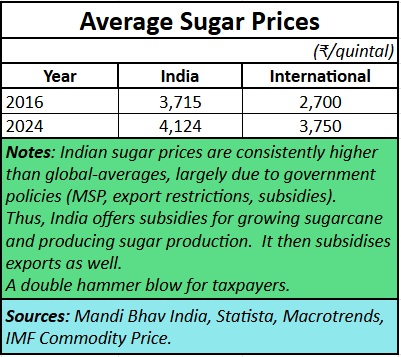
What is worse is that in spite of higher yields than other countries, subsidised electricity and free water, sugar production in India continues to be more expensive than elsewhere.
Clearly, something is wrong with this sector in India.
Sugar prices in India have consistently remained higher than international prices. On the contrary, like milk, India could have been the cheapest producer of sugarcane and sugar as well. But milk had the fortune to have a visionary leader – Verghese Kurien (https://youtu.be/AutA01BBwd8?si=22z1qMI1j0AuAzdy). Sugar did not have this advantage. Hence India remains the cheapest producer of milk in the world. But it remains an expensive producer of sugar.
On the contrary, unlike milk, sugarcane has huge opportunities for generating more profit. Molasses from the sugarcane can be used for producing alcohol (https://youtu.be/XdtKi9srvVE?si=dFQIB6Cc0clWUNjF). Spentwash (or bedmass in the local language – a thick noxious sticky residue which can contaminate the soil, and was therefore Incinerated) can be used for producing CNG or methane. And the alcohol can be used for producing not just potable alcohol (with all the benefits of under-the-table deals), but it also produces ethanol which can be used for blending with petrol for vehicles.
Ethanol twists
Of course, ethanol has been given another twist by the government. It first advocated the sugarcane/molasses route for producing ethanol which a Niti Aayog repot itself confirms (https://bhaskarr.substack.com/p/myopic-sugar-and-ethanol-policies). Then when Bihar elections were approaching, the government advocated using the corn route. It claimed that this route was better. Bihar remains a big grower of corn.
All of a sudden came the news that the Food Corporation of India had sold its rice for making ethanol (https://www.moneycontrol.com/news/business/economy/fci-sells-23-lakh-tonnes-of-rice-for-ethanol-in-2026-27-two-rice-diversion-cases-detected-centre-tells-parliament-14002163.html). Many people believe that this was just a ruse to end the audit trail which would show that FCI had purchased second grade rice and paid out first rate prices to powerful politically connected farmers. This would be the same method through which the FCI had earlier claimed that huge quantitites of rice and wheat had got destroyed because it had been stored in poorly constructed storage facilities. Thus, it was damaged by pests in addition becoming rain soaked and rotting.
This was further compounded by changing government policies. The government first touted the merits of using CNG as fuel for vehicles. Then it recommended EVs using batteries. Now it has been promoting ethanol blended fuel.
Diversion of profits
Sadly, however, the most profitable activities arising from sugarcane are invariably promoted through private companies linked to the promoter families. This is nothing short of privatising profits and socialising losses. The subsidies given by the government to the cooperative sector for losses ‘incurred’ in the production of sugar are given to cooperatives. They are from taxpayers’ contributions. The profits from the most lucrative businesses (liquor, alcohol, ethanol) are enjoyed by the promoters.
That is what keeps farmers poor.
 Killing farmers
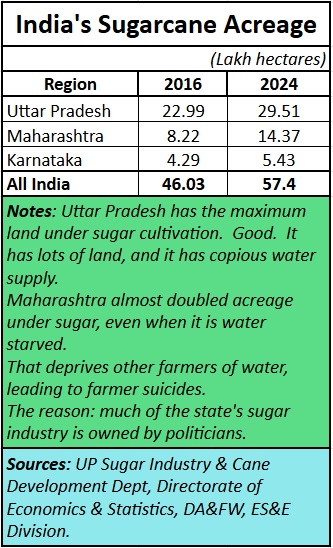
There is another problem. Sugarcane is a water guzzling crop.
Maharashtra “is one of the five states in the country most vulnerable to the impacts of climate change,” says a United Nations note. (https://www.un.org/en/climatechange/maharashtra-power-grassroot-mobilisation). Yet watch how the country’s policymakers (at the persuasion of the state government, has allowed the acreage under sugarcane to grow exponentially (https://asiaconverge.com/2023/03/maharashtra-has-a-fatal-obsession-for-sugarcane/).
It is this crassness of the policymakers that has been directly responsible for the state having the largest number of farmer suicides (https://asiaconverge.com/2023/03/poor-land-management-has-caused-many-farmers-to-commit-suicide/).
 Collusion promotes death
But farmers are not the only people on the casualty list. The entire population of India is headed towards the sick bay.
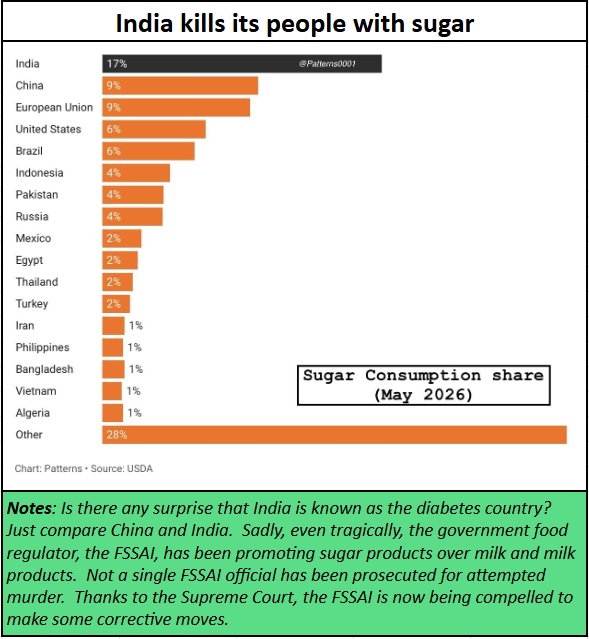
Watch how India has become the largest comer of sugar. One pious explanation could be that India has a large population. But then look at China. It consumes only 9% of global sugar production. India consumes a whopping 17%.
Part of it could be blamed on cultural practices. Indians love sweets. But a large part of the blame goes to the government. It has failed to educate people on the dangers of excessive sugar conditions.
The biggest ‘criminal’ is the government’s own FSSAI which is supposed to be in charge of ensuring people that healthy food reaches them. Just look at the sheer crassness of this department (https://bhaskarr.substack.com/p/fssai-and-its-new-nutrition-ratings). It devised a ratings system which displayed a “star ranking” which made people believe that sugar products like aerated drinks were healthier than even milk or other dairy products. The rating system promoted deep-fried products over products like cheese.
Its specious defence was that the stars were given for the best product in the product segment. Thus, aerated drinks which did better than other aerated products were given a great star ranking. How imbecilic! Customers just look at stars and don’t read the fine print. The rating system was designed to mislead consumers into believing that sugar products were good for health.
It finally took the Supreme Court rap on the knuckles (https://indianexpress.com/article/legal-news/supreme-court-fssai-front-of-pack-warning-labels-packaged-foods-10831674/). It ordered FSSAI to immediately display warning signs on sugar and other unhealthy products.
This should have been done by the legislators. But as the apex court observed, the pressure of the corporate lobby which wanted to make profits persuaded the FSSAI and other arms of the government to look the other way. FSSAI actually began to promote ‘sin’ products.
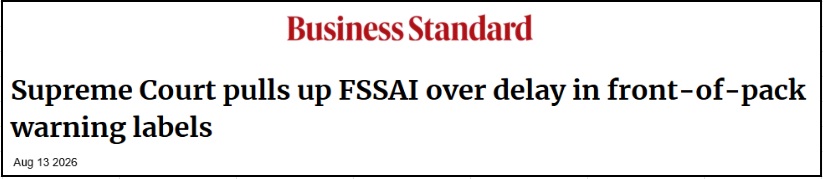 It is sad that the apex court just ordered the FSSAI to immediately display warning signs and desist from promoting sugar products. FSSAI’s officers should have been charged with promoting genocide. It is mindless actions like these that have contributed to India becoming the diabetes capital of the world.
That in turn pushes up medicare costs in a country where there is no effective safety net for health-related care or expenses. Most people still pay for treatment out of their pockets.
 Mixed bag
That is why sugar has turned bitter.
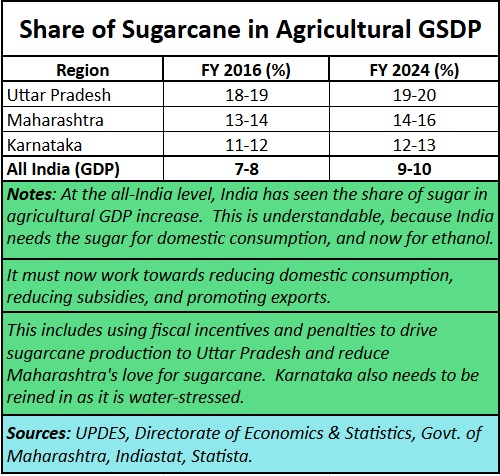
It is good that sugar has begun to account for a higher share of agricultural GSDP over the past decade. But it is sad to see states like Maharashtra which is water stressed to become a bigger player than it was earlier.
It is good to see sugarcane yields going up. But it is sad to see that subsidies still continue to fatten sugar mill owners. What is shocking is that the government has not clubbed the profits from sugar, alcohol, liquor and ethanol before working out subsidies. What is sad is that the government first subsidises sugarcane production, then the sugar production, and then even exports. This triple subsidy is paid for by taxpayers. That is patently wrong.
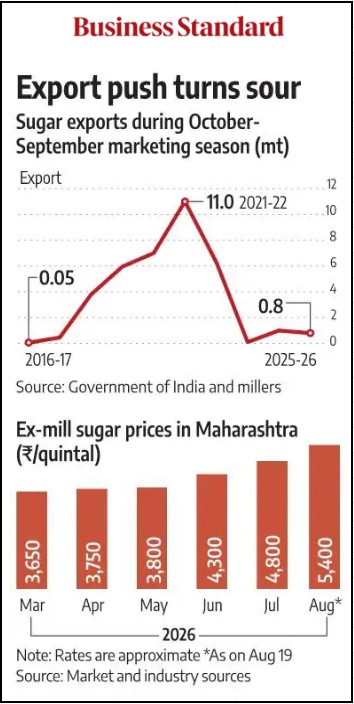 Now, however, bad government policies for sugarcane and ethanol, have caused sugar prices to spike. The contain domestic prices during the festive season, the government has banned exports. In turn sugar exports too are falling.
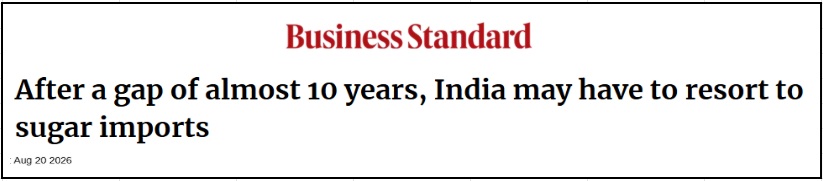 Effectively, India has promoted a sugarcane policy that hurts the common man. It has refused to create sensible policies that ensure that Uttar Pradesh produces more sugarcane, and not states like Maharashtra and Karnataka. That will require changing the exploitative policies of Uttar Pradesh (https://asiaconverge.com/2021/08/poverty-in-uttar-pradesh-and-bihar-is-not-accidental/). It is a state that should terrify anyone (https://asiaconverge.com/2025/04/uttar-pradesh-terrifies/), notwithstanding the high ratings given to this state (often just before elections) by organisations like the Niti Aayog (https://www.drishtiias.com/state-pcs-current-affairs/niti-aayog-s-report-up-tops-among-all-states-in-reducing-poverty).
Conclusion
India is being destroyed by people in charge of agricultural policies. Sugar is one example. True yields have gone up. But so has the three-fold subsidy. India’s sugar prices remain higher than other countries. And it has failed to emulate the milk industry by becoming the cheapest producer of sugar in the world.
==========
Watch our latest podcast on FCRA or the Foreign Contributions Regulations Act, and how it is being weaponised by the government. The decision to defer voting on the amendments needs to be understood. You can find it at https://www.youtube.com/watch?v=Otud7Vb7nJQ
=============
Finally, do view our News Behind the News:
- India’s controversial GDP growth
- The police gets a rap from the SC
- The NE, especially Manipur doesn’t trust Citizenship enumeration
- The FSSAI is pulled up by the SC
You can find it at https://www.youtube.com/watch?v=VA2pw9r7n_E&t=2s
================







COMMENTS