






















20 April 2026
The economy the government is blind to
By RN Bhaskar and Sakeena Bari Sayyed
Image: CoPilot
India has been haemorrhaging for the past decade. The Iran war only jolted India by focussing the spotlights on the fissures that government policies have created during these ten years. Many sectors of the economy are haemorrhaging. The list can be extremely long. But given below are some key issues confronting the Indian economy. They need an urgent overhaul.
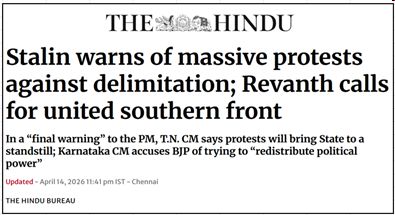 As was pointed out in Part I of this series (https://asiaconverge.com/2026/04/options-before-india-part-i/) the government is under huge financial pressure. Its forex reserves are declining. Its FDI is slipping. Its outward FDI flow is increasing, causing a negative FDI. Moreover, communal issues in border states threaten to tear the nation apart, and the issue of delimitation could hurt the economy grievously. They could also splinter the country.
Worrisome sectors
But the most worrisome sectors are
- India’s oil and gas policy
- Its fertiliser focus and the farm sector
- Defence policies
- Salaries and perquisites of elected representatives.
- India’s desire to splurge
We examine each of them below.
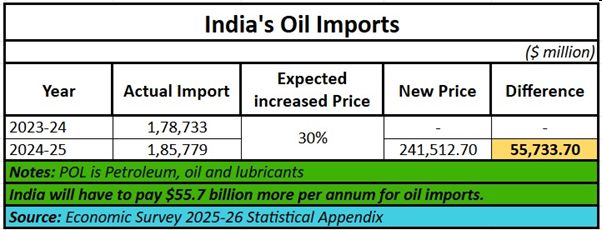 The oil/gas problem
The unjustified and illegal attack on Iran suddenly made people realise how its strategic reserves of oil are horribly inadequate. This was revealed by Navdeep Singh Suri, a retired 1983-batch Indian Foreign Service (IFS) officer. He was also India’s Ambassador to the UAE and Egypt, and High Commissioner to Australia. He mentioned this in a conversation with Jyoti Malhotra, editor in chief with Tribute (timeline (4:24 to 46:45). — https://www.youtube.com/watch?v=e5sUnLKcGpc&t=2781s)
Three of India’s operational Strategic Petroleum Reserves (SPRs) are located at Visakhapatnam, Mangaluru, and Padur. Two more are approved – one at Chandikhol (Odisha) and an expanded facility at Padur. No additional centres beyond these have been officially announced.
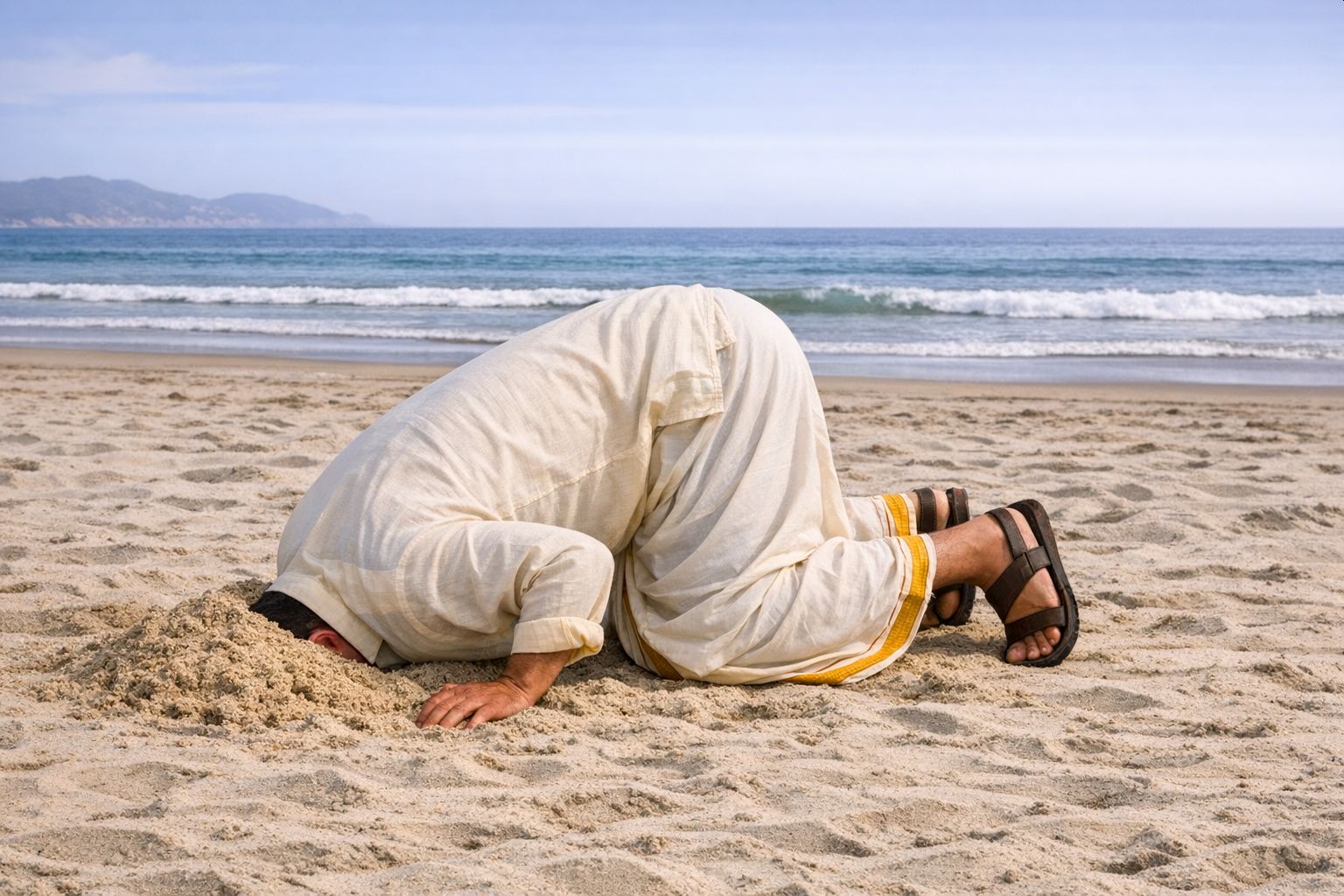
The dedicated SPR covers just 9.5 days of national oil demand (https://thecsrjournal.in/indias-strategic-crude-oil-reserves-sufficient-for-just-9-5-days/). Says Suri, “It is nowhere close to our requirement. I think we should urgently start planning to have at least 90 days’ worth of strategic petroleum reserves.” He believes India has a lot to learn from China. Clearly, India’s policymakers had their heads in the sand.
India needs to have strategic reserves for LNG and LPG as well.
The country’s failure to do this has put India at significant risk. Already, small and medium restaurants in the country are either closed or working with sever limits on output. Many have chosen not to make rotis or dosas as making them requires more LPG. So, you can get rice, or idlis or items that can be cooked in bulk, using up as little gas as possible.
So even while the government tells people that everything is under control, reality presents a different picture. The government’s myopia has endangered the nation.
 Fertilisers
India’s first cross-country gas pipeline was constructed between 1986 and 1989. It was the HBJ (Hazira-Bijaipur -Jagdishpur) pipeline. Spanning over 1,750 km initially, it was built by GAIL to connect Hazira (Gujarat) to Jagdishpur (Uttar Pradesh).
After that, several other pipelines have been built, mostly by GAIL and Indian Oil (please refer to https://iocl.com/gas-pipelines, https://iocl.com/pages/natural-gas-overview, and https://gailonline.com/PressRelease08082024.html). However, in spite of these efforts, the fact remains that India is still not self-sufficient in its production of fertilisers. This is something the country should have planned for at least a decade ago.
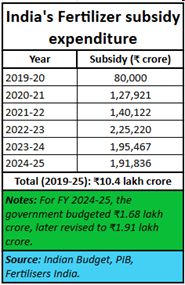
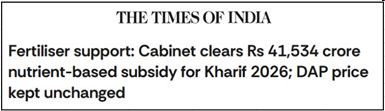
 The government claims that the situation is under control, and that if prices go up, prices for farmers will not be allowed to increase. Obviously, this will widen India’s fiscal deficit. The fertiliser crisis comes at a time when rains this year are not likely to be adequate. That is a double whammy. Add to this terrible agricultural policies highlighted in the first part of this series. India needs to wake up.
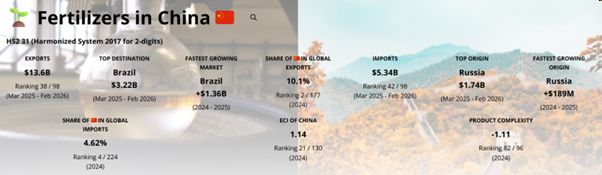
Why couldn’t India augment its fertiliser production capacities? Look at China. It is not an agricultural economy. Yet it produces enough fertiliser and exports much of it (https://oec.world/en/profile/bilateral-product/fertilizers/reporter/chn). It has curtailed exports after the current war being waged against Iran by USA and Israel. Earlier, it exported around $13.68 billion worth of fertilisers annually.
 The reason for this lapse was both oversight on the one hand, and misplaced priorities on the other. India has instead spent more legislative time discussing changing of names – of books, penal codes, temple building, Vande Mataram, and a lot of other ideological stuff — than on policy plans to actually strengthen the country.
Naturally, India panicked when the war against Iran erupted. Suddenly, many people realised that the government was swimming naked.
 The government had been waxing eloquent about self-sufficiency and atma-nirbharta. In reality, it had been utilising the funds for purposes that were clearly not aimed at self-sufficiency or coping with emergencies. Itg encourage imports (especially of agricultural items) which weakened India. Since almost 50% of India’s population is involved in agriculture, fertiliser self-sufficiency should have assumed a very high priority.
Given below are just two instances that show how the government misutilised the funds and misappropriated them as well.
 Defence imports
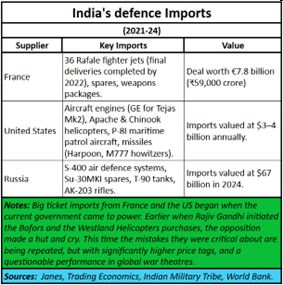
Over the past 70 years, India has ensured that it got the best technology at the most cost-effective prices. This balance was disturbed by Rajiv Gandhi when he entered into deals for acquiring technology and equipment from both Bofors (https://corruption-tracker.org/case/the-bofors-scandal) and Westland helicopters (https://indianexpress.com/article/opinion/40-years-ago/may-3-1985-forty-years-ago-defence-deal-9979543/). Though the first deal did allow for the import of good technology, the second was one where India had been sold a lemon.
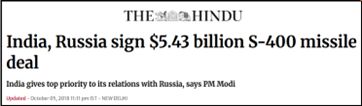 Prime minister Modi began his defence equipment procurement quite well. In October 2018, he concluded the $5.43 billion deal to acquire S-400 Triumf missile systems from Russia (https://www.thehindu.com/news/national/india-russia-sign-543-billion-s-400-missile-deal/article25137177.ece). In retrospect, the deal with Russia made immense sense. Russia has been the only country which has shared technology with India. It did that with pharmaceuticals and even steel when India got its independence. It was doing this with defence as well. Every other country has taught India more about how to use screwdrivers than sharing source codes and technology. Moreover, Russian technology proved to be more cost effective compared to prices that other suppliers of military hardware and technology.
Thereafter, the purchase of Rafale planes and US equipment can (at the most charitable level) be described as unwise. Not only have these technologies proved themselves inadequate or ineffective against the technologies offered by Russia and China, but they have also been extremely expensive as well. Some of the most sophisticated planes were shot down in the Iran war theatre (https://www.theguardian.com/world/2026/apr/05/timeline-us-military-jets-shot-down#:~:text=In%20a%20significant%20escalation%20of,Trump%20administration%20has%20broadly%20claimed). Ironically, as John Mearsheimer, American political scientist and international relations scholar, explains, the US lost more aircraft in Iran on a single day than it has over the past 50 years. The vanquished aircraft included the F-15 and the A-10 Warthog ground attack planes. Even F-35 aircraft were destroyed.
True, India may not have had this knowledge earlier, but the rush to conclude new deals with both USA and France is extremely worrisome. More so, because there has been no technology transfer from these countries.
Similarly, India went ahead and signed a deal with Elon Musk’s Starlink, even though wireless technologies from Russia and China have proved to be both more resilient and capable. Moreover, the government has been silent about Starlink being used to promote subversion against governments in both Venezuela and Iran. There are reports of such training being given to Mizo rebels as well (https://www.orfonline.org/expert-speak/the-emerging-drone-space-panopticon-in-india-s-northeast-frontier). If India wants a technology which is superior to the GPS or Starlink, it must look to Russia or China.
However, it is good that India has now begun to look at Russia once again. It has resumed discussions on arms procurement from Russia – finally (https://www.livemint.com/news/india/russian-first-deputy-pm-manturov-meets-pm-modi-discusses-energy-unveils-5-year-roadmap-for-reaching-100-billion-trade-11775148119428.html.
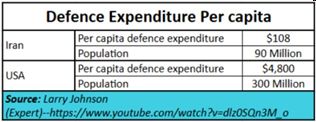 India must learn from Iran ways to reduce defence expenditure. Iran created an arsenal that could support it for over a year in its fight against the US and Israel (both formidable nuclear powers). Yet compare the per capita costs incurred by Iran compared to costs incurred by the US. If India purchases expensive arms from the US, it will have to pay the price for the high-cost structure of the that country.
Finally, compare the speed with which Iran could build its defence capabilities, with the number of years India has taken to create a suitable fighter jet or a battle tank. The inefficiencies built into the Indian system are deplorable (or was it an excuse for justifying more expensive imports from the West?).
 Agriculture
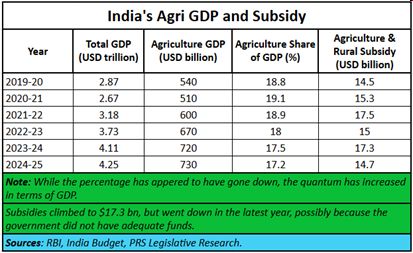
Also consider how it has failed to increase the per capita income of small farmers. Whether it was through edible oil imports (often from the West) or even the recently concluded deal with New Zealand for import of dairy items, India has adopted methods that weaken the farmer and end up benefitting foreigners (often Western nations).
Ideological reasons made the government introduce cattle slaughter laws. The crudeness with which they were promoted in the Hindi belt – giving rise to vigilantism and minority targeting – worsened the plight of farmers (https://youtu.be/4RPgaohYZhQ?si=bdR2lXs78Ut1LCDt). Thus, Southern states where cattle slaughter laws were not introduced had farmers increasing milk production, doubling the growth ratge over the Northern states.
The government has instead tried to mute farmer protests through subsidies. Effectively, the government has crowded out funds for economic development. What it has done is to focus on first impoverishing farmers, then massaging them with subsidies.
The best proof of how warped the subsidy culture has become is the government’s own admission that it offers free food to over 60% of its population (https://youtu.be/pB06HIfAC5Y?si=T8L4obwxmnkWciot). The irony is that India calls itself a great economy, even though it indirectly admits that 60% of its population does not have enough money even to buy food.
 Misappropriation and misuse
Expensive procurement, and financing of subsidies, cost money. To finance them, the government allocates less funds to education and health. It has also begun dipping into funds it should not be touching. More importantly, it began squandering money on its own people – the legislators.
Misappropriations
Two instances come to mind. There could be a lot of other ways in which the government cornered funds.
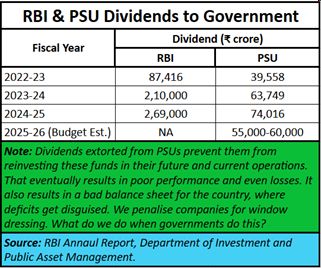
Take the way it pushed the central bank to give to the government higher dividends than had ever been given before.
While the RBI had earlier refused to buckle before the government’s demands, this changed with the appointment of Shaktikanta Das. Just before he assumed office, Urjit Patel, the RBI governor, resigned (https://www.bbc.com/news/world-asia-india-46506275). Shortly thereafter the deputy governor, Viral Acharya, the RBI deputy governor, also resigned (https://www.indiatoday.in/india/story/rbi-governors-who-resigned-viral-acharya-1555308-2019-06-24). But Das allowed the governor to draw out a huge dividend of Rs.2.1 lakh crore. He was probably rewarded with a sinecure by being appointed within the Prime Minister’s office – a new post was created especially for him (https://gfmag.com/economics-policy-regulation/india-narenda-modi-appoints-shaktikanta-das/).
Sanjay Malhotra was appointed governor after Das. He bent even further. He gave away a dividend of Rs.2.69 lakh crore. His tenure has also seen the revaluation of gold so that the reserves appear to have grown, when actually reserves minus gold have fallen. It is under his governorship that the rupee has depreciated steeply (https://informistmedia.com/MoneyWire/45300/Jamal-Mecklai-says-RBI-must-spook-rupee-speculators-with-volatility). Had the money not been given away, the RBI would have been in a better position to defend the Indian rupee today.
 Misallocation
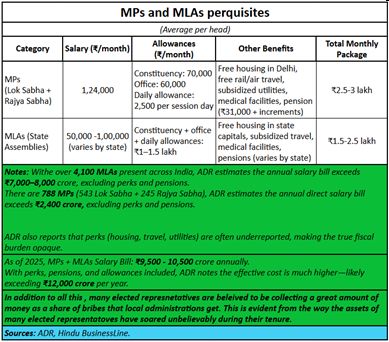
On the other hand, the government has permitted elected representatives to fatten themselves even though the middle class has seen its incomes shrivel (https://youtu.be/g_S6J4tmKek?si=EZr4M1RzoFmorym8). So, the farmers suffer, the middle class shrinks. But the affluent do well, and so do the elected representatives.
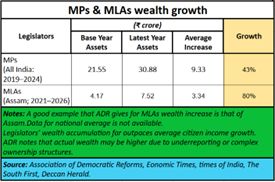 Moreover, many elected representatives learnt to make money through other means. The average elected representative, even though he is enjoined not to hold an office of profit, saw his wealth increase by 43% within a single term.
MLAs also saw their wealth increase. But data on this has not been compiled by ADR (Association of Democratic Reforms https://adrindia.org/) However, if Assam has to be used as an example, MLAs saw their wealth grow by a whopping 80% during their tenure.
The addition of new MPs in the Parliament will mean the bill for elected representatives will increase. That means higher deficit, higher taxes and more pressures splintering India.
The irony couldn’t be starker. You have a country which has to offer free food to 60% of its population yet allows its elected representatives to become fatter.
This must change if India has to grow strong.
Is there a way out for India. Yes, if there is political will. But that is something we shall discuss in the third and final part of this series.
==================
My latest podcast is the first of a three-part series – tunder the umbrella heading “Options before the government”. The first one is on the crisis India will face from returning NRIs working in the Gulf region. There will be a decline in remittances inflows, which will be extremely painful for the country. The second will be the surge in unemployment. You can find it at https://youtu.be/S7_z7YSGAdk
======================
And do view our podcast on why Trump did not actually block a single ship plying through the Hormuz Strait. You can find it at https://www.youtube.com/live/0z8s21o73os
======================
And do watch our weekly “News Behind the News” podcasts, streamed ‘live’ every Saturday morning, at 8:15 am IST. The latest can be found at https://www.youtube.com/live/byKHIdbfxzk?si=RopaU0zfWJCB3kgu . It features
- – India’s recklessly dangerous gambits
- – Noida’s protests: symptom of an all-India crisis
- – India’s penchant for regressive taxes remains undiminished
===================








COMMENTS